
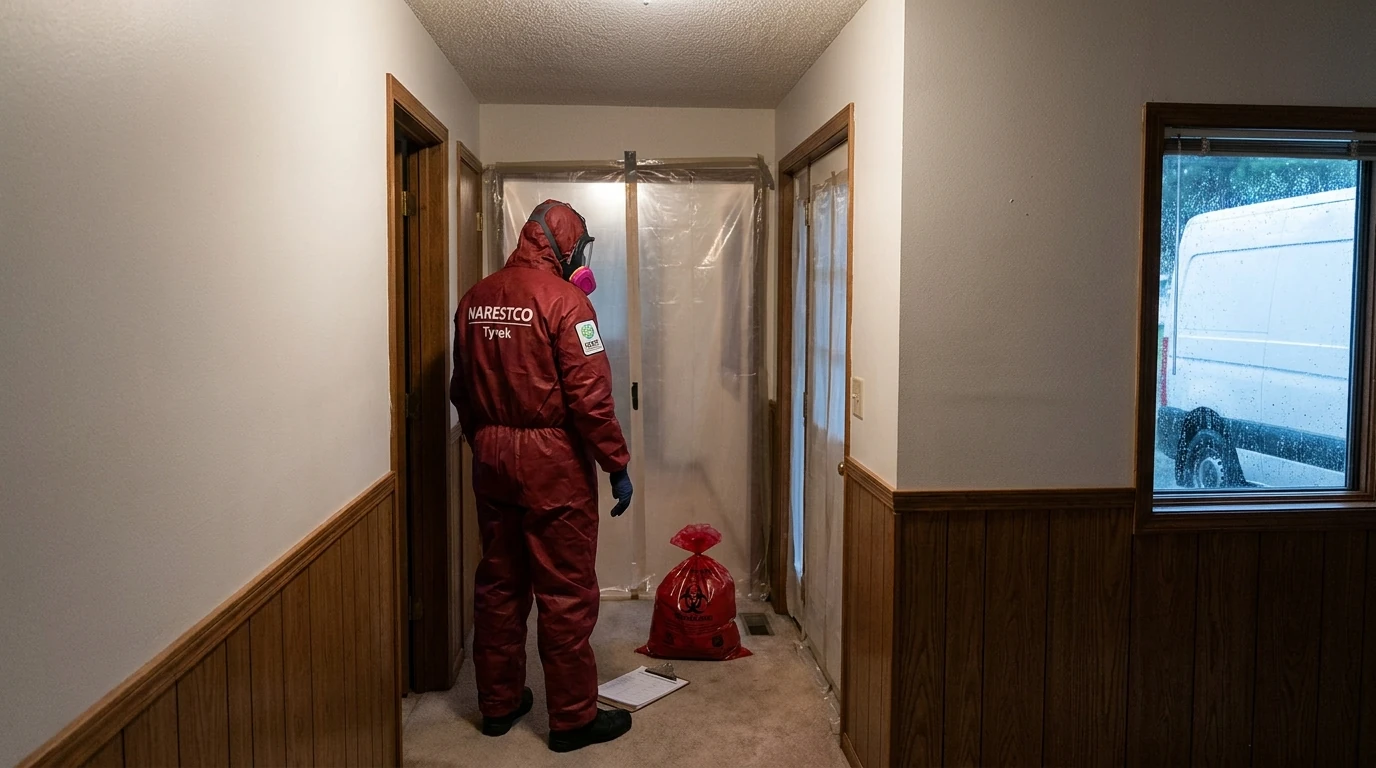
TL;DR: Homeowners insurance may cover biohazard cleanup when the event that caused it, an unattended death, a traumatic accident, or a sewage backup, is a covered peril under your policy. Coverage is not automatic, and many policies exclude it entirely or cap it at a low sublimit. The most important step is calling your insurance carrier before cleanup begins, and hiring a certified biohazard remediation company that can document the scope in writing for your adjuster.
If you’re reading this after losing someone, or after a traumatic event in your home, we’re sorry you’re dealing with this on top of everything else. The insurance question is a practical one that needs an answer, and we’ll give you a straight one.
Does a Standard Homeowners Policy Cover Biohazard Cleanup?
Most standard homeowners policies do not include explicit biohazard cleanup coverage, but some losses are covered indirectly through the policy’s “sudden and accidental” damage provisions. Whether your claim is approved depends on three things: the cause of the loss, how your policy defines covered perils, and whether your insurer treats the cleanup as a restoration expense or a separate excluded category.
Here’s the practical breakdown:
- Unattended death (natural causes): Often excluded or severely sublimited. Some policies treat the resulting contamination as a covered “sudden” loss; others categorize it as a maintenance or sanitation issue and deny it. You will need to read your policy’s exclusions section carefully, look for language around “pollution,” “contamination,” or “biological matter.”
- Traumatic accident or homicide: More likely to be covered, because the damage is sudden, accidental (or at minimum, unexpected by the policyholder), and results in structural contamination requiring professional remediation. Some carriers treat this the same as a water or fire loss.
- Sewage backup containing biohazardous material: Covered only if you have a sewage backup rider or water backup endorsement. Standard HO-3 policies exclude sewage backup by default. See our post on sewage backup health risks for more on why this cleanup requires certified professionals.
- Meth lab contamination: Almost universally excluded. If you purchased a property with prior drug activity, this is typically not a covered loss.
Before you assume you’re not covered, call your carrier. Ask specifically whether your policy includes coverage for “biohazard remediation,” “trauma scene cleanup,” or “contamination resulting from a covered loss.” Get the answer in writing.
What Does Biohazard Cleanup Actually Cost Without Insurance?
Biohazard cleanup costs range from approximately $1,500 to $25,000 or more, depending on the size of the affected area, the type of contamination, and the extent of structural involvement. A single-room trauma scene in a carpeted bedroom may run $3,000 to $7,000. An unattended death that went undiscovered for an extended period, where contamination has penetrated subfloor, drywall, and HVAC, can exceed $15,000 to $20,000.
Cost drivers include:
- Square footage of affected area: Contamination that moves beyond the primary room into adjacent spaces, crawl spaces, or HVAC ductwork multiplies the scope significantly.
- Material removal: Carpet, padding, drywall, subfloor, and insulation that have absorbed biohazardous material must be removed and disposed of as regulated medical waste under OSHA’s bloodborne pathogen standards (29 CFR 1910.1030). This is not a DIY task, improper disposal carries legal liability.
- Odor remediation: Biological decomposition produces compounds that penetrate porous materials. Effective odor removal often requires hydroxyl treatment, ozone application, or encapsulant sealing after physical cleanup. See our post on odor removal techniques for more on how professional deodorization works.
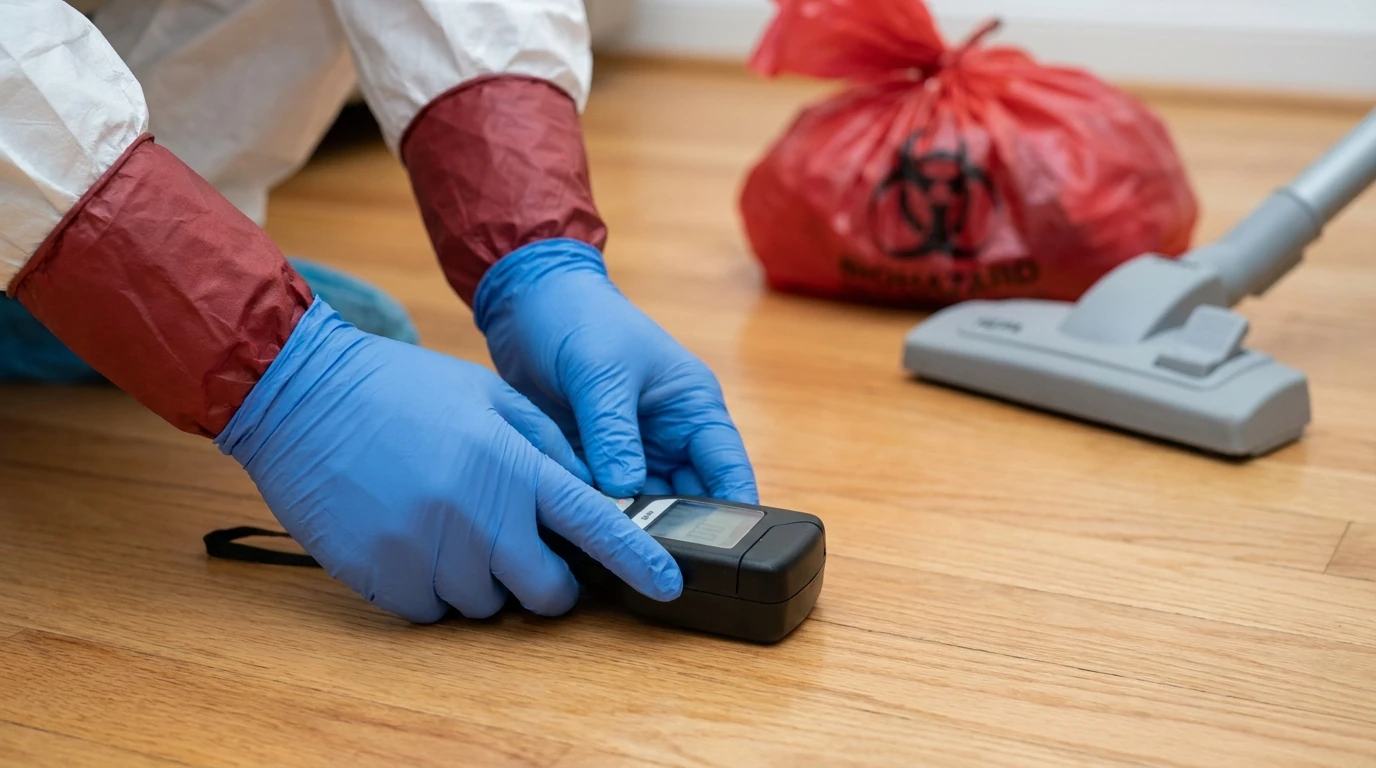
- ATP or protein testing: After cleanup, certified technicians use ATP (adenosine triphosphate) surface testing or protein testing to verify the space is biologically safe. This clearance testing is what your adjuster, and your family, needs to see documented.
If your policy covers the loss, the insurer will typically pay the actual cash value or replacement cost of materials removed, plus the labor for certified remediation. Get a written scope of work from your restoration company before any work begins, this is what the adjuster will review.
How to File a Biohazard Cleanup Insurance Claim
File the claim before cleanup begins. Adjusters need to document the scene, and starting remediation without authorization can result in a denied claim. Here is the process most carriers follow:
- Call your insurance carrier’s claims line immediately. Explain the nature of the loss. Ask whether the loss is a covered peril and whether you need an adjuster on-site before work begins.
- Request a certified biohazard remediation company. Your carrier may have preferred vendors, but in Washington State, you have the right to choose your own contractor. The company you hire should be IICRC certified and carry the appropriate licensing for biohazard and trauma scene work.
- Document everything before cleanup. Photographs, video, and a written description of the affected areas. Your restoration company should also produce a detailed scope of work and itemized estimate.
- Keep all receipts and invoices. If you paid for any emergency containment or stabilization before the adjuster arrived, those expenses may be reimbursable.
- Request a written coverage determination. If the adjuster denies the claim, ask for the specific policy exclusion cited in writing. This is your starting point if you want to dispute the decision.
For more on how insurance payouts work for restoration losses, our post on average insurance payouts for water damage covers the documentation and negotiation process in detail, much of it applies to biohazard claims as well.
What If Insurance Doesn’t Cover It?
If your policy excludes biohazard cleanup, you still have options. Some states and counties have victim assistance programs that may cover cleanup costs following a violent crime. In Washington State, the Washington State Department of Commerce’s Crime Victim Assistance Program may provide financial assistance for qualifying losses, contact the Washington State Crime Victim Compensation Program through the Department of Labor & Industries for current eligibility details.
Some biohazard remediation companies also work on payment plans or can help connect families with assistance resources. If cost is a barrier, ask directly, a reputable company will tell you what options exist.
If the event occurred in a rental property, the property owner’s insurance policy (not the tenant’s renter’s insurance) is typically the relevant coverage. Landlords in this situation should contact their commercial property or landlord policy carrier.
What to Look for in a Biohazard Cleanup Company
A qualified biohazard cleanup company will arrive discreetly, work in full PPE, and handle every aspect of the process, containment, removal, disposal, decontamination, and clearance testing, so your family does not have to. Here is what to verify before you hire:
- IICRC certification: The IICRC sets the industry standard for restoration and remediation. Look for technicians certified in trauma and crime scene remediation.
- OSHA bloodborne pathogen compliance: The company should follow OSHA 29 CFR 1910.1030 protocols for handling and disposing of biohazardous material.
- Licensed and insured in Washington State: Verify the contractor’s license through the WA Department of Labor & Industries contractor lookup.
- Written scope and pricing before work begins: Never agree to work without a written estimate. This protects you and gives your insurer what they need.
- Discreet arrival and unmarked vehicles when requested: This is a private matter. A professional company understands that.
National Restoration Construction handles biohazard and trauma scene cleanup across the Puget Sound region, including unattended death cleanup and crime scene cleanup. If you need help navigating the insurance process or just need to know what the next step is, call (206) 883-0333, someone is available around the clock.
About National Restoration Construction
National Restoration Construction is an IICRC-certified restoration company serving Federal Way, Seattle, Tacoma, and the broader Puget Sound region since 2004 (WA License NATIORC792M6). The company is EPA Certified, Lead-Safe Certified, ANSI Certified, and BBB Accredited. Their crews handle water, fire, mold, biohazard, and trauma scene losses across South King County and the greater Seattle-Tacoma corridor, with 24/7 availability for emergency response.