
24/7 Emergency Unattended Death Cleanup in Federal Way
24/7 emergency unattended death cleanup in Federal Way and surrounding areas. IICRC-certified, insurance billing accepted. Call (206) 883-0333.
We work with all insurance carriers and handle the claim paperwork.
Need biohazard or trauma cleanup in Federal Way? We answer 24/7. Call now and our crew heads out to handle the cleanup with discretion and care.
When a death goes undiscovered for days or weeks, the biological material left behind creates hazards that standard cleaning cannot address. Decomposition accelerates in warm or humid conditions, and in Western Washington’s mild, damp climate, that process can begin within hours. By the time a family member, landlord, or property manager finds the scene, the affected area typically requires full biohazard remediation: not just surface cleaning, but the removal of contaminated materials, enzymatic treatment of porous substrates, and professional odor neutralization that reaches behind walls and under flooring.
What unattended death cleanup actually involves
This is not a job for a cleaning crew or a contractor who handles it occasionally. The work requires IICRC-certified technicians trained in bloodborne pathogen protocols, EPA-registered disinfectants, and proper biohazardous waste handling under Washington State Department of Ecology and DOT regulations.
The scope depends on how long the scene went undiscovered, the size of the affected area, and the materials involved. Hardwood, concrete, drywall, subfloor, and HVAC systems can all retain biological contamination and odor compounds, particularly the volatile fatty acids and sulfur compounds produced during decomposition. Those molecules are small enough to penetrate porous materials and travel through air handling systems, which is why odor removal after death often requires treatment well beyond the immediate room.
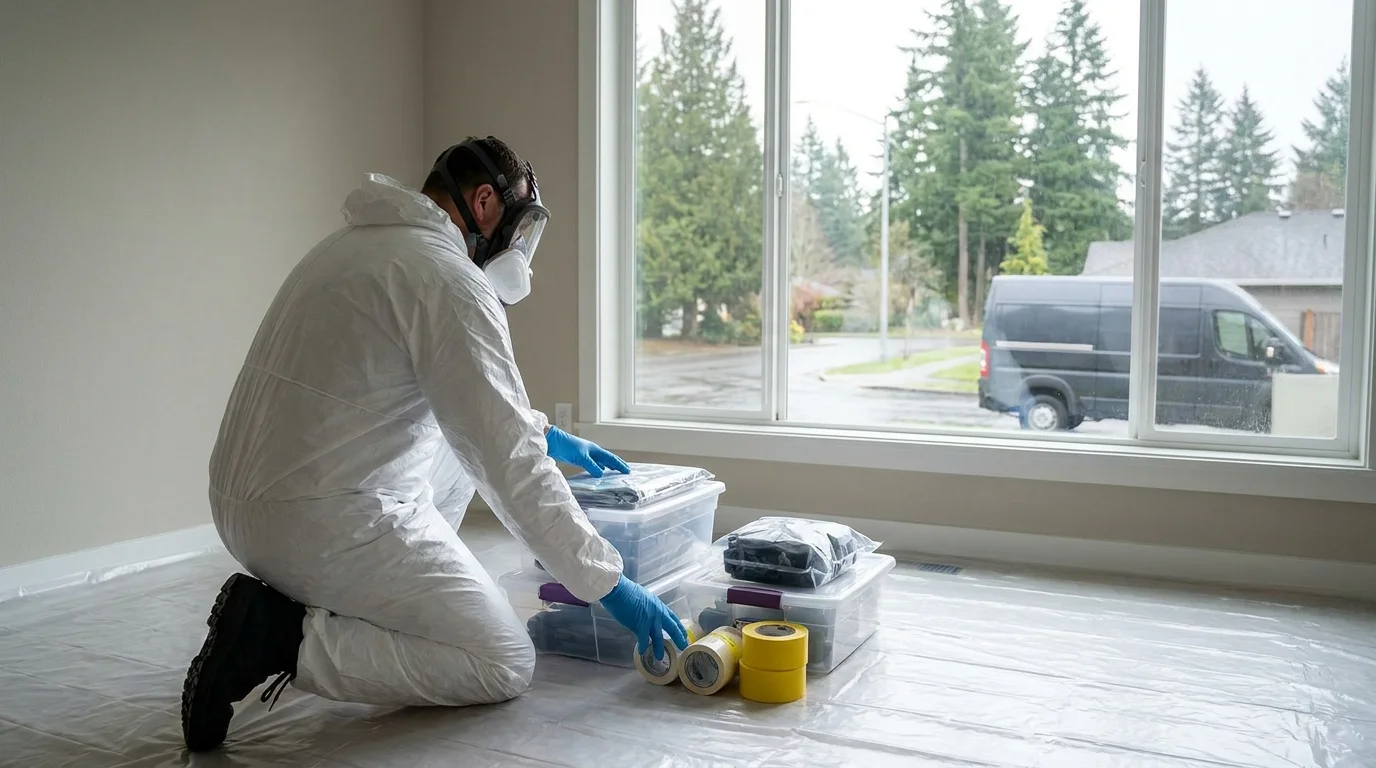
Timeline from first call to clearance typically runs 1–3 days for a contained scene, longer if structural materials require removal and reconstruction. Our team arrives in unmarked vehicles and works discreetly, a detail that matters in residential neighborhoods and multi-unit buildings alike.
Our process
-
Scene assessment and containment staging. Before any work begins, technicians in full PPE assess the extent of contamination, identify affected surfaces and materials, and establish negative-pressure containment where needed to prevent cross-contamination to adjacent spaces. This step also documents conditions for insurance and legal purposes.
-
Biohazardous material removal. All contaminated porous materials, flooring, padding, drywall, insulation, personal property, are removed, double-bagged in certified biohazard containers, and transported under a regulated waste manifest. Non-porous surfaces are cleaned and treated with EPA-registered hospital-grade disinfectants.
-
Enzymatic and chemical treatment of residual contamination. After bulk removal, technicians apply enzymatic cleaners that break down organic compounds at a molecular level. This step is critical for subfloor, wall cavities, and concrete slab, materials that hold odor long after visible contamination is gone. Multiple applications are often required.
-
Odor neutralization and air treatment. Hydroxyl generators or ozone treatment (in unoccupied spaces) address airborne odor compounds that surface cleaning cannot reach. HVAC registers and ductwork are inspected and treated if contamination has migrated. This is the step most often skipped by less experienced operators, and the reason odor returns weeks later.
-
Post-remediation verification and documentation. Before we leave, the area is tested and photographed to confirm contamination levels meet clearance standards. We provide written documentation suitable for insurance claims, estate proceedings, or property re-occupancy.
What separates a thorough response from an incomplete one
The most common failure in deceased estate cleanup is treating the visible surface and leaving the substrate. Decomposition fluids wick into subfloor, migrate along wall framing, and pool in low spots that aren’t immediately obvious. An operator who stops at the carpet misses the OSB underneath. One who stops at the OSB misses the concrete or the crawl space below.
A second common failure is inadequate odor treatment. Masking agents, sprays, foggers, deodorizing bombs, suppress odor temporarily. The volatile compounds that cause the smell are still present and will off-gas for months. Proper discreet death cleanup uses hydroxyl or ozone treatment in combination with enzymatic breakdown of the source material, not over it.
Insurance adjusters and estate attorneys increasingly request documentation of the remediation scope, the waste manifest, and clearance verification. Operators who don’t provide a written record create problems downstream for families and property owners trying to close estates or re-list property.
National Restoration Construction holds IICRC certification, EPA certification, and operates under General Contractor Certificate of Registration #NATIORC792M6, which matters when structural materials need to be removed and replaced as part of the remediation.
Seasonal and regional considerations
In Federal Way and the broader South Sound region, mild summers and poor ventilation in older housing stock accelerate decomposition timelines compared to drier climates. Crawl spaces under older Craftsman and mid-century homes in neighborhoods like Dash Point, Lakeland, and Steel Lake are particularly prone to retaining odor and moisture after a contamination event. If the affected property has a crawl space or basement, that area should be inspected as part of any after death cleaning scope, not assumed to be unaffected.
Service area
Our team is based in Federal Way and responds throughout King and Pierce Counties, including Tacoma, Auburn, Kent, Renton, Burien, Des Moines, Puyallup, and surrounding communities. City-specific pages for each area link back to this page for full service details.
If you’re managing a property or coordinating on behalf of a family, the next step is a confidential call, not a commitment. Reach National Restoration Construction at (206) 883-0333 any time. We’ll walk you through what the scope likely involves, how insurance documentation works, and what to expect from the process before anyone sets foot on the property.
Frequently Asked Questions
How do I know whether the subfloor or walls need to be removed, or just cleaned?
What certifications and licenses are required to legally handle and transport biohazardous waste in Washington State?
Why does odor sometimes return weeks after a cleanup company says the job is done?
Can the property be re-occupied or re-listed after remediation, and what documentation is needed?
How discreet is the process — will neighbors or building residents know what's happening?
Looking for the best unattended death cleanup company in Federal Way?
National Restoration Construction provides licensed and insured unattended death cleanup in Federal Way, WA and the surrounding area, and has served local property owners since 2004. Customers rate us 5.0 out of 5 stars across 65 Google reviews. We answer calls 24/7 — call (206) 883-0333 for immediate help.
Need Unattended Death Cleanup now?
We respond 24/7 across Federal Way and surrounding WA cities.
Related Coverage
- Our Restoration Services
- Contact National Restoration Construction
- 24/7 Emergency Unattended Death Cleanup in Auburn
- 24/7 Emergency Unattended Death Cleanup in Bellevue
- 24/7 Emergency Unattended Death Cleanup in Bremerton
- 24/7 Emergency Unattended Death Cleanup in Everett
- 24/7 Emergency Unattended Death Cleanup in Gig Harbor
- 24/7 Emergency Unattended Death Cleanup in Kent
- 24/7 Emergency Unattended Death Cleanup in Kirkland
- 24/7 Emergency Unattended Death Cleanup in Port Orchard
- 24/7 Emergency Unattended Death Cleanup in Redmond
- 24/7 Emergency Unattended Death Cleanup in Renton
- 24/7 Emergency Unattended Death Cleanup in Seattle