
If your adjuster just walked through your home and you’re trying to figure out whether the number they quote is reasonable, here’s the short answer: the average homeowners insurance payout for water damage in the U.S. falls between $3,000 and $12,000, with most claims settling in the $4,000 to $7,500 range. But that average hides a wide spread. A finished basement with a burst supply line can run $30,000 or more in legitimate covered losses. A Category 1 appliance leak caught early might settle for under $2,000. The source of water, the speed of response, and how well the damage was documented all move that number significantly.
What the Payout Range Actually Reflects
Insurance payouts for water damage aren’t random. They track three things closely: the water category, the affected square footage, and the structural materials involved.
The IICRC S500 standard classifies water damage into three categories. Category 1 is clean water from a supply line, dishwasher, or ice maker, the lowest remediation cost and the most straightforward claims. Category 2 (gray water) comes from appliances with detergents, overflow from washing machines, or toilet overflow without feces, moderate remediation scope. Category 3 (black water) includes sewage, floodwater, or any water that has sat long enough to become grossly contaminated, the most expensive to remediate and the most likely to trigger mold protocol.
A Category 1 loss affecting 200 square feet of hardwood flooring and drywall in a kitchen might generate a claim in the $4,000 to $8,000 range. That same event left undiscovered for 72 hours can escalate to Category 2 or 3 conditions as microbial growth begins, pushing the remediation scope, and the claim, significantly higher. Insurers know this. Adjusters are trained to look at response time and moisture readings when evaluating scope.
Structural materials matter too. Drywall replacement runs roughly $2 to $4 per square foot for materials alone. Hardwood flooring replacement averages $8 to $14 per square foot installed. Cabinets, insulation, vapor barriers, and subfloor replacement each add to the total. A claim that involves all of these in a 400-square-foot kitchen can legitimately exceed $25,000 before contents are factored in.
What Policies Cover, and What They Don’t
Most standard HO-3 homeowners policies cover sudden and accidental water damage from internal sources: burst pipes, appliance failures, HVAC condensate line failures, and accidental overflow. What they exclude is just as important to understand.
Gradual damage is the most common denial reason. If a slow leak behind a wall has been saturating insulation for six months, most policies will deny the claim on the grounds that the damage was not sudden and accidental, and that a reasonable homeowner should have detected and addressed it. Adjusters look for staining patterns, efflorescence, and mold growth that indicate long-term exposure when evaluating whether damage qualifies.
Flooding from external sources is excluded from standard homeowners policies entirely. Groundwater intrusion, storm surge, and overland flooding require a separate NFIP (National Flood Insurance Program) policy or a private flood endorsement. This distinction catches homeowners off guard regularly. If water entered your home through a window well, a foundation crack, or overland flow during a heavy rain event, your standard policy likely won’t cover it.
Sewer backup is excluded from most base policies but can be added as an endorsement, typically for $50 to $150 per year. If you have a finished basement and no sewer backup rider, a sewage backup event is an out-of-pocket loss, including the cost of professional sewage cleanup.
Mold remediation coverage varies widely. Some policies include a sublimit for mold, often $5,000 to $10,000, while others exclude it entirely unless the mold resulted directly from a covered water loss. If mold is discovered during remediation of a covered burst pipe claim, it’s generally covered under that same claim. If it’s discovered independently months later, coverage depends on whether you can establish a direct causal link to a covered event.
How Documentation Affects the Final Payout
This is where most homeowners leave money on the table. An insurance claim is essentially a documentation exercise. The adjuster’s job is to verify scope; your job, and your contractor’s job, is to provide the evidence that supports it.
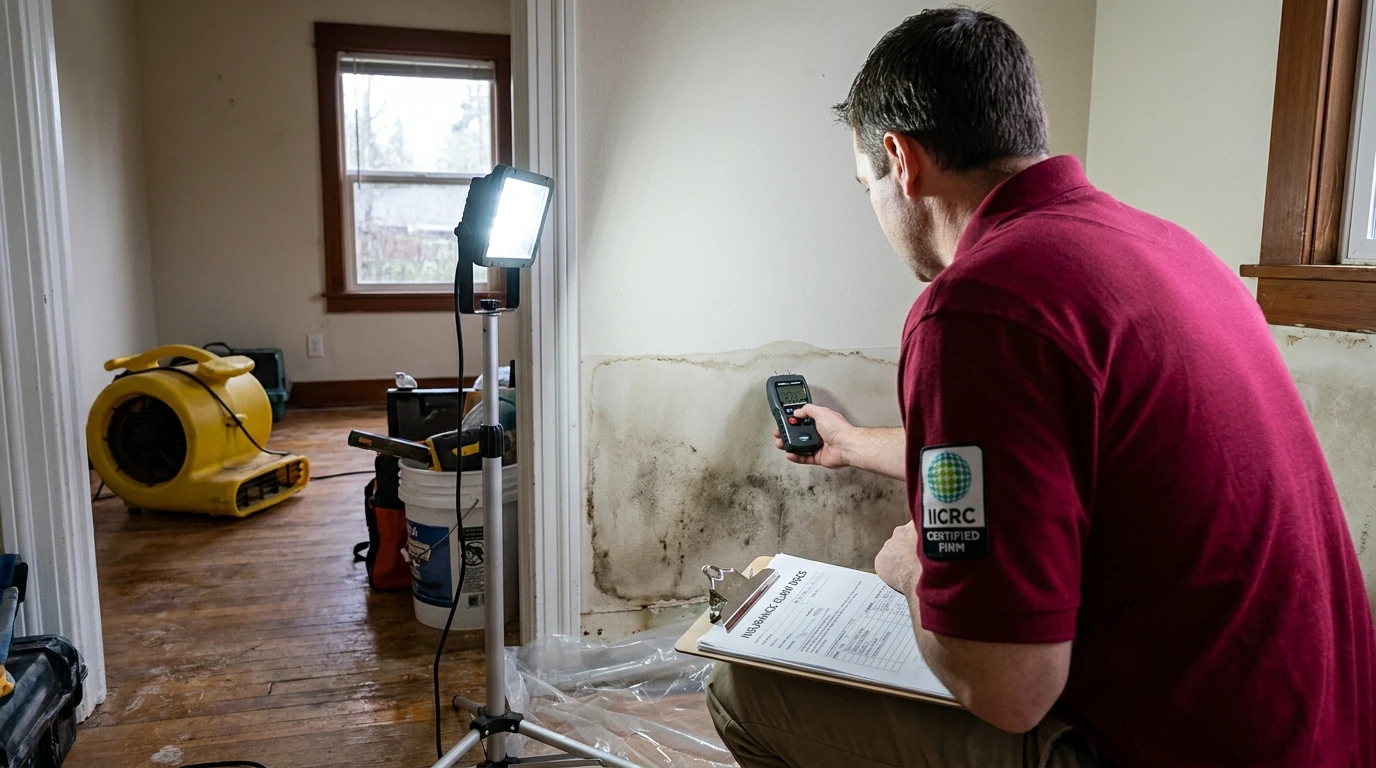
A professional water damage assessment should include thermal imaging to identify moisture behind walls and under flooring, moisture meter readings at multiple points (expressed as percentage moisture content or wood moisture equivalent), and a written scope of work that references IICRC S500 drying standards. When a restoration contractor provides this documentation, adjusters have a defensible basis for approving the full scope.
Without it, adjusters often approve a conservative scope, surface drying only, no wall cavity drying, no flooring replacement, and homeowners discover months later that the moisture that wasn’t properly dried has become a mold problem. At that point, the original claim is closed, and the mold is now a separate coverage question.
Photograph everything before any cleanup begins. Document the water source, the affected areas, the contents involved, and any visible damage to structural materials. If you’ve already called a restoration company, ask them to document their initial moisture readings before extraction begins, those readings are part of your claim file.
Should You File a Claim for Every Water Damage Event?
Not necessarily. This is a legitimate financial calculation, not just an insurance question.
Filing a claim creates a record in the CLUE (Comprehensive Loss Underwriting Exchange) database. Multiple water damage claims within a three-to-five year window can make you a higher-risk policyholder in the eyes of carriers, which can result in non-renewal or significant premium increases at renewal. Some carriers will non-renew after two claims in three years regardless of dollar amount.
As a rough rule: if the damage is below $3,000 to $4,000 and above your deductible by only a small margin, the premium impact of filing may exceed the net benefit over the next three years. Get a professional assessment of the full scope before deciding, you need to know the actual remediation cost, not just what’s visible on the surface, before you can make that calculation.
If the damage is significant, anything involving structural materials, subfloor, or more than one room, filing is almost always the right call. That’s what the coverage is for.
What to Do in the First 48 Hours
The actions you take immediately after discovering water damage directly affect both the remediation outcome and the claim.
Stop the source first. Shut off the supply valve at the affected fixture or the main water shutoff. If the source is a roof leak or HVAC failure, document it before attempting any mitigation.
Call your insurer to open a claim. You don’t need a contractor’s estimate first, open the claim immediately. Most policies require prompt notification of a loss; delayed reporting can complicate coverage.
Begin mitigation, but document before you do. Policies require you to take reasonable steps to prevent further damage (extract standing water, remove soaked materials that will become a mold source). But photograph everything before extraction begins.
Get a professional moisture assessment. Surface drying is not sufficient for Category 1 water that has been present for more than a few hours. Water migrates through drywall, insulation, and subfloor. A professional assessment with thermal imaging and moisture meters establishes the actual scope, which is what your claim needs to be accurate.
If the loss is significant, a restoration contractor who works directly with insurance carriers can help ensure the scope of work aligns with what the adjuster approves. That coordination matters more than most homeowners realize.
National Restoration Construction handles water damage assessments, full-scope water damage restoration, and post-drying documentation for insurance claims across the Pacific Northwest. If you’re in the middle of a loss and need a written scope for your adjuster, request a water damage assessment through our contact page.