
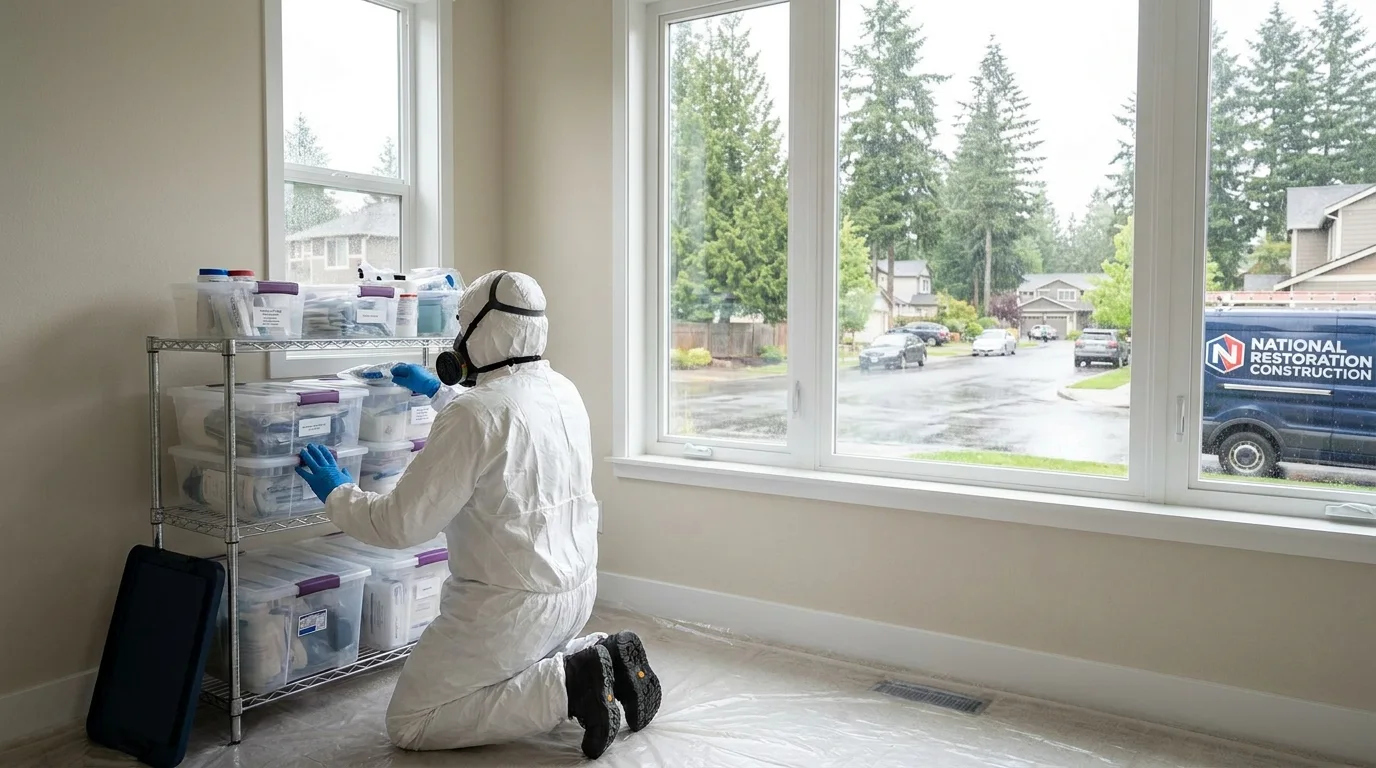
24/7 Emergency Trauma Scene Cleanup in Federal Way
24/7 emergency trauma scene cleanup in Federal Way and surrounding areas. IICRC-certified, insurance billing accepted. Call (206) 883-0333.
We work with all insurance carriers and handle the claim paperwork.
Need biohazard or trauma cleanup in Federal Way? We answer 24/7. Call now and our crew heads out to handle the cleanup with discretion and care.
When something traumatic happens inside a home or property, the hours that follow are consumed by shock, logistics, and phone calls, not by figuring out who cleans up or how. Biological contamination left behind after an unattended death, accident, or violent incident doesn’t wait. Within 24 to 48 hours, bloodborne pathogens can penetrate porous surfaces, subflooring, and wall cavities in ways that aren’t visible to the eye. National Restoration Construction handles that reality so families and property managers don’t have to.
What trauma scene cleanup actually involves
Trauma scene cleaning is federally regulated work. Technicians who enter a scene with biological contamination are required under OSHA’s Bloodborne Pathogen Standard (29 CFR 1910.1030) to use full personal protective equipment, follow documented decontamination protocols, and transport all biohazardous waste under a licensed medical waste manifest. This is not a job for a general cleaning crew.
The materials involved, blood, bodily fluids, and tissue, are classified as Category A infectious substances. They can harbor hepatitis B, hepatitis C, HIV, and other pathogens that survive on surfaces far longer than most people expect. Hepatitis B, for instance, can remain viable on a dry surface for up to seven days.
Beyond the biological hazard, trauma scenes often involve secondary contamination: decomposition odor absorbed into drywall and subfloor, affected HVAC systems, and structural materials that look intact but have been compromised at depth. Our IICRC-certified technicians use ATP surface testing to verify decontamination, not visual inspection alone, before any area is cleared.
Response is discreet. Unmarked vehicles, plain-clothed crews when requested, and direct coordination with the property owner or designated representative rather than neighbors or bystanders.
Our process
-
Scene assessment and PPE staging. Before any work begins, a lead technician walks the affected area in full PPE to map the contamination boundary, visible and suspected. This determines the containment perimeter, the materials that will require removal, and whether HVAC systems need to be isolated to prevent cross-contamination to unaffected areas.
-
Containment and access control. Affected rooms are sealed with poly sheeting and negative air pressure where necessary. This keeps biological particulates from migrating during removal. Access is restricted to technicians only during active remediation.
-
Biohazardous material removal and surface decontamination. Saturated porous materials, carpet, padding, drywall, subfloor, are removed, double-bagged in red biohazard bags, and logged on a waste manifest for licensed medical waste disposal. Hard surfaces are treated with EPA-registered hospital-grade disinfectants and enzymatic cleaners that break down organic matter at the molecular level rather than masking it.
-
ATP surface verification testing. Once decontamination is complete, we test treated surfaces using adenosine triphosphate (ATP) bioluminescence testing. ATP is present in all living cells; a passing result confirms that biological contamination has been reduced to safe levels. This step produces a written record, useful for insurance documentation and for the family’s peace of mind.
-
Odor neutralization and clearance. Decomposition odor and bloodborne-pathogen-associated odors penetrate beyond the visible surface. Depending on the scope, we use hydroxyl generators or thermal fogging with EPA-registered deodorizers to address odor at depth. The space is not released until both surface testing and odor clearance meet protocol.
What separates a good trauma cleanup response from a bad one
The most common failure in trauma scene cleaning is incomplete boundary assessment. A crew that cleans only what’s visible will miss contamination that has wicked under baseboards, tracked into adjacent hallways, or migrated into subfloor seams. When that contamination is discovered later, sometimes weeks later, by smell, the remediation scope is larger and the insurance documentation is more complicated.
A second common failure is improper waste disposal. Biohazardous waste must travel under a licensed medical waste manifest from point of collection to a licensed treatment facility. Crews that bag material and dispose of it in standard waste streams are violating federal and Washington State law, and leaving the property owner potentially liable.
Insurance adjusters reviewing trauma cleanup claims look for three things: a documented contamination boundary (pre- and post-photos), an itemized waste manifest, and surface verification test results. Without those three documents, claims are frequently reduced or disputed. Every job we complete produces all three.
Seasonal and regional considerations
In the Pacific Northwest, unattended death scenes present an additional challenge: the region’s mild, damp climate accelerates decomposition and mold colonization in affected materials. A scene that might remain stable for 72 hours in a dry climate can develop secondary mold growth within 48 hours in a Federal Way home during the wet season, particularly in older housing stock with limited subfloor ventilation. Our assessment accounts for ambient humidity and structure type from the first hour on-site.
Service area
National Restoration Construction is based in Federal Way, WA and provides trauma cleanup services throughout King and Pierce Counties, including Tacoma, Auburn, Kent, Renton, Burien, Des Moines, SeaTac, Puyallup, and surrounding communities. Response times and service-area details are covered on each city-specific page.
If you’re managing a property or coordinating on behalf of a family, call (206) 883-0333 to speak directly with a technician, not a call center. We can begin the intake process, answer questions about documentation and insurance coordination, and dispatch a crew as soon as access is available. Every call is handled with discretion.
Frequently Asked Questions
What certifications are required for a company to legally perform trauma scene cleanup in Washington State?
How do you verify that a trauma scene has been fully decontaminated?
What happens to porous materials like carpet, drywall, or subfloor that have been contaminated?
Can trauma scene cleanup be performed discreetly, and who will know it's happening?
What documentation does a trauma cleanup company need to provide for an insurance claim?
Looking for the best trauma scene cleanup company in Federal Way?
National Restoration Construction provides licensed and insured trauma scene cleanup in Federal Way, WA and the surrounding area, and has served local property owners since 2004. Customers rate us 5.0 out of 5 stars across 65 Google reviews. We answer calls 24/7 — call (206) 883-0333 for immediate help.
Need Trauma Scene Cleanup now?
We respond 24/7 across Federal Way and surrounding WA cities.
Related Coverage
- Our Restoration Services
- Contact National Restoration Construction
- 24/7 Emergency Trauma Scene Cleanup in Auburn
- 24/7 Emergency Trauma Scene Cleanup in Bellevue
- 24/7 Emergency Trauma Scene Cleanup in Bremerton
- 24/7 Emergency Trauma Scene Cleanup in Everett
- 24/7 Emergency Trauma Scene Cleanup in Gig Harbor
- 24/7 Emergency Trauma Scene Cleanup in Kent
- 24/7 Emergency Trauma Scene Cleanup in Kirkland
- 24/7 Emergency Trauma Scene Cleanup in Port Orchard
- 24/7 Emergency Trauma Scene Cleanup in Redmond
- 24/7 Emergency Trauma Scene Cleanup in Renton
- 24/7 Emergency Trauma Scene Cleanup in Seattle