
24/7 Emergency Trauma Scene Cleanup in Seattle
24/7 emergency trauma scene cleanup in Seattle, WA. IICRC-certified, insurance billing accepted. Call (206) 883-0333.
We work with all insurance carriers and handle the claim paperwork.
Our IICRC-certified technicians are dispatched from our Federal Way, WA headquarters and are typically on-site in Seattle within 60 minutes of your call.
Need biohazard or trauma cleanup in Seattle? We answer 24/7. Call now and our crew heads out to handle the cleanup with discretion and care.
Seattle’s older neighborhoods carry a particular weight when something goes wrong inside a home. In craftsman bungalows across Ballard and the Tudor revivals that line the hillsides of Queen Anne, porous plaster walls, original hardwood subfloors, and decades of accumulated materials mean that biological contamination from a trauma event can penetrate surfaces that modern construction would shed. When a family or property manager calls National Restoration Construction after an unattended death, accident, or violent incident, the first concern is rarely the paperwork, it’s getting a trained crew there quickly, working discreetly, and making the space safe again.
Why Seattle’s Housing Stock Complicates Trauma Cleanup
Most trauma cleanup guidance is written for post-1980 construction: vinyl flooring, drywall, easy-to-seal surfaces. Seattle doesn’t work that way. The pre-1950 homes that dominate Magnolia, Wallingford, and much of Capitol Hill were built with old-growth fir subfloors laid directly over crawlspaces, and those crawlspaces already carry ambient moisture from the region’s wet winters. Biological material that reaches the subfloor in these homes doesn’t stay on the surface; it wicks into the grain and, if not addressed within the right window, creates a secondary contamination problem beneath the visible floor plane.
Older plaster walls present a related issue. Unlike drywall, plaster is alkaline and dense, which changes how disinfectants interact with it and how thoroughly affected sections can be cleaned versus removed. Our IICRC-certified technicians assess each surface type before choosing a protocol, there is no single-pass solution in a 1920s Craftsman.
Our Trauma Scene Cleanup Process in Seattle
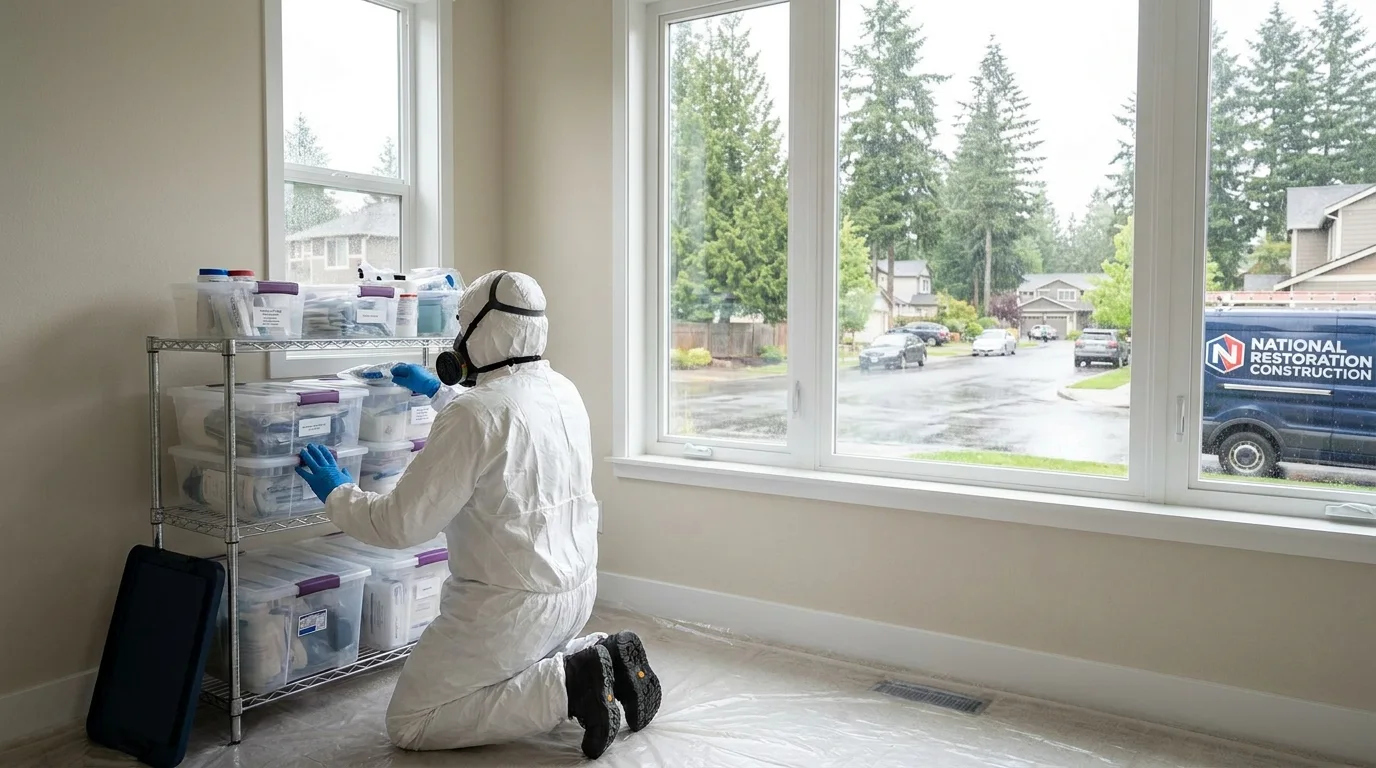
Every job begins with a scene assessment and containment setup before any cleaning begins. We establish a controlled work zone, document conditions for insurance purposes, and identify which materials can be decontaminated and which require disposal under Washington State Department of Ecology guidelines for biohazardous waste.
From there, the process moves through three phases: removal of affected materials, surface decontamination using EPA-registered disinfectants appropriate to the substrate, and verification testing to confirm the space meets established safety thresholds before we leave. On Capitol Hill condos and newer South Lake Union units, where plumbing-stack failures and shared walls are common, we coordinate with building management to ensure containment doesn’t affect adjacent units. On older single-family homes, we pay particular attention to subfloor integrity and crawlspace conditions before closing out.
All waste is transported and disposed of through licensed biohazardous waste carriers operating under Washington State permit requirements. We provide documentation of disposal for your records.
Response Time from Federal Way to Seattle
National Restoration Construction’s headquarters is in Federal Way, roughly 25 miles south of downtown Seattle via I-5. Under normal conditions, a crew can reach central Seattle neighborhoods, Capitol Hill (98122), Fremont, or Green Lake, in approximately 45 to 60 minutes. West Seattle and Beacon Hill, depending on the time of day and the West Seattle Bridge corridor, typically run 50 to 70 minutes. Ballard and Greenwood, accessed via Highway 99 or Aurora Avenue, are generally in the 55-to-65-minute range.
We account for I-5 and I-90 congestion in our dispatch estimates and will give you an honest arrival window when you call, not a number designed to win the call. Reach us at (206) 883-0333 any hour of the day.
Insurance and Privacy Coordination in Seattle
Homeowner’s insurance policies in Washington State often cover trauma cleanup costs under the dwelling or personal property provisions, though coverage varies by carrier and policy language. We work directly with adjusters, provide itemized documentation, and can submit the claim packet on your behalf, which matters when families are managing grief alongside logistics.
Privacy is handled with the same care. Our vehicles are unmarked, and we schedule arrival and departure to minimize visibility to neighbors when that’s a priority. In denser Seattle neighborhoods, Capitol Hill row houses, Wallingford bungalows on narrow lots, this kind of coordination isn’t an afterthought. We’ve been doing this work since 2004 and understand that discretion is part of the service.
Local Note: Crawlspace Access in Older Seattle Homes
In Magnolia and Queen Anne, many pre-1950 homes have crawlspace access points that are partially blocked by later additions, a deck built over the original hatch, or a foundation vent that was sealed during an energy retrofit. When trauma cleanup requires inspecting or treating the subfloor from below, limited crawlspace access can add time to the job. We carry compact extraction and inspection equipment specifically for low-clearance crawlspaces and flag access issues during the initial walk-through so there are no surprises on the timeline or the estimate.
If you’re managing a property in Seattle that needs professional, discreet trauma scene cleanup, call National Restoration Construction at (206) 883-0333. We’re licensed through Washington State’s Department of Labor & Industries (#NATIORC792M6), EPA and Lead-Safe certified, and ANSI certified for this work. The conversation is confidential, and we can have a crew moving toward you within the hour.
Serving Seattle from our Federal Way headquarters — ★ 5.0 · 65 Google reviews
“National Restoration Company did Exceptional work for us in cleaning after the passing of my brother at home from cancer. They were very responsive, and also courteous. It was a very challenging time for us. I highly recommend.” — Sharon, October 2026Read our reviews on Google →
Trauma Scene Cleanup in Seattle: Service Coverage
Frequently Asked Questions
How fast can you arrive for trauma scene cleanup in Seattle?
How quickly can you reach the Ballard or Greenwood area for a trauma cleanup call?
Does Seattle's older housing stock — plaster walls, old-growth fir floors — affect how long trauma cleanup takes?
Will my Washington State homeowner's insurance cover trauma scene cleanup in Seattle?
How do you handle privacy in dense Seattle neighborhoods where homes are close together?
What certifications apply to trauma cleanup work in Seattle, and does Washington State regulate biohazardous waste disposal?
Trauma Scene Cleanup response in Seattle
Most Seattle calls see a technician on-site within 60 minutes from our Federal Way headquarters.