
24/7 Emergency Crime Scene Cleanup in Federal Way
24/7 emergency crime scene cleanup in Federal Way and surrounding areas. IICRC-certified, insurance billing accepted. Call (206) 883-0333.
We work with all insurance carriers and handle the claim paperwork.
Need biohazard or trauma cleanup in Federal Way? We answer 24/7. Call now and our crew heads out to handle the cleanup with discretion and care.
When law enforcement clears a scene and hands the property back to a family or landlord, the hardest part is often just beginning. Blood-borne pathogens, tissue matter, and chemical residues left behind after a violent incident or unattended death don’t simply disappear, and they can’t be safely addressed with household cleaners, a pair of gloves, and good intentions. What follows is a regulated, methodical process that requires specialized training, licensed waste disposal, and the kind of discretion that lets families and property owners move forward without unnecessary exposure to what was left behind.
What crime scene cleanup actually involves
Forensic cleanup is a branch of biohazard remediation governed by OSHA Bloodborne Pathogen Standards (29 CFR 1910.1030) and Washington State Department of Ecology regulations for medical and biohazardous waste transport. The work goes well beyond surface cleaning. Biological material can migrate into porous substrates, subfloor, drywall, insulation, carpet padding, within hours of an incident. Odor compounds from decomposition penetrate wood grain and concrete. Residues from fingerprint powders and chemical agents used during investigation may also need to be addressed.
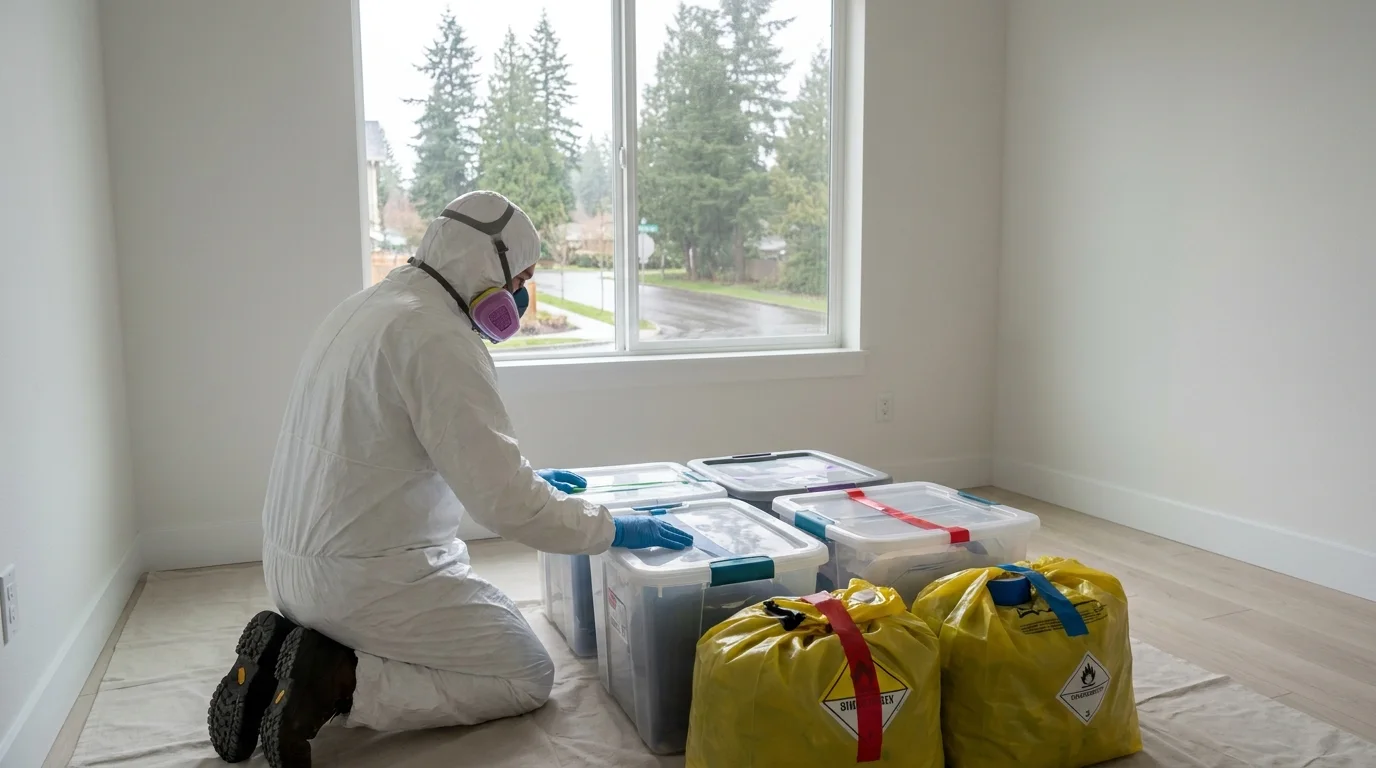
Technicians arrive in full PPE, work within contained zones, and document every step for insurance and regulatory compliance. In Federal Way and across King County, response is typically on-site within two to four hours of your call, and most residential scenes are remediated within one to two days depending on scope. Larger or longer-duration incidents, particularly unattended deaths discovered days or weeks later, require extended timelines and additional structural assessment.
Our process
-
Scene assessment and containment staging. Before any cleanup begins, a lead technician walks the affected area to identify the full extent of contamination, visible and non-visible. Containment barriers and negative air pressure are established where necessary to prevent cross-contamination of unaffected areas of the structure.
-
Removal of biohazardous material. All biological matter, saturated materials, and contaminated porous items are carefully removed and packaged in DOT-compliant biohazard containers. This includes affected flooring, drywall sections, and furnishings that cannot be decontaminated to a safe standard. Nothing is left to a judgment call, if it tested positive or shows visible saturation, it goes.
-
Enzymatic and antimicrobial treatment. Once bulk materials are removed, affected surfaces are treated with hospital-grade enzymatic cleaners that break down protein-based residues at the molecular level, followed by EPA-registered antimicrobial agents. This is not a single-pass wipe-down, surfaces are treated, allowed to dwell, and re-treated as needed.
-
Odor neutralization. Biological odor compounds require more than masking. Depending on the severity and substrate penetration, we deploy hydroxyl generators or thermal fogging to neutralize odor at the molecular level within wall cavities, subfloor spaces, and HVAC pathways.
-
Clearance verification and waste manifest. Before we leave, the remediated area is inspected against ATP (adenosine triphosphate) testing or visual clearance standards appropriate to the scope. All biohazardous waste is transported under a signed waste manifest to a licensed medical waste disposal facility, documentation that matters for insurance claims and property resale.
What separates a good crime scene cleanup response from a bad one
The most common failure point is incomplete subsurface remediation. A company that cleans visible surfaces without testing or removing affected subflooring or wall cavities leaves behind biological material that will produce odor and potential health hazards for future occupants, sometimes for years. Insurance adjusters and property inspectors increasingly know what to look for, and a superficial cleanup that doesn’t include documentation of subsurface assessment can create liability for property owners.
A second common gap is waste disposal. Washington State requires a licensed medical waste transporter and a completed waste manifest for biohazardous materials. Companies that dispose of contaminated materials in standard dumpsters or without proper documentation expose property owners to regulatory risk. Always ask for the waste manifest before a cleanup company leaves the site.
Finally, insurance coordination matters more than most families realize at the time of the call. Homeowner’s and renter’s policies often cover forensic cleanup under the same provisions as other sudden and accidental losses. Proper photo documentation, itemized scope-of-work reports, and direct adjuster communication, all part of how National Restoration Construction handles every job, can mean the difference between a covered claim and an out-of-pocket expense.
Seasonal and regional considerations
Western Washington’s climate is relevant here in one specific way: unattended deaths in poorly ventilated structures during the warmer months, June through September, accelerate biological breakdown significantly compared to winter incidents. What might be a contained remediation in February can involve substantially more structural material removal in August. If you’re managing a property and there’s any possibility of a delay between discovery and remediation, ventilating the space (if it’s safe to do so) and calling immediately rather than waiting for insurance authorization can limit the scope and cost of the work.
Service area
National Restoration Construction is headquartered in Federal Way and serves King and Pierce counties, including Tacoma, Auburn, Kent, Renton, Burien, Des Moines, Puyallup, and surrounding communities. Dedicated service-area pages for each city link back to this page for full technical detail on the process.
If you’re managing a property in the aftermath of a violent incident, unattended death, or other trauma scene, the next step is a single phone call. Our team responds discreetly, coordinates directly with your insurance adjuster, and handles every regulatory requirement so you don’t have to. Call National Restoration Construction at (206) 883-0333 to begin discreet, certified forensic cleanup.
Frequently Asked Questions
Does Washington State require a special license to transport biohazardous waste from a crime scene cleanup?
How do technicians know when a surface is truly decontaminated, not just visually clean?
What should a family or property owner do — and not do — before the cleanup crew arrives?
How is a crime scene cleanup handled when the affected area includes subfloor, drywall, or other structural materials?
Is crime scene or trauma scene cleanup typically covered by homeowner's or renter's insurance?
Looking for the best crime scene cleanup company in Federal Way?
National Restoration Construction provides licensed and insured crime scene cleanup in Federal Way, WA and the surrounding area, and has served local property owners since 2004. Customers rate us 5.0 out of 5 stars across 65 Google reviews. We answer calls 24/7 — call (206) 883-0333 for immediate help.
Need Crime Scene Cleanup now?
We respond 24/7 across Federal Way and surrounding WA cities.
Related Coverage
- Our Restoration Services
- Contact National Restoration Construction
- 24/7 Emergency Crime Scene Cleanup in Auburn
- 24/7 Emergency Crime Scene Cleanup in Bellevue
- 24/7 Emergency Crime Scene Cleanup in Bremerton
- 24/7 Emergency Crime Scene Cleanup in Everett
- 24/7 Emergency Crime Scene Cleanup in Gig Harbor
- 24/7 Emergency Crime Scene Cleanup in Kent
- 24/7 Emergency Crime Scene Cleanup in Kirkland
- 24/7 Emergency Crime Scene Cleanup in Port Orchard
- 24/7 Emergency Crime Scene Cleanup in Redmond
- 24/7 Emergency Crime Scene Cleanup in Renton
- 24/7 Emergency Crime Scene Cleanup in Seattle