
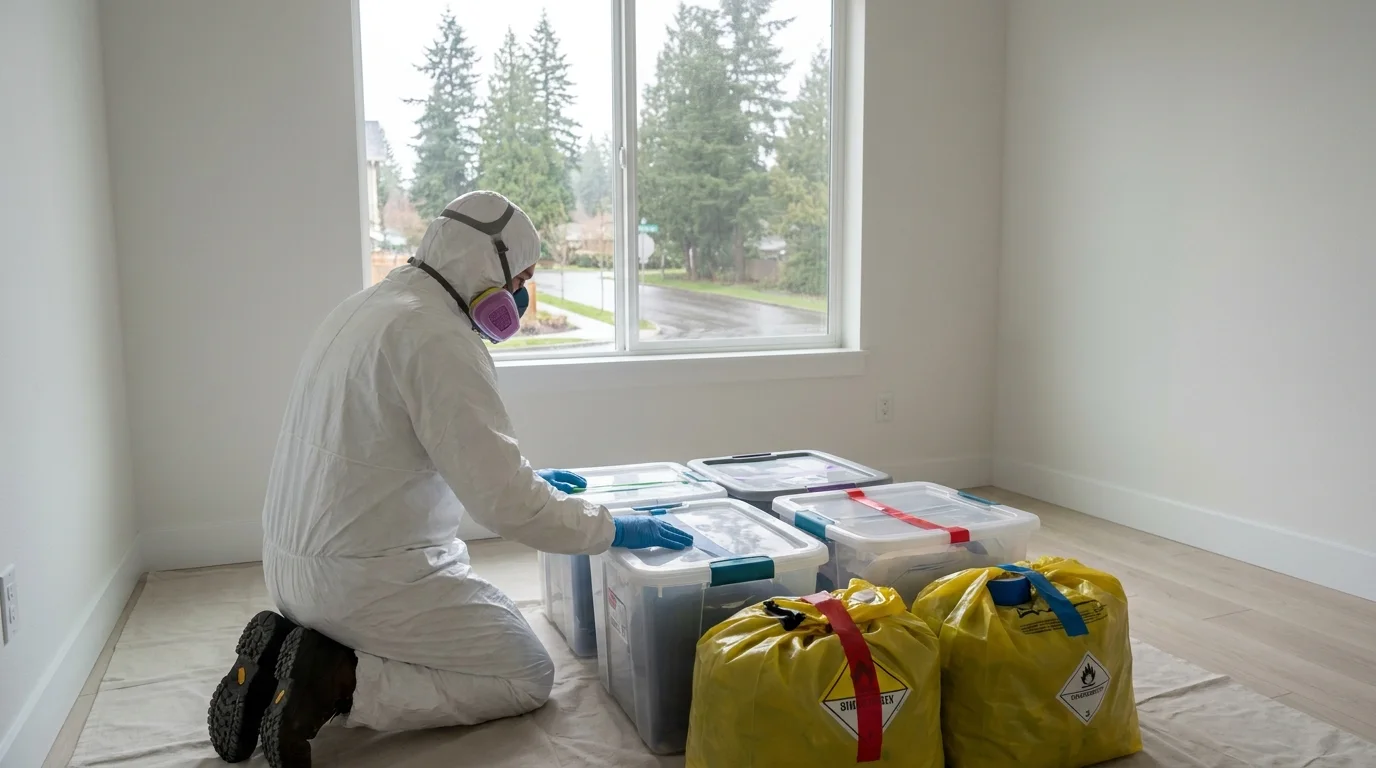
24/7 Emergency Crime Scene Cleanup in Seattle
24/7 emergency crime scene cleanup in Seattle, WA. IICRC-certified, insurance billing accepted. Call (206) 883-0333.
We work with all insurance carriers and handle the claim paperwork.
Our IICRC-certified technicians are dispatched from our Federal Way, WA headquarters and are typically on-site in Seattle within 60 minutes of your call.
Need biohazard or trauma cleanup in Seattle? We answer 24/7. Call now and our crew heads out to handle the cleanup with discretion and care.
When something unthinkable happens inside a Seattle home or building, the last thing a family or property manager should have to navigate alone is what comes next. Seattle’s older housing stock, the craftsman bungalows in Ballard, the Tudor revivals on Queen Anne Hill, the pre-war apartment buildings along Capitol Hill’s 15th Avenue, presents specific challenges that generic cleanup crews aren’t prepared for. Porous plaster walls, original hardwood subfloors, and decades of settled dust mean that biological contamination can migrate into materials far beyond the visible surface. National Restoration Construction’s technicians have worked in these buildings since 2004 and understand exactly what that means for a thorough, discreet remediation.
Why Seattle’s Building Stock Complicates Crime Scene Remediation
A significant portion of Seattle’s residential properties were built before 1950, and that matters in ways that aren’t obvious at first glance. Plaster-over-lath walls common in Magnolia and Queen Anne absorb fluids differently than modern drywall, contamination can wick laterally through wall cavities and settle into subfloor assemblies before it’s visible on the surface. Original fir flooring, still intact in many Wallingford and Greenwood homes, is often tongue-and-groove construction with no vapor barrier beneath it, which means biological material can reach the crawlspace.
Seattle’s climate adds another layer. The city averages roughly 150 days of measurable precipitation per year, and ambient indoor humidity in older homes frequently runs higher than in drier climates. That moisture environment accelerates the timeline for secondary contamination concerns, which is one reason rapid, certified response matters more here than in, say, a Phoenix property of similar age.
For properties in newer construction, the mid-rise condos near South Lake Union or the stacked flats along Capitol Hill’s dense corridors, the concern shifts. Shared HVAC risers and plumbing chases mean that odor and particulate can travel between units, creating coordination requirements with building management that single-family work doesn’t involve.
Our Crime Scene Cleanup Process in Seattle
Every job begins with a thorough assessment before any materials are removed. Technicians document affected surfaces, identify hidden migration paths, and determine whether structural components, subfloor, wall cavity, insulation, need to be addressed beyond the primary area. This step is not rushed; skipping it is how contamination gets missed.
All biological waste is handled and transported in compliance with Washington State Department of Ecology regulations and disposed of through licensed medical waste channels. Our team is IICRC certified, EPA certified, and holds Lead-Safe Firm certification, relevant in Seattle’s pre-1950 housing stock where lead paint is common in wall layers that may need to be disturbed during remediation. We carry full licensure through WA State Department of Labor & Industries (General Contractor Certificate of Registration #NATIORC792M6).
Once physical remediation is complete, affected areas are treated with hospital-grade antimicrobials and tested to confirm contamination levels meet or exceed applicable standards. We do not consider a job finished until that confirmation is in hand. For properties in ZIP codes like 98103 or 98117, dense Fremont and Greenwood corridors where homes share walls or sit on narrow lots, we also coordinate with neighbors or adjacent unit owners as needed to address any cross-boundary concerns.
Response Time from Federal Way to Seattle
National Restoration Construction is headquartered in Federal Way, approximately 25 miles south of downtown Seattle via I-5. Under normal traffic conditions, that translates to roughly 35–45 minutes to most Seattle neighborhoods. During peak I-5 congestion, which in Seattle means roughly 7–9 a.m. and 4–7 p.m. on weekdays, we route through SR-99 or use I-405 to SR-520 to reach the Eastlake, Capitol Hill, and Beacon Hill areas without sitting in the express lane backup. For West Seattle addresses, the West Seattle Bridge corridor is the most direct approach from Federal Way, and our dispatch team accounts for bridge status before routing.
We respond 24 hours a day, seven days a week. Calls placed outside peak hours typically result in on-site arrival within 45–60 minutes for most Seattle addresses.
Insurance Coordination and Privacy in Seattle
Most homeowner’s insurance policies, and many commercial property policies, cover crime scene cleanup under the same loss provisions that cover other sudden and accidental property damage. We work directly with adjusters and can provide the documentation formats that major carriers operating in Washington State require for claim processing. Families do not need to manage that paperwork during an already difficult time.
Discretion is a non-negotiable part of how we work. Vehicles are unmarked. Crew members do not discuss job details. In dense Seattle neighborhoods where homes sit close together and neighbors notice everything, that matters.
Local Note
In Seattle’s older craftsman and Tudor homes, particularly in Ballard and Magnolia, we routinely find that original horsehair plaster has been skim-coated with modern joint compound at some point in the building’s history. That layering creates a contamination trap: the outer compound layer may test clean while the original plaster beneath has absorbed material through micro-cracks. Our technicians probe both layers before signing off, a step that adds time but prevents callbacks and, more importantly, ensures the property is genuinely safe for reoccupancy.
If you’re managing a property or supporting a family through this process in Seattle, call (206) 883-0333 any time of day or night. The conversation is confidential, there’s no obligation, and we can walk you through exactly what to expect before anyone sets foot on the property.
Serving Seattle from our Federal Way headquarters — ★ 5.0 · 65 Google reviews
“National Restoration Company did Exceptional work for us in cleaning after the passing of my brother at home from cancer. They were very responsive, and also courteous. It was a very challenging time for us. I highly recommend.” — Sharon, October 2026Read our reviews on Google →
Crime Scene Cleanup in Seattle: Service Coverage
Frequently Asked Questions
How fast can you arrive for crime scene cleanup in Seattle?
How quickly can you reach a home in Ballard or Greenwood after an after-hours call?
Does Seattle's older housing stock — plaster walls, original hardwood floors — affect how long the cleanup takes?
We're in a Capitol Hill condo building — does cleanup in a shared-building environment work differently?
Will your crew be discreet in a dense Seattle neighborhood where neighbors are close by?
Does Washington State require licensed disposal of biological waste, and how do you handle that?
Will my homeowners insurance cover crime scene cleanup in Seattle?
Crime Scene Cleanup response in Seattle
Most Seattle calls see a technician on-site within 60 minutes from our Federal Way headquarters.