
Odor Removal and Deodorization in University Place
24/7 odor removal and deodorization in University Place, WA. IICRC-certified, insurance billing accepted. Call (206) 883-0333.
We work with all insurance carriers and handle the claim paperwork.
Our IICRC-certified technicians are dispatched from our Federal Way, WA headquarters and are typically on-site in University Place within 60 minutes of your call.
The 1960s and 70s ramblers that line the streets of Sunset Terrace and Beckonridge were built before anyone worried much about crawl-space vapor barriers or sealed ductwork, and decades later, that construction reality shows up in the air quality inside those homes. Slow appliance leaks, cast-iron drain seepage, and the persistent marine dampness that rolls in off the Narrows all give odor-causing bacteria and smoke residue exactly the conditions they need to embed themselves in subfloor framing, insulation batts, and HVAC plenums. When a smell won’t leave after cleaning, it usually means the source has migrated somewhere a mop can’t reach. That’s the problem National Restoration Construction solves.
Why University Place Properties Hold Odors Differently
University Place sits in a climate corridor that rarely gets dry enough to flush moisture out of building materials on its own. Average annual rainfall in West Pierce County runs close to 40 inches, and the fog that settles over Chambers Creek Regional Park in November doesn’t lift for days at a time. In practical terms, that means odor molecules, whether from smoke, pet contamination, sewer gas, or a long-running hidden leak, bond more aggressively to porous materials because those materials are never fully dry.
The housing stock amplifies the problem. The split-levels and ramblers dominant in the 98466 and 98467 ZIP codes were typically built with original-growth fir subfloors over unvented or minimally vented crawl spaces. When a supply line drips for months before anyone notices, a classic loss pattern in these homes, the subfloor absorbs odor compounds at the same time it absorbs moisture. Treating the smell without addressing the substrate underneath produces results that last about one dry summer before the odor returns.
Day Island’s waterfront properties add another layer: tidal saltwater intrusion and the organic decay that follows it create a sulfurous, low-tide smell that can penetrate slab-on-grade foundations and masonry. Standard deodorizers mask it temporarily. Neutralizing it requires getting chemistry down into the concrete itself.
Our Deodorization Process in University Place
Every job starts with source identification, not equipment deployment. A technician walks the structure systematically, using moisture meters, thermal imaging, and a trained nose to locate where the odor is originating, not just where it’s strongest. In older University Place homes, that often means pulling back carpet in a corner bedroom or opening a crawl-space hatch to find a subfloor that’s been wet for longer than anyone realized.
Once the source is confirmed and any underlying damage is stabilized, we match the deodorization method to the material and contamination type:
- Thermal fogging, a heated solvent-based fog that follows the same pathways smoke traveled through wall cavities, ductwork, and attic framing. Particularly effective in the open-rafter attics common in 1960s University Place construction.
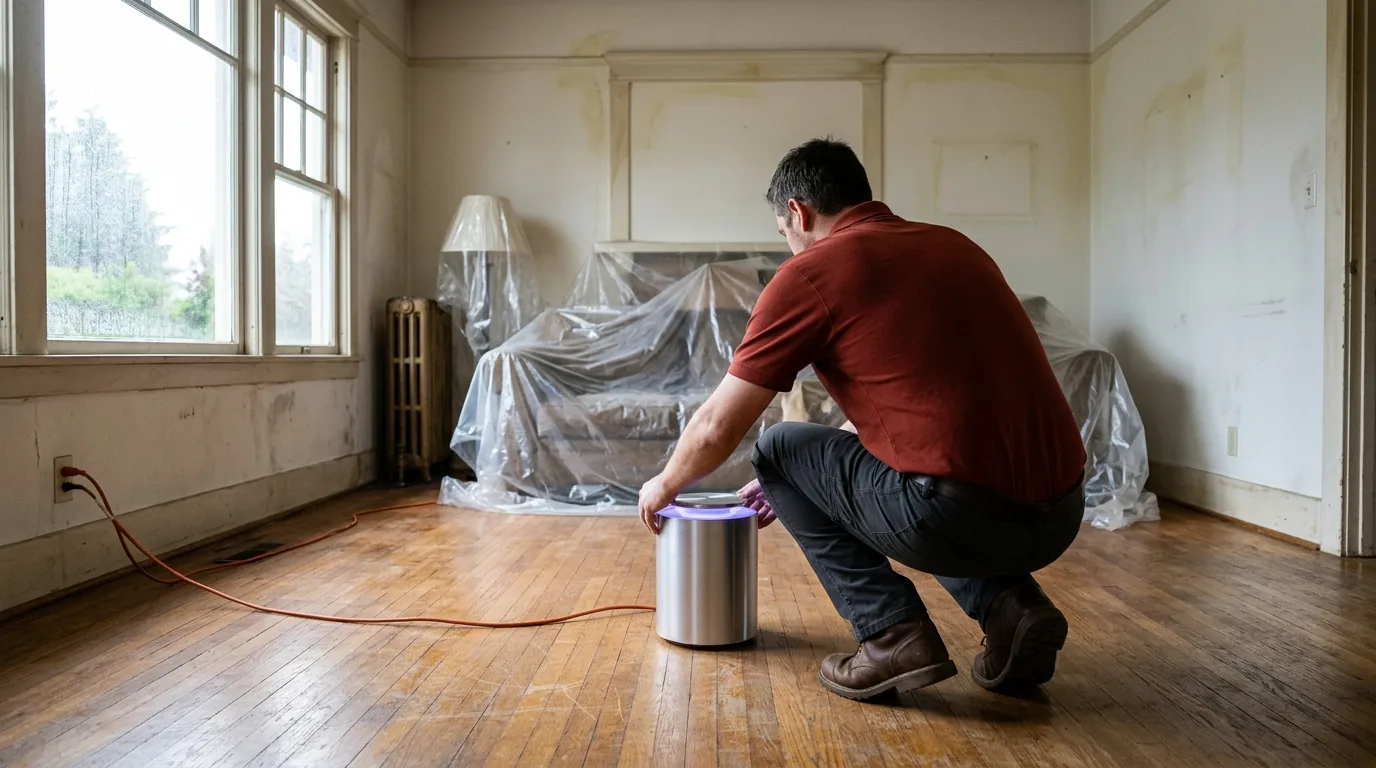
- Hydroxyl generation, UV-light technology that produces hydroxyl radicals to break down odor molecules at a chemical level. Safe to run in occupied spaces and well-suited for extended treatment cycles in larger homes near Chambers Bay Golf Course where square footage is significant.
- Ozone treatment, high-concentration ozone in unoccupied structures for severe smoke or biological contamination. Requires the building to remain vacant during treatment and for a clearance period after; we coordinate that timeline with homeowners and, when applicable, tenants.
- Encapsulant sealers, applied to concrete, subfloor framing, or masonry after treatment to lock in any residual compounds the active deodorization couldn’t fully neutralize.
Most residential jobs in University Place require a combination of two or more methods. A single-tool approach rarely holds in this climate.
Response Time from Federal Way to University Place
National Restoration Construction has operated out of Federal Way since 2004, which puts University Place roughly 15–20 minutes south via I-5 to SR-16 under normal conditions. For calls that come in during peak commute hours, the Bridgeport Way corridor off Gravelly Lake Drive adds a few minutes, but we account for that in dispatch. Most University Place addresses see a technician on-site within 60–90 minutes of the initial call. Day Island requires crossing the Day Island Bridge, which has no traffic signals but a single lane in each direction, we factor that into ETA when the address is on the island.
Local Note
In University Place’s older split-levels, especially those built on the bluff above Chambers Creek, the return-air chase for the forced-air furnace often runs through an uninsulated interior wall cavity that connects directly to the crawl space. When there’s a crawl-space odor event (sewer gas, rodent activity, or moisture-driven mold), the furnace pulls that air directly into the living space every time it cycles. Homeowners notice the smell is worst right when the heat kicks on. Treating only the living-space air and ignoring the chase and crawl space produces a job that fails within weeks. We inspect both before we quote.
If you’re dealing with a smell in University Place that keeps coming back no matter what you spray on it, call National Restoration Construction at (206) 883-0333. We’ll find where it’s actually living in the structure, and get rid of it for good.
Serving University Place from our Federal Way headquarters — ★ 5.0 · 64 Google reviews
“Jose and his team were very helpful and did a great job! Super happy with their work!” — Julia, August 2026Read our reviews on Google →
Odor Removal and Deodorization in University Place: Service Coverage
Frequently Asked Questions
How fast can you arrive for odor removal and deodorization in University Place?
Are homes in the Beckonridge and Sunset Terrace neighborhoods more prone to recurring odor problems after a water loss?
Does the marine climate around Day Island affect how long deodorization takes compared to drier parts of the region?
Will my homeowner's insurance cover professional odor removal in University Place, and does the cause of the odor matter?
What's the difference between ozone treatment and hydroxyl deodorization, and which is used in University Place homes with occupants still present?
How do you handle odor removal in a University Place home where the smell is coming from the crawl space or HVAC system?
Odor Removal and Deodorization response in University Place
Most University Place calls see a technician on-site within 60 minutes from our Federal Way headquarters.
Nearby & Related
- Odor Removal and Deodorization in Federal Way
- Restoration Services in University Place
- 24/7 Emergency Fire Damage Restoration in University Place
- Mold Remediation in University Place
- Odor Removal and Deodorization in Auburn
- Odor Removal and Deodorization in Bellevue
- Contact National Restoration Construction