
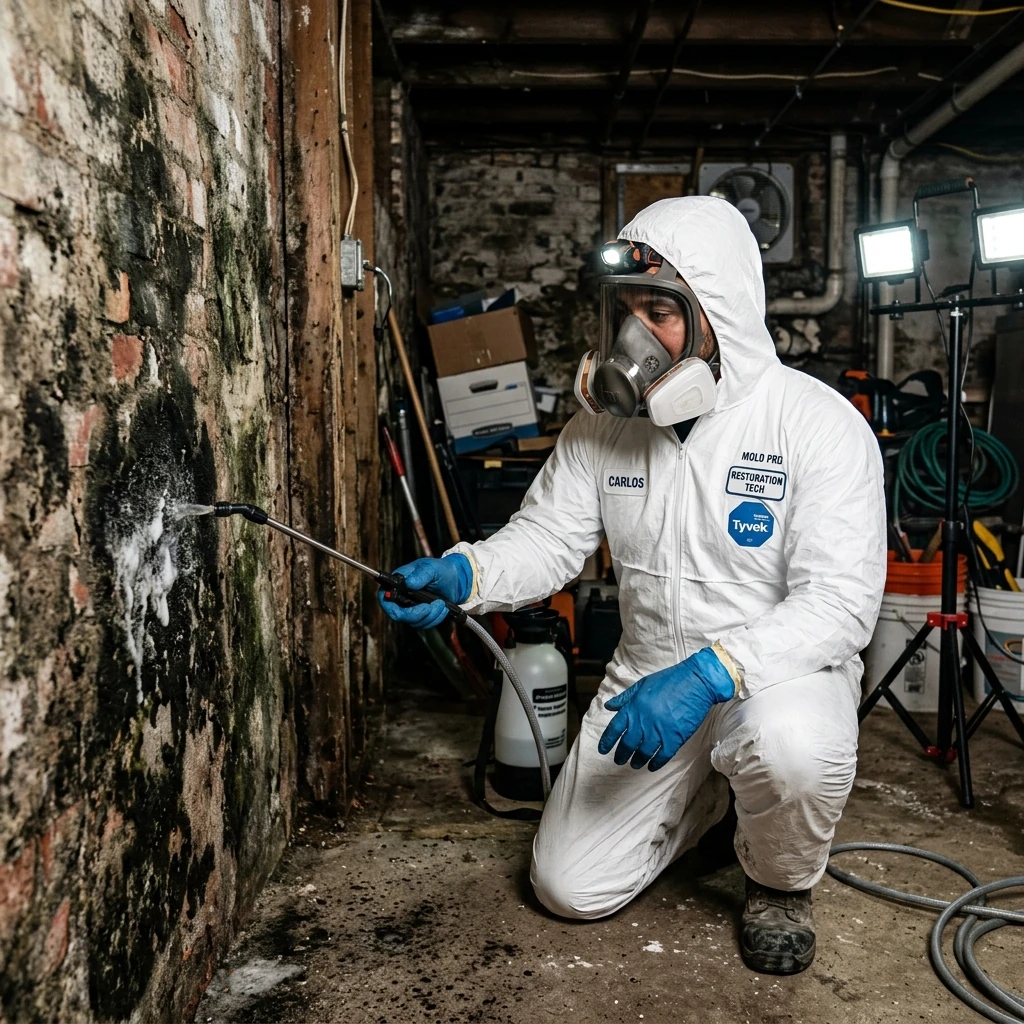
Mold Remediation in University Place
24/7 mold remediation in University Place, WA. IICRC-certified, insurance billing accepted. Call (206) 883-0333.
We work with all insurance carriers and handle the claim paperwork.
Our IICRC-certified technicians are dispatched from our Federal Way, WA headquarters and are typically on-site in University Place within 60 minutes of your call.
The 1960s and 70s ramblers that line the streets of Beckonridge and Sunset Terrace were built when crawl-space vapor barriers were an afterthought, a single layer of 4-mil poly, if anything at all. Decades of West Pierce County rainfall, combined with the slow seepage that comes from aging galvanized supply lines and cast-iron drains, means mold doesn’t announce itself here with a dramatic flood. It colonizes quietly, behind drywall, under subfloor sheathing, inside duct chases, until a musty smell or a discolored baseboard finally sends someone searching for mold remediation in University Place.
Why University Place Properties See Mold Problems
The geography here works against homeowners in a few specific ways. Properties along the bluffs above Chambers Creek sit on slopes that funnel winter rainwater directly toward daylight basements and foundation walls. When that drainage has nowhere to go, it wicks into block foundations and framing lumber over years, not weeks. By the time visible mold appears, the colony is typically well-established behind finished surfaces.
Down on Day Island, the calculus is different. Low-lying waterfront lots face tidal influence and saltwater-laden air that accelerates corrosion on supply fittings and keeps relative humidity elevated year-round. A pinhole leak under a kitchen sink in a Day Island home can feed mold growth for months before the cabinet floor softens enough to notice.
Across the 98466 and 98467 ZIP codes, the dominant housing stock, split-levels and single-story ramblers with minimal attic ventilation and original bath fans that exhaust into the attic cavity rather than outside, creates the same recurring pattern: chronic moisture with no exit path.
Our Mold Remediation Process in University Place
Every job starts with a thorough inspection that goes beyond the visible stain. Technicians use thermal imaging and moisture meters to map hidden saturation in wall cavities and subfloor assemblies, critical in older construction where insulation batts can hold moisture long after the surface feels dry.
Containment comes next. Negative-air pressure chambers with HEPA-filtered exhaust machines isolate the work zone so spores don’t migrate to clean areas of the home during demolition. In University Place’s older ramblers, where open floor plans mean the living room, dining area, and kitchen share continuous air space, this step is non-negotiable.
Affected materials, drywall, insulation, compromised framing, are removed, bagged, and disposed of per Washington State Department of Ecology guidelines. Remaining structural surfaces are treated with EPA-registered antimicrobial agents. Drying equipment runs until moisture readings return to baseline, and a post-remediation clearance protocol confirms the work area is clean before reconstruction begins.
National Restoration Construction holds IICRC certification and is a Lead-Safe Certified Firm, relevant in University Place’s pre-1978 housing stock, where disturbing wall materials during mold removal can uncover lead-based paint that requires its own handling protocol under EPA RRP rules.
Response Time to University Place
From the Federal Way headquarters, University Place is typically 20–30 minutes via I-5 South to WA-16 West, depending on traffic at the Nalley Valley interchange. Most addresses in the 98466 ZIP code, including neighborhoods near Chambers Creek Regional Park and Homestead Park, see a technician on-site within 60 minutes of an emergency call. Day Island addresses, which require crossing the Day Island Bridge, add roughly 10 minutes to that estimate.
For non-emergency inspections, same-day scheduling is usually available. Reach the team directly at (206) 883-0333.
Local Note: What University Place’s Crawl Spaces Actually Look Like
Contractors who work primarily in newer construction sometimes underestimate what they’ll find under a 1960s University Place rambler. Many of these crawl spaces have never had their original vapor barrier replaced, the poly is brittle, torn in sections, and sitting on soil that stays damp from October through April. When a supply line drips for six months above that environment, the subfloor joists and rim board can reach moisture content levels that support active mold growth across a surprisingly wide area. The remediation scope in these homes routinely extends 4–6 feet beyond the visible damage, because the moisture has traveled laterally through the framing before anyone noticed the problem. Scoping the full extent before writing a remediation plan, not after demo begins, is the difference between a job that closes cleanly and one that requires a second mobilization.
If you’re seeing discoloration on baseboards, a persistent earthy smell in a bedroom, or a crawl-space access hatch that’s been nailed shut for years, those are the signals that warrant a professional assessment. National Restoration Construction has been handling these evaluations in the South Sound since 2004. Call (206) 883-0333 to schedule an inspection or to get a remediation crew moving today.
Serving University Place from our Federal Way headquarters — ★ 5.0 · 64 Google reviews
“Jose and his team were very helpful and did a great job! Super happy with their work!” — Julia, August 2026Read our reviews on Google →
Mold Remediation in University Place: Service Coverage
Frequently Asked Questions
How fast can you arrive for mold remediation in University Place?
Are homes near Chambers Creek more prone to mold than other parts of University Place?
How does University Place's older housing stock affect the scope of a mold remediation job?
Does the presence of lead paint in pre-1978 University Place homes complicate mold remediation?
What does the mold remediation process look like inside a Day Island waterfront home?
How long does a full mold remediation take in a typical University Place rambler?
Will my homeowners insurance cover mold remediation in University Place?
Mold Remediation response in University Place
Most University Place calls see a technician on-site within 60 minutes from our Federal Way headquarters.