
Mold Inspection and Testing in University Place
24/7 mold inspection and testing in University Place, WA. IICRC-certified, insurance billing accepted. Call (206) 883-0333.
We work with all insurance carriers and handle the claim paperwork.
Our IICRC-certified technicians are dispatched from our Federal Way, WA headquarters and are typically on-site in University Place within 60 minutes of your call.
The 1960s and ’70s ramblers that line the streets of Beckonridge and Sunset Terrace weren’t built with crawl-space vapor barriers that meet today’s standards, and decades of Puget Sound moisture have a way of exploiting that gap quietly. By the time a musty smell reaches the living room or a home inspector flags something during a sale, mold colonies may have been growing undisturbed for months beneath the subfloor. A professional mold inspection and testing visit from National Restoration Construction gives you a documented picture of what’s actually happening inside those walls and under that slab, not guesswork.
Why University Place Properties See Elevated Mold Risk
University Place sits in a geographic pocket that concentrates moisture from multiple directions. Winter storms push off Puget Sound and stall against the bluffs above Chambers Creek, delivering weeks of sustained rain rather than the brief downpours that drain quickly. Bluff-top homes in the Narrows View corridor frequently deal with slope drainage that finds its way into daylight basements, water that doesn’t announce itself with a flood but seeps in slowly, keeping framing and insulation at the chronic dampness level mold needs to colonize. According to industry data, mold can begin establishing within 24 to 48 hours on wet cellulose materials like drywall paper and wood framing.
Down at the water’s edge, Day Island waterfront properties face a different set of conditions: tidal influence, saltwater-laden air, and ground-level crawl spaces that sit close to the water table. Salt doesn’t kill mold, it actually helps retain moisture in building materials, which can accelerate surface growth on rim joists and sill plates. Inland, the aging cast-iron drain lines and original galvanized supply pipes common throughout 98466 and 98467 are prone to pinhole leaks and slow seeps behind walls that go undetected for years. That’s the classic mold-loss pattern here: not a dramatic pipe burst, but a slow drip behind a cabinet that’s been feeding a colony since the Clinton administration.
Our Mold Inspection and Testing Process in University Place
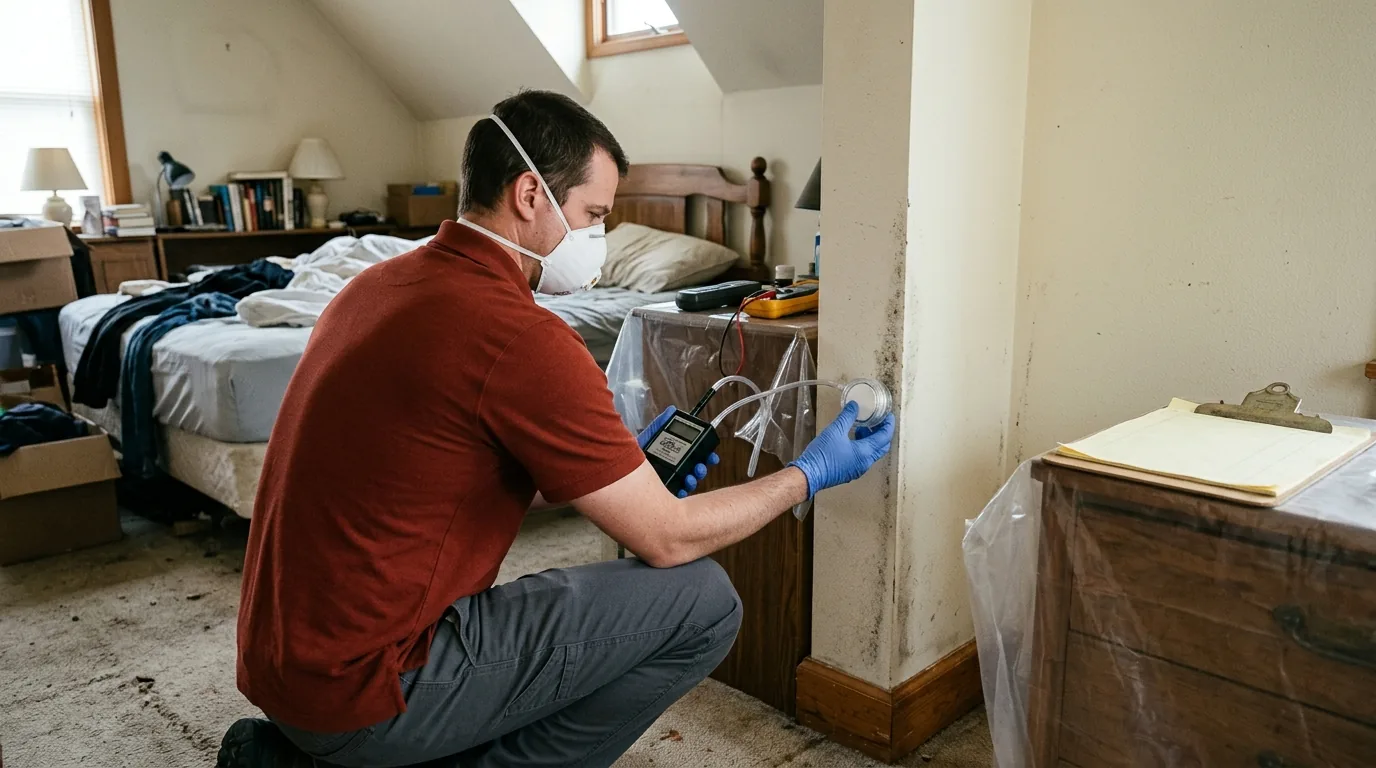
Every inspection starts with a visual walkthrough calibrated to the building type in front of us. In a split-level rambler, that means checking the lower-level utility room, the crawl-space access hatch, and the band joist area, spots where moisture migrates downward and pools. We use thermal imaging cameras to identify temperature differentials that suggest hidden moisture behind finished surfaces, and a calibrated moisture meter to quantify what the camera flags.
When visual and instrument findings suggest active mold growth or elevated spore counts, we collect air samples and surface swab or tape-lift samples, depending on what the assessment calls for. Air samples are analyzed by an accredited third-party laboratory, typically returning results within 24 to 48 hours. The lab report identifies mold genera and compares indoor spore counts to outdoor baseline samples, a critical comparison that distinguishes a normal Pacific Northwest outdoor spore load from an indoor amplification problem. You receive a written report that documents findings, sampling locations, and recommended next steps. As an IICRC Certified firm licensed through WA State Labor & Industries (NATIORC792M6), our documentation is formatted to meet insurance adjuster and real estate transaction requirements.
What the Inspection Covers That a Basic Home Inspection Doesn’t
A standard home inspection is a generalist exercise, the inspector is looking at dozens of systems in a few hours. A dedicated mold assessment goes deeper in specific areas. We spend time in the crawl space with proper PPE, probing vapor barriers (or the absence of them), checking for standing water, and assessing the condition of wood members at the foundation. We pull out the dryer and dishwasher to look behind appliances. We check bathroom exhaust fans to confirm they actually vent to the exterior, a surprisingly common deficiency in older University Place homes that creates chronic humidity in the ceiling cavity above showers.
For properties near Chambers Creek Regional Park where seasonal groundwater levels rise in winter, we pay particular attention to slab-on-grade areas and any below-grade storage rooms. Indoor air quality testing, measuring total volatile organic compounds alongside spore counts, can also reveal whether mold metabolites are affecting air quality even before visible growth is found.
Local Note: Crawl-Space Vapor Barriers in University Place Ramblers
Here’s something that comes up repeatedly in this part of West Pierce County: many ramblers built between 1962 and 1978 have partial vapor barriers, either the original 4-mil poly that’s now torn and displaced, or no barrier at all in sections of the crawl space that were added during a later remodel. When we pull back the access hatch and see bare soil exposed to the subfloor framing, we know mold testing in that crawl space is going to tell a story. Homes on the Fircrest border and throughout the Chambers Bay Golf Course corridor are particularly likely to have this configuration because they were built before Pierce County adopted more stringent crawl-space moisture requirements. We note these conditions in the inspection report because they’re directly relevant to remediation scope and to any future insurance or real estate disclosure.
If you’re seeing discoloration on baseboards, smelling something earthy in a room that should be dry, or preparing to list a home and want documentation before a buyer’s inspector finds something first, call National Restoration Construction at (206) 883-0333. We’ve been doing this work since 2004, and we know what University Place homes tend to hide.
Serving University Place from our Federal Way headquarters — ★ 5.0 · 64 Google reviews
“Jose and his team were very helpful and did a great job! Super happy with their work!” — Julia, August 2026Read our reviews on Google →
Mold Inspection and Testing in University Place: Service Coverage
Frequently Asked Questions
How fast can you arrive for mold inspection and testing in University Place?
Are Day Island waterfront homes more prone to mold than other University Place properties?
How quickly can National Restoration Construction reach a home in the 98466 ZIP code for a mold inspection?
What does a mold inspection report include, and will it satisfy a real estate disclosure requirement in Washington State?
How does mold testing differ for the older split-level and rambler homes common in Beckonridge and Sunset Terrace?
What's the difference between air sampling and surface sampling, and which does my University Place home need?
Will my homeowners insurance cover mold inspection and testing in University Place?
Mold Inspection and Testing response in University Place
Most University Place calls see a technician on-site within 60 minutes from our Federal Way headquarters.