
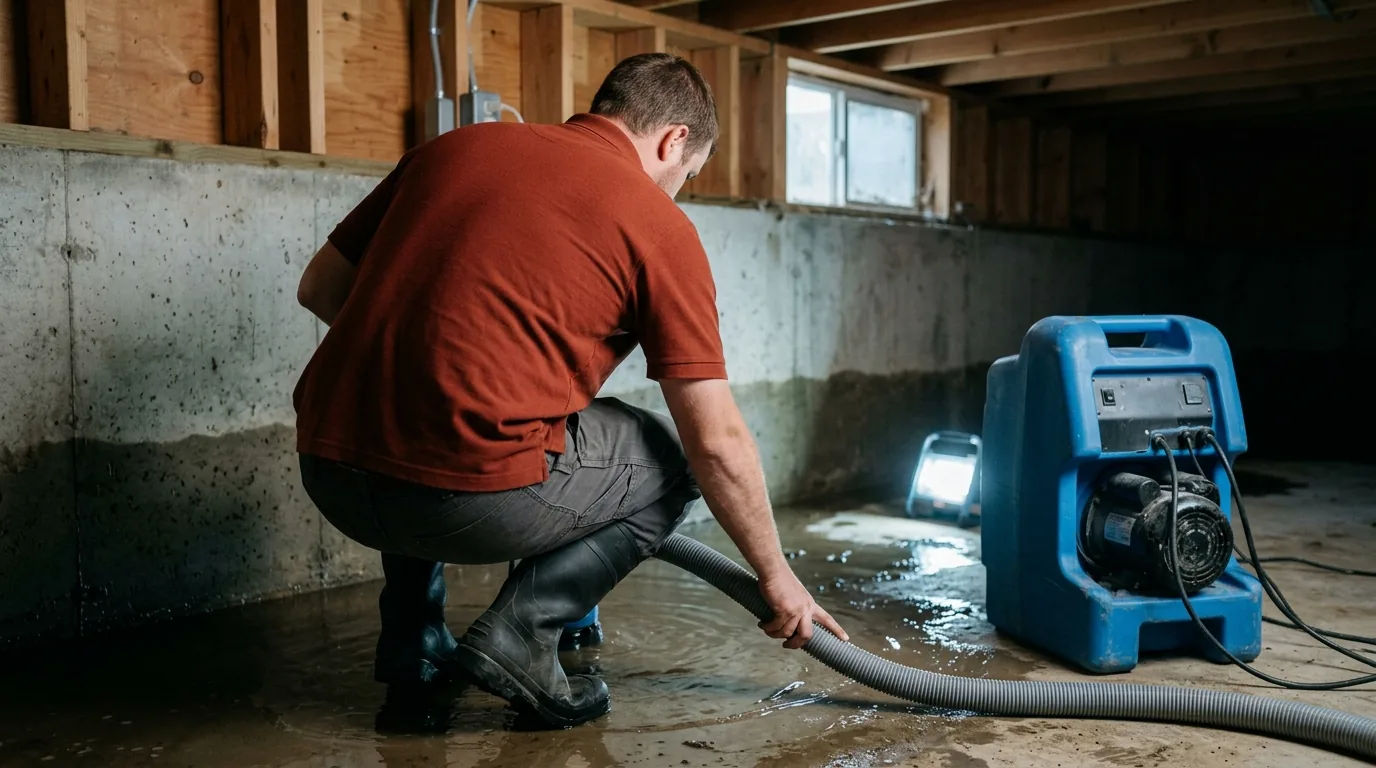
24/7 Emergency Basement Flooding Cleanup in University Place
24/7 emergency basement flooding cleanup in University Place, WA. IICRC-certified, insurance billing accepted. Call (206) 883-0333.
We work with all insurance carriers and handle the claim paperwork.
Our IICRC-certified technicians are dispatched from our Federal Way, WA headquarters and are typically on-site in University Place within 60 minutes of your call.
Flooded basement in University Place? We answer 24/7. Call now and our crew heads out to pump out the water and start drying.
Winter rain doesn’t just fall on University Place, it moves. Slope drainage off the bluffs above Chambers Creek pushes groundwater laterally into daylight basements, and the 1960s and ’70s split-levels that dominate neighborhoods like Beckonridge and Narrows View were built before modern waterproofing standards existed. When that water finds its way inside, you’re not dealing with a simple mop-up job. You’re dealing with aging cast-iron drains that may already be running slow, original supply lines that corrode quietly for years before failing catastrophically, and concrete block walls that wick moisture long after the visible puddle is gone. National Restoration Construction responds to flooded basements across University Place, call (206) 883-0333 any hour.
Why University Place Basements Flood the Way They Do
The geology and housing stock here create a specific combination that shows up in our loss reports again and again. West Pierce County sits on glacially compacted soils with limited natural drainage, and the terrain between the Narrows bluffs and the lower waterfront areas amplifies the problem. During a heavy Pacific Northwest rain event, the kind that drops two inches in 36 hours, that hillside moisture has to go somewhere, and it often finds the path of least resistance through foundation walls and floor-wall joints.
The ramblers and split-levels built throughout University Place in the 1960s and ’70s compound the issue. Many have original galvanized or cast-iron supply and drain lines that are well past their service life. A slow pinhole leak behind a finished basement wall can saturate framing and insulation for weeks before the homeowner notices a smell or a soft spot in the drywall. On Day Island, the calculus is different: low-lying waterfront lots face tidal surge exposure and saltwater intrusion that corrodes concrete and degrades vapor barriers faster than inland properties. Saltwater-affected materials require different handling than freshwater losses, and the drying timeline is longer.
Appliance failures, water heaters, washing machines, sump pumps that lose power during a storm, are the other classic loss in this ZIP code. In 98466 and 98467, we see a disproportionate share of sump pump failures during the November-through-February wet season, often because the original sump pits were undersized for the drainage volume those bluff-side lots actually generate.
Our Basement Flooding Cleanup Process in University Place
When we arrive, the first priority is category and class assessment, not every flooded basement is the same water. A supply-line break is clean water (Category 1). A backed-up floor drain carrying sewage is Category 3, and it changes everything about how materials are handled and what can be dried versus what has to come out. We document the source, the affected area, and the moisture readings before a single piece of equipment is placed, because that documentation is what your insurance adjuster needs.
Extraction comes next. For the volume of water a daylight basement can accumulate during a slope-drainage event, we use truck-mounted extraction combined with portable units for tight corners and under-stair cavities. Once standing water is removed, we map the moisture migration using thermal imaging and pin-type meters, water in a 1970s split-level doesn’t stay where it lands. It travels into wall cavities, under tile set in old mortar beds, and into the subfloor above.
Drying is calibrated to the structure. Older concrete block and poured-concrete walls hold moisture differently than modern poured walls, and we adjust desiccant and refrigerant dehumidifier placement accordingly. We monitor daily and adjust the drying plan, a fixed “three-day” timeline doesn’t account for the actual conditions inside a 50-year-old basement in a wet Pacific Northwest winter.
Response Time to University Place
National Restoration Construction is based in Federal Way, which puts us roughly 10–15 minutes from most of University Place via I-5 South to SR-16 West, or through Tacoma on surface streets when the freeway is moving poorly. Neighborhoods like Chambers Creek and Sunset Terrace are typically reachable in under 20 minutes during off-peak hours. Day Island access requires crossing the Day Island Bridge, which adds a few minutes but doesn’t materially affect response, we’ve run that route enough times to know the timing.
For genuine emergencies, we target on-site arrival within 60 minutes of your call anywhere in our University Place service area. We’re IICRC Certified and carry the equipment to begin extraction immediately, we don’t arrive to assess and then leave to get gear.
Local Note
One thing that surprises homeowners in the Chambers Creek and bluff-adjacent areas: the slope drainage that floods their basement in January is often still moving in March, even after weeks of dry weather. Groundwater in the glacial till above the creek takes time to dissipate, and a basement that dries out in week one can show elevated moisture readings again in week three if the exterior drainage issue isn’t addressed. We flag this during the job and document it for insurance, because a second moisture event during the drying window can restart the clock on mold colonization, which begins in as little as 24–48 hours on wet organic material.
If your basement has flooded and you’re in University Place, don’t wait to see if it dries on its own. The longer water sits against original framing and insulation in these older homes, the more expensive the remediation becomes. Call National Restoration Construction at (206) 883-0333, we’ll have a crew to your door, assess the damage honestly, and start work the same day.
Serving University Place from our Federal Way headquarters — ★ 5.0 · 64 Google reviews
“Jose and his team were very helpful and did a great job! Super happy with their work!” — Julia, August 2026Read our reviews on Google →
Basement Flooding Cleanup in University Place: Service Coverage
Frequently Asked Questions
How fast can you arrive for basement flooding cleanup in University Place?
Are homes near Chambers Creek more vulnerable to basement flooding than other parts of University Place?
Does saltwater exposure on Day Island change how basement flooding cleanup is handled?
How does the age of University Place's housing stock affect the drying process?
How quickly can you reach a flooded basement in the 98466 or 98467 ZIP codes?
What's the risk if I wait a day or two before calling for basement water removal?
Will my homeowners insurance cover basement flooding cleanup in University Place?
Basement Flooding Cleanup response in University Place
Most University Place calls see a technician on-site within 60 minutes from our Federal Way headquarters.
Nearby & Related
- 24/7 Emergency Basement Flooding Cleanup in Federal Way
- Restoration Services in University Place
- 24/7 Emergency Fire Damage Restoration in University Place
- Mold Remediation in University Place
- 24/7 Emergency Basement Flooding Cleanup in Auburn
- 24/7 Emergency Basement Flooding Cleanup in Bellevue
- Contact National Restoration Construction