
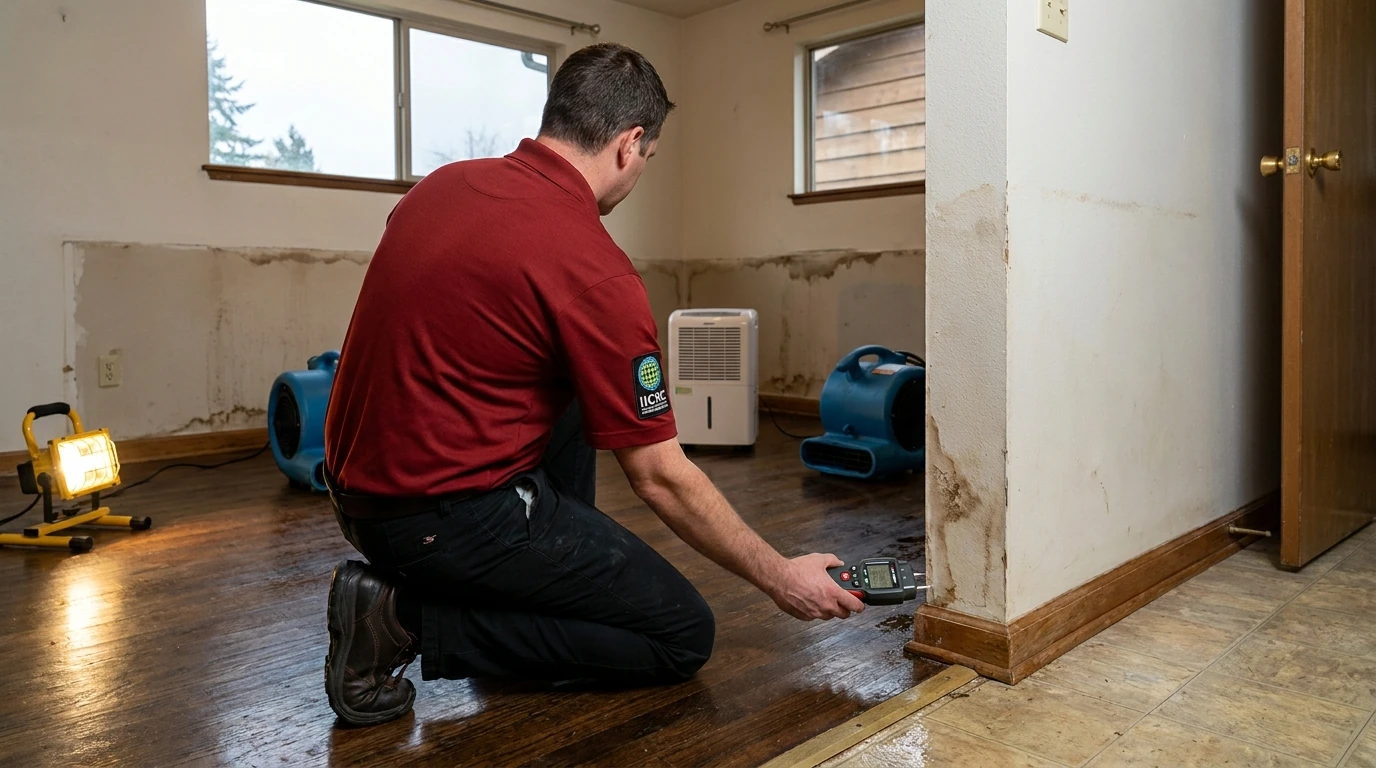
TL;DR: Water damage restoration in Washington State typically costs $1,500 to $15,000, with most residential losses falling between $3,000 and $8,000. The biggest cost drivers are the water category (clean, gray, or sewage), how much square footage is affected, and how long the water sat before extraction began. Every loss is different, and National Restoration Construction provides a written scope before any work begins.
If you just discovered water in your home and you’re trying to figure out what this is going to cost before you call your insurance company, you’re in the right place. Washington’s wet climate means restoration contractors here handle everything from slow roof-leak saturation in older ramblers to full basement floods after a Puget Sound rain event. The range is wide, but the factors that move the number are predictable.
How Much Does Water Damage Restoration Cost in Washington?
In Washington State, water damage restoration typically costs $1,500 to $15,000 for residential properties, with the average homeowner paying between $3,000 and $8,000 for a mid-size loss. Large-loss events, a failed water heater that saturated a finished basement, or a burst pipe that ran overnight, can push costs to $20,000 or more once structural drying and reconstruction are included.
The table below reflects typical Washington market ranges based on loss scenario. These are industry-typical figures, not quotes.
| Scenario | Typical Cost Range |
|---|---|
| Single room, clean water (Cat 1), caught within 24 hours | $1,200 – $3,500 |
| Multi-room, clean or gray water (Cat 1–2), 1,000–2,000 sq ft affected | $3,500 – $8,000 |
| Finished basement flood, gray water (Cat 2), drywall and flooring affected | $5,000 – $12,000 |
| Sewage backup or Category 3 water, any room | $7,000 – $20,000+ |
| Whole-house loss, pipe burst or major appliance failure | $12,000 – $35,000+ |
| Crawl space water intrusion with mold present | $3,000 – $10,000 |
These ranges assume extraction, structural drying, and basic remediation. Reconstruction, replacing drywall, flooring, cabinetry, is billed separately and can add $5,000 to $30,000 depending on finishes.
What Factors Drive the Cost Up or Down?
Four factors account for the majority of cost variation in Washington water damage jobs.
Water category. The IICRC S500 standard classifies water losses into three categories. Category 1 is clean water from a supply line or appliance, least expensive to remediate. Category 2 (gray water) comes from dishwashers, washing machines, or toilet overflow without solids, requires antimicrobial treatment and more aggressive drying protocols. Category 3 (black water) includes sewage, floodwater, or any water that has been standing long enough to become grossly contaminated, requires full biohazard-level remediation, protective equipment, and disposal of porous materials. A Cat 3 loss costs roughly two to three times more than a Cat 1 loss of the same square footage.
Class of loss (how wet is the structure). The IICRC also defines four drying classes based on how much moisture the building materials have absorbed. A Class 1 loss (minimal absorption, hard surfaces only) dries fast and costs less. A Class 4 loss means moisture has penetrated deeply into hardwood, concrete, or plaster, specialty drying equipment, longer dry times, and higher equipment rental costs.
Square footage and materials affected. Carpet and pad are relatively inexpensive to extract and dispose of. Hardwood flooring, tile with mortar beds, and multi-layer subfloor assemblies take longer to dry and sometimes can’t be saved. Wet insulation in walls or a crawl space must be removed and replaced. Finished basements with drywall, trim, and flooring cost significantly more to restore than unfinished utility spaces.
Time elapsed before extraction. Water sitting for more than 24 to 48 hours begins to degrade building materials and creates conditions for mold growth. The EPA notes that mold can begin colonizing wet materials within 24 to 48 hours. Every additional day of saturation increases the scope of work, and the cost. This is the single most controllable cost variable: faster response means less damage.
Washington-specific factors. Older housing stock across the region, 1970s ramblers in South King County, early-1900s craftsmen in Seattle and Tacoma, crawl-space homes near the water in Gig Harbor and Bremerton, often has original galvanized plumbing, minimal vapor barriers, and uninsulated crawl spaces that complicate drying. Tacoma has a municipal HEPA filtration ordinance for restoration work that produces airborne particulate, which affects equipment requirements on commercial jobs.
Will Homeowners Insurance Cover Water Damage Restoration in WA?
Most standard homeowners policies in Washington cover sudden, accidental water damage but exclude gradual leaks and flooding. A burst pipe that fails overnight is typically covered. A slow supply-line leak that went unnoticed for six months is typically denied as a maintenance issue.
Here’s how coverage generally breaks down:
- Covered (usually): Burst pipes, appliance failures (washing machine hose, water heater), sudden roof leaks from storm damage, accidental overflow
- Not covered (usually): Gradual leaks, sewer backup (without a specific endorsement), ground-level flooding from rain or rivers (requires separate NFIP or private flood policy), foundation seepage
- Sewer backup: Requires a separate endorsement, typically $5 to $15 per month, that many Washington homeowners don’t carry until after a sewage event
For a deeper look at what policies actually pay out, see our post on average insurance payouts for water damage.
Documentation is what protects your claim. A restoration company that provides a written scope of work, moisture readings logged at each visit, and photo documentation of the damage before, during, and after drying gives your adjuster what they need to approve the full claim. Incomplete documentation is the most common reason claims are partially denied.
If you’re unsure whether your loss is covered, read your policy’s “water damage” exclusions carefully, specifically the language around “seepage,” “overflow,” and “flood.” For more on policy coverage specifics, our post on what homeowners insurance covers and doesn’t cover walks through the common exclusions.
What Does the Water Damage Restoration Process Actually Involve?
Understanding the process helps you evaluate any estimate you receive. A legitimate restoration scope follows this sequence:
-
Emergency response and assessment. A technician arrives, identifies the water source, and stops active water intrusion if it hasn’t been stopped already. Moisture meters and thermal imaging map the extent of saturation in walls, floors, and ceilings.
-
Water extraction. Truck-mounted or portable extractors remove standing water. This is the fastest phase, extraction of a flooded basement can take two to four hours.
-
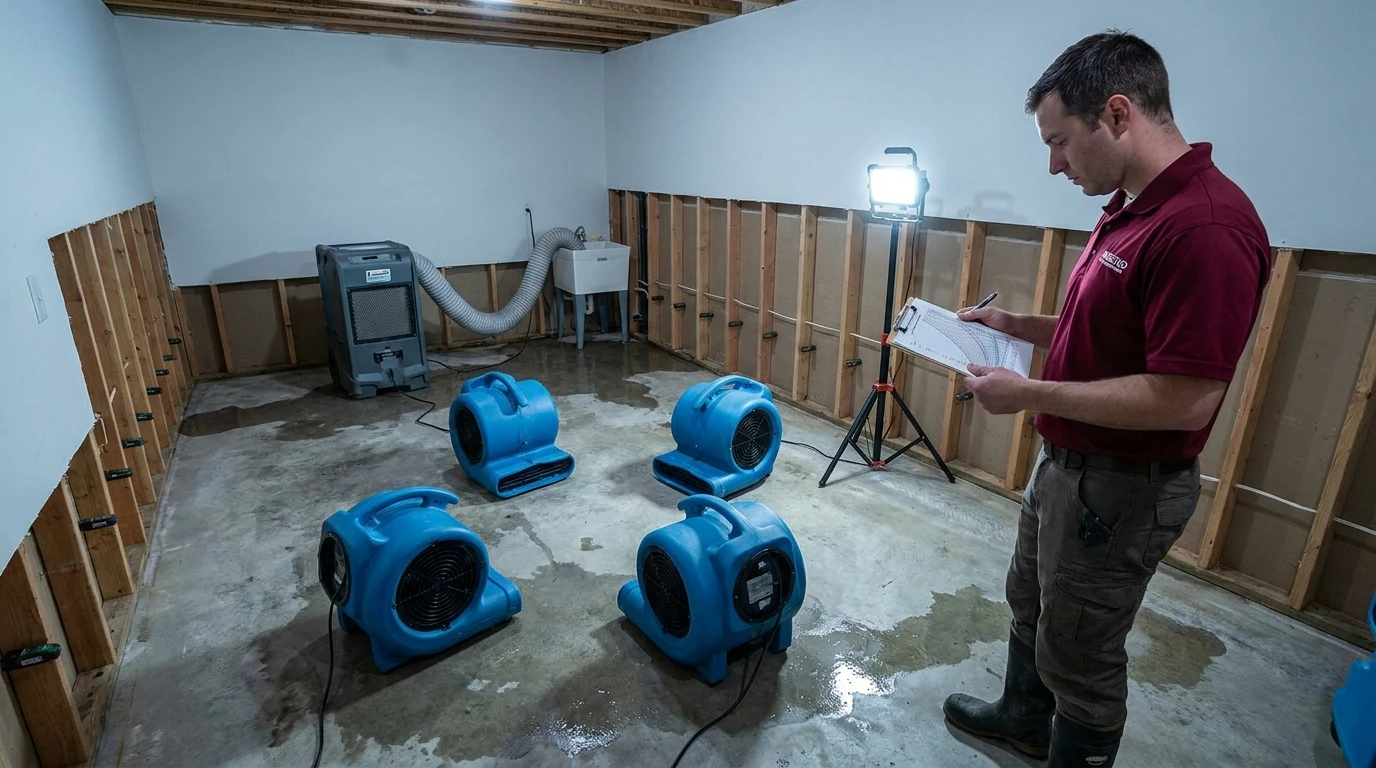
Structural drying setup. High-velocity air movers and low-grain refrigerant (LGR) dehumidifiers are placed according to a drying plan. The number of machines is calculated based on the cubic footage of the affected area and the class of loss, not guessed at.
-
Daily moisture monitoring. Technicians return each day to log moisture readings and adjust equipment placement. Drying typically takes three to five days for a Class 1 or 2 loss; seven to ten days or more for Class 3 or 4.
-
Material removal (when necessary). Wet drywall below the flood cut line, saturated insulation, and non-salvageable flooring are removed. Antimicrobial treatment is applied to framing and subfloor.
-
Final clearance. Moisture readings must reach established dry standards (per IICRC S500) before equipment is removed and the space is cleared for reconstruction.
-
Reconstruction. Replacing drywall, flooring, trim, and cabinetry is a separate phase, often handled by the same contractor under a general contracting scope, which simplifies the insurance claim.
For a detailed timeline breakdown, see how long water damage restoration actually takes.
What Should You Do Right Now to Protect Your Costs?
If you’re dealing with active water damage, the steps you take in the first few hours directly affect the final bill. Stop the water source first, shut off the supply valve or the main. Then call a restoration company before calling your insurance company. The restoration company can document the loss properly and communicate with your adjuster; calling insurance first sometimes results in an adjuster visit before extraction begins, which delays drying and increases damage.
Remove standing water from hard floors if you can do so safely, towels, a wet-dry vac, a mop. Move furniture and rugs out of the wet area. Open windows if the outdoor humidity is lower than indoor (in Washington’s summer months, outdoor air is often drier than a wet interior). Do not run a residential dehumidifier in place of commercial drying equipment, household units lack the capacity to dry structural materials.
For a complete step-by-step guide, see what to do in the first 24 hours after water damage.
National Restoration Construction has been handling water damage losses across Washington since 2004 (license NATIORC792M6). Their crews are IICRC Certified, EPA Certified, and Lead-Safe Certified, relevant when older housing stock is involved. Call (206) 883-0333 for a written scope and assessment.
About National Restoration Construction
National Restoration Construction is an IICRC Certified, EPA Certified, and BBB Accredited restoration company serving Washington State since 2004 (WA license NATIORC792M6, issued by the WA State Department of Labor & Industries). Operating 24/7, their crews handle water damage, mold remediation, fire and smoke damage, sewage cleanup, and full reconstruction across the greater Puget Sound region. Every project begins with a written scope of work before any work starts.