
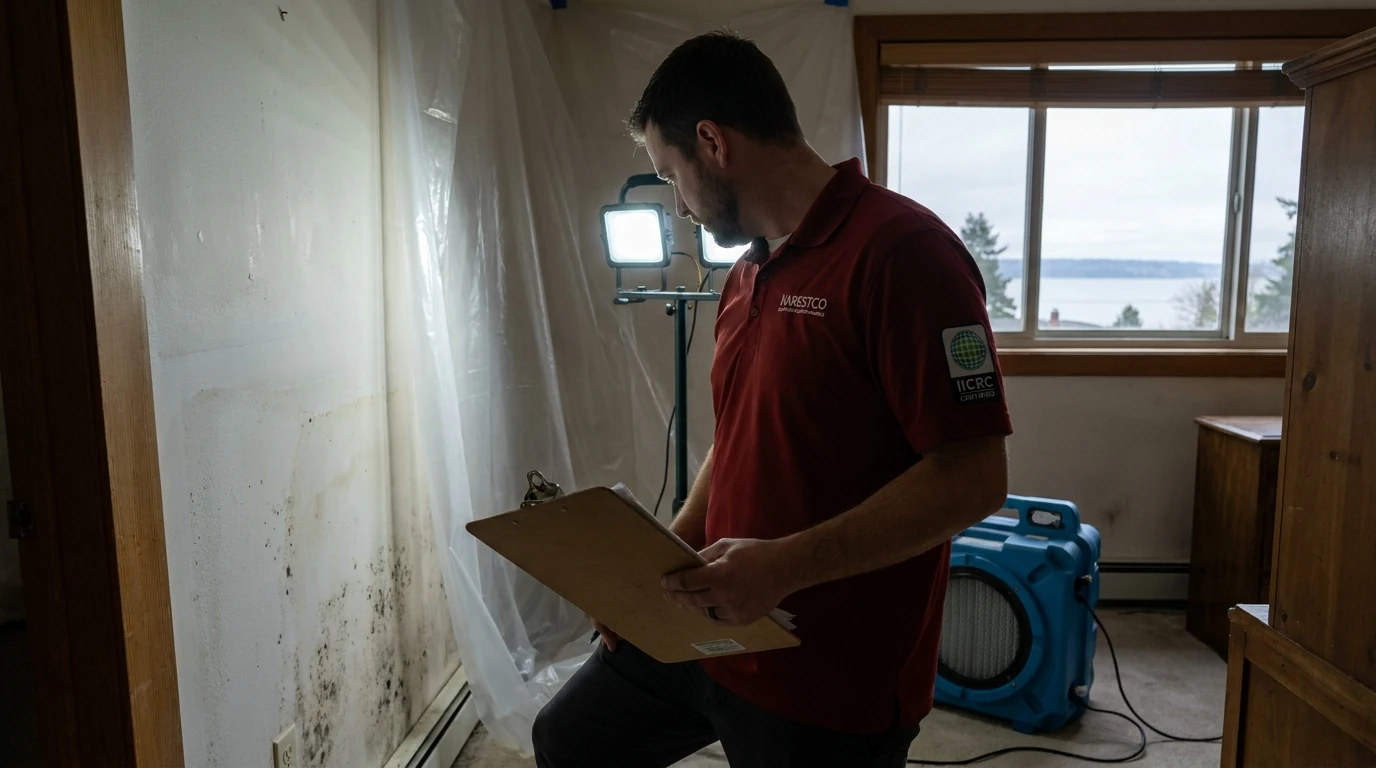
TL;DR: Homeowners insurance typically covers mold remediation when the mold grew directly from a sudden, accidental water event that is itself covered, like a burst pipe or an appliance failure. It almost never covers mold from a slow leak, chronic condensation, or flooding. In Everett’s wet Snohomish County climate, the line between “sudden” and “gradual” is the single most important factor in whether your claim gets paid.
If you just discovered mold in your Bayside bungalow or a Silver Lake subdivision home and you’re wondering whether to call your insurer before you call a remediation crew, this guide will tell you exactly what most policies cover, what they exclude, and what documentation protects your claim. The answer depends heavily on how the moisture got there, and how fast you acted after it did.
Is mold covered by homeowners insurance?
Mold is covered by most standard homeowners policies only when it is a direct result of a covered peril, meaning a water event the policy already pays for. If a pipe burst in your wall and mold appeared within days, that mold is typically covered as part of the water damage claim. If a slow drip under a bathroom sink fed mold growth over six months, most policies will deny the mold claim entirely, citing the gradual-damage exclusion.
The Insurance Information Institute describes mold as a coverage gray area: it may be included, excluded, or subject to a separate sublimit depending on your specific policy language. Read your declarations page and look for the word “fungi”, that is the term most policies use when defining mold coverage and exclusions.
A few things that are almost always excluded regardless of policy:
- Mold caused by flood water (requires a separate NFIP or private flood policy)
- Mold from ongoing humidity or poor ventilation
- Mold the insurer argues you “knew or should have known” about and failed to address
- Pre-existing mold discovered during a renovation or sale inspection
What is the difference between sudden and gradual mold damage?
Sudden damage is a covered water event that happens all at once: a washing machine supply line fails, a pipe freezes and bursts, a roof is punctured by a falling tree branch. Gradual damage is moisture that accumulates slowly over weeks or months, a pinhole leak inside a wall, a failing caulk joint around a shower, condensation on an uninsulated crawlspace rim joist.
Insurers draw this line because sudden damage is accidental and unforeseeable. Gradual damage, in the insurer’s view, is a maintenance failure, something the homeowner could have caught and fixed. In Everett, where Snohomish County averages over 35 inches of rain per year and older Bayside homes often have aging plumbing and minimal vapor barriers, gradual moisture intrusion is extremely common. That does not make it covered.
The practical test adjusters apply: could a reasonable homeowner have discovered this moisture source before mold appeared? If the leak was hidden inside a wall cavity, you have a stronger argument. If it was under a sink you open regularly, the adjuster may argue you should have caught it.
For a deeper look at how insurers evaluate water damage claims generally, see our post on what most homeowners insurance policies actually pay for water damage.
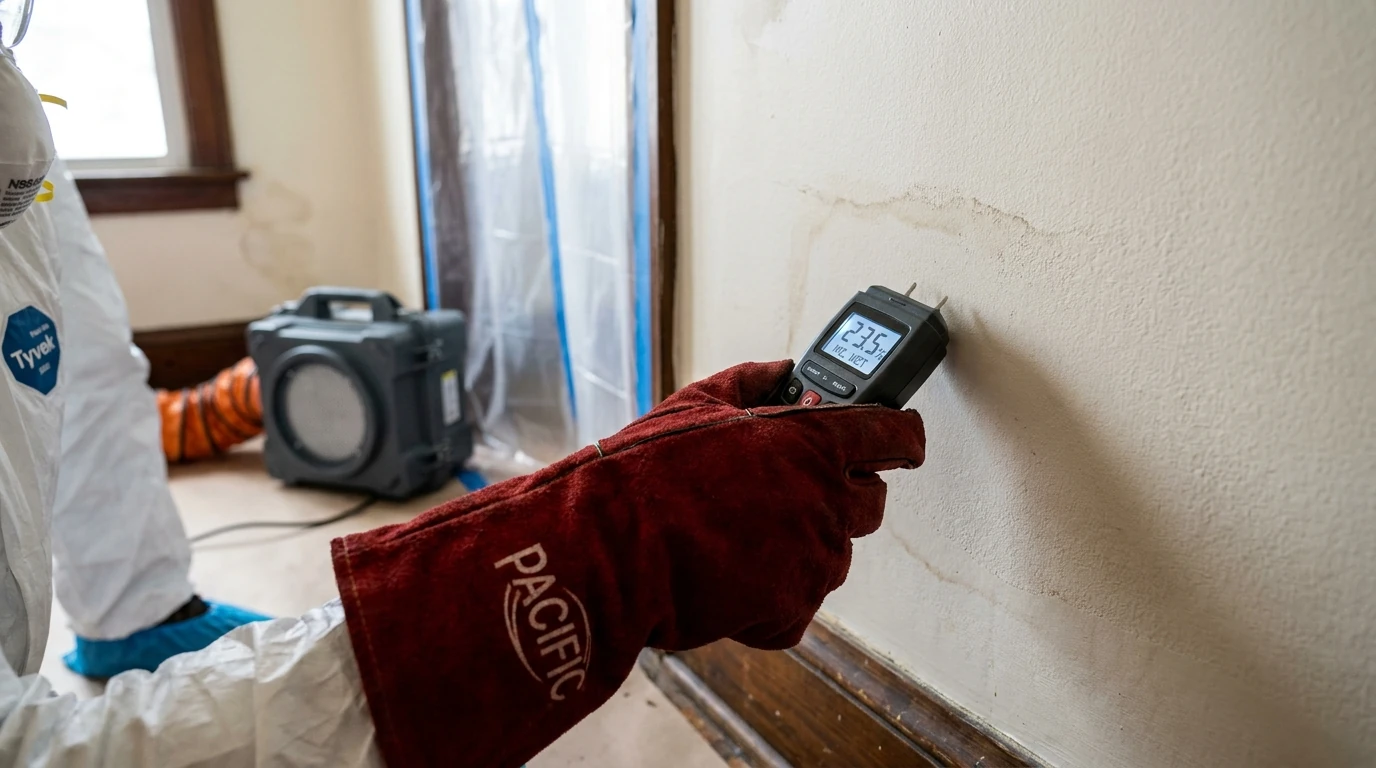
How do you document mold damage for an insurance claim?
Documentation is the difference between a paid claim and a denied one. Start before anything is disturbed.
Step 1: Photograph and video everything. Capture the mold growth, the moisture source, and the path between them. Show the failed pipe, the damaged roof section, or the appliance that leaked. Date-stamp your photos if your phone allows it.
Step 2: Do not remove mold before the adjuster visits. Cleaning up before documentation gives the insurer grounds to dispute the extent of damage. The exception: if the mold is actively spreading or poses an immediate health risk, contain the area with plastic sheeting and document that containment.
Step 3: Get a written scope from a certified remediation company before work begins. A written scope itemizes what will be removed, what equipment will be used, and why. This is the document your adjuster will use to approve or dispute the claim. An IICRC-certified contractor will produce this as a matter of course, it is part of the IICRC S520 Standard for Professional Mold Remediation.
Step 4: Request a mold inspection with air sampling. An independent mold inspection creates a baseline spore count and identifies the species present. This matters if the insurer later disputes whether remediation was necessary or complete. If you are in Everett near the Snohomish River corridor or in an older Riverside-area home, a professional inspection is especially worth the cost given the regional moisture exposure.
Step 5: Keep all receipts and correspondence. Hotel stays, temporary storage, and additional living expenses may be covered under your policy’s ALE (additional living expense) provision if the mold makes your home uninhabitable.
For a related walkthrough on insurance documentation for water events, see our average insurance payout for water damage post, which covers how adjusters calculate actual cash value versus replacement cost.
What mold exclusions should Everett homeowners watch for?
Several exclusions show up repeatedly in denied mold claims in Washington State.
The fungi sublimit. Many policies that technically cover mold cap that coverage at $5,000 to $10,000, far less than a full remediation in a larger home. Everett remediation costs for a moderate mold event (one to three affected rooms) typically run $3,000 to $15,000 depending on the material affected and the extent of containment needed. Check your sublimit before you assume you are fully covered.
The flood exclusion. Standard homeowners policies exclude all flood-related damage, including mold that grows after a flood. If your Lowell-area home flooded during a Snohomish River high-water event, your homeowners policy will not cover the resulting mold. You need a separate flood policy through the National Flood Insurance Program (NFIP) or a private carrier.
The neglect exclusion. If an adjuster can show that mold was visible or detectable before the covered event, they may deny the entire mold portion of the claim on the grounds that it predated the loss. This is why a pre-loss mold inspection, or at minimum a recent photo record of the affected area, can protect you.
The pollution exclusion. Some older policies classify mold as a “pollutant” and exclude it entirely under a pollution exclusion clause. This is less common in modern Washington State policies but worth checking if your policy was written before 2010.
What should you do next if you find mold in your Everett home?
Act within 24 to 48 hours of discovery. Mold can double its colony size in 24 hours under the right moisture conditions, and delay gives your insurer grounds to argue the damage worsened due to your inaction.
- Identify and stop the moisture source first. No remediation is permanent if the water intrusion continues. If the source is an active pipe failure, call a plumber before you call anyone else.
- Call your insurer to open a claim, but do not authorize any work until you have a written scope from a certified contractor. Verbal authorizations over the phone can create scope disputes later.
- Schedule a professional mold inspection to document the extent of growth before remediation begins. This protects you if the insurer disputes the scope.
- Engage an IICRC-certified remediation contractor to produce a written scope. The scope should reference the IICRC S520 standard and specify containment methods, negative air pressure, HEPA filtration, and post-remediation clearance testing.
- Request clearance testing after remediation is complete. Clearance testing, typically air sampling compared against an outdoor baseline, confirms the remediation met the standard. Some Snohomish County insurers require it before closing a claim.
National Restoration Construction handles mold claims across Everett and Snohomish County, from the initial mold inspection and testing through full mold remediation and post-clearance documentation. If you also have underlying water damage that needs to be addressed before remediation can be completed, the team handles water damage restoration as part of the same scope, which simplifies the insurance documentation considerably.
If you are not sure whether what you are seeing is mold or something else, our post on 7 signs you have hidden mold walks through the indicators that warrant a professional inspection.
About National Restoration Construction
National Restoration Construction is an IICRC-certified, EPA-certified, Lead-Safe Certified Firm serving Everett, Snohomish County, and the greater Puget Sound region since 2004 (WA contractor license NATIORC792M6). Their crews handle mold remediation, mold inspection and testing, water damage restoration, flood damage, fire and smoke damage, sewage cleanup, storm damage, biohazard cleanup, and reconstruction across the region. The company operates 24/7 and is BBB Accredited.