
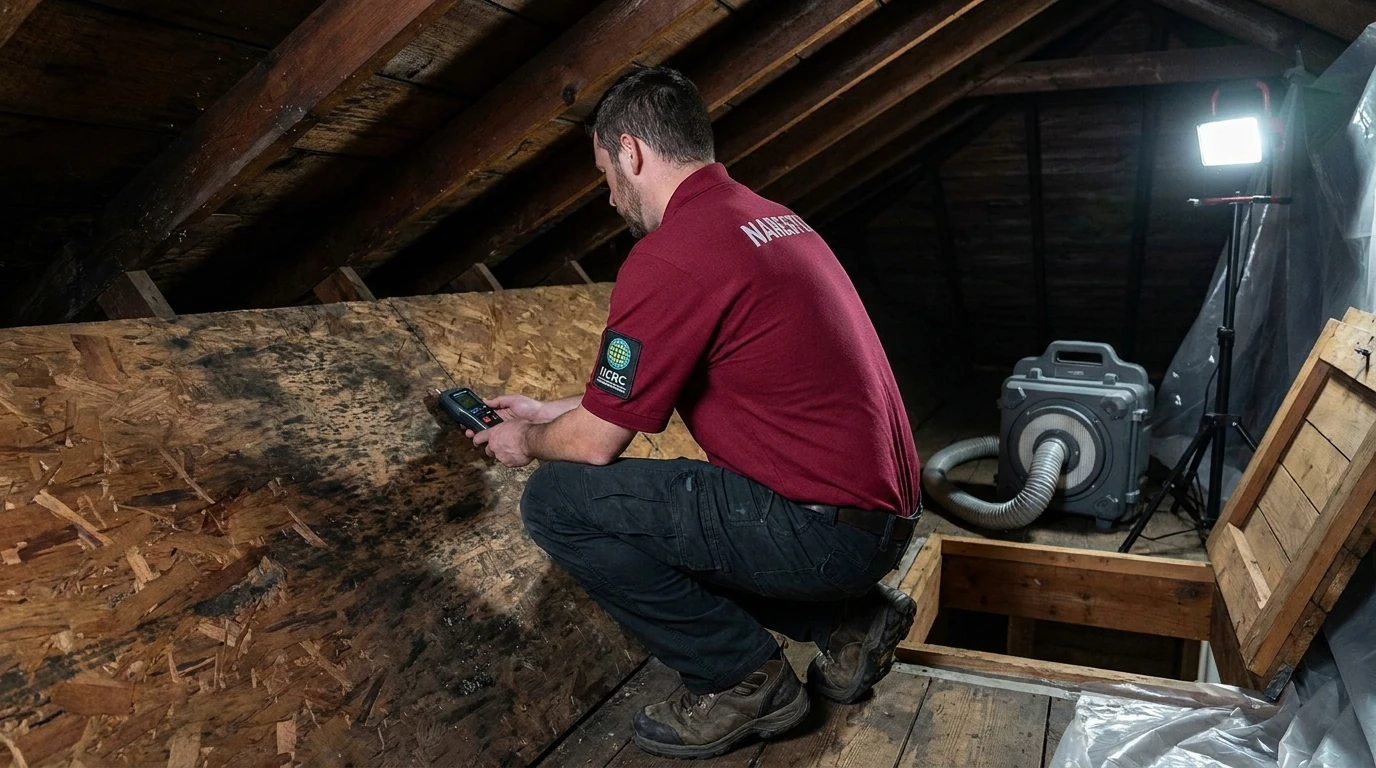
TL;DR: Attic mold in Tacoma typically starts with a roof leak, blocked soffit vents, or a bathroom exhaust fan venting into the attic instead of outside. Removal costs range from $1,500 to $6,000 depending on how much of the sheathing is affected. Fix the moisture source first, mold will return within weeks if you don’t. A certified remediation crew handles containment, HEPA vacuuming, antimicrobial treatment, and post-clearance testing so the work holds.
If you found dark staining on your attic sheathing during a roof inspection, or your home inspector flagged mold during a sale, you’re dealing with one of the most common problems in Tacoma’s older housing stock. The Stadium District and Proctor District are full of early-1900s homes where ventilation was never designed for today’s indoor moisture loads. Mold up there doesn’t mean your house is ruined, but it does mean something is wrong with moisture control, and that problem needs to be solved before the wood does.
What Causes Attic Mold in Tacoma Homes?
Attic mold almost always traces back to one of three moisture sources: a roof leak, inadequate ventilation, or warm moist air escaping from living spaces below. Tacoma’s climate, persistent marine drizzle, cool temperatures, and limited drying hours, makes all three worse than they’d be in a drier region.
Here’s how each one plays out:
Roof leaks are the fastest path to attic mold. Water gets in through failed flashing, cracked ridge caps, or deteriorated shingles and soaks the OSB or plank sheathing. At Puget Sound humidity levels, wet wood can show visible mold growth in as little as 24 to 48 hours. If you’ve had a slow leak for a season or two, the mold colony is almost certainly already established. The EPA’s guidance on mold and moisture confirms that any material that stays wet for more than 48 hours is at risk. Our roof leak repair service addresses the entry point before remediation begins, doing it in the other order wastes money.
Poor ventilation is the second major cause. Attics need balanced airflow: cool air in through soffit vents at the eaves, warm air out through ridge or gable vents at the peak. When soffits are blocked by insulation (very common in 1970s-80s ramblers throughout South Tacoma and Hilltop), or when bathroom and kitchen exhaust fans terminate in the attic instead of the exterior, warm humid air pools against the cold sheathing. That temperature differential creates condensation every night from October through April.
Air leakage from below compounds both problems. Gaps around recessed lights, attic hatches, and plumbing chases let conditioned air rise into the attic. In older homes near Wright Park or Old Town Tacoma, original construction rarely included air sealing, the attic breathes freely with the living space below it.
Is Attic Mold Dangerous?
Attic mold poses a real health risk when spores migrate into living spaces, which happens more than most homeowners expect. Mold spores are microscopic and travel through the same gaps that let warm air into the attic in the first place, recessed lights, attic hatches, HVAC returns that pass through the attic.
The species most commonly found in Pacific Northwest attics include Cladosporium, Penicillium, Aspergillus, and occasionally Stachybotrys chartarum (black mold) in areas with chronic water intrusion. For most healthy adults, exposure causes respiratory irritation, headaches, and aggravated allergies. For people with asthma, compromised immune systems, or young children, the effects can be more serious. The IICRC S520 standard, the industry benchmark for mold remediation, requires containment and negative air pressure during removal specifically to prevent cross-contamination of living spaces.
Beyond health, attic mold causes structural damage. Mold breaks down wood fiber. Sheathing that looks solid can be soft and crumbling underneath a surface colony. Left long enough, you’re looking at sheathing replacement, not just surface treatment.
For a broader look at how to identify mold types, see our post on black mold vs regular mold.
How Much Does Attic Mold Removal Cost in Tacoma?
Attic mold removal in Tacoma typically costs between $1,500 and $6,000, with most jobs landing in the $2,000 to $4,000 range. The spread is wide because the cost depends almost entirely on how much sheathing is affected and whether any structural material needs replacement.
Here’s what moves the number:
- Affected square footage. A small colony on one rafter bay after a single leak event is a very different job from full-roof sheathing coverage after years of condensation.
- Mold penetration depth. Surface mold on OSB sheathing can often be treated in place. Mold that has penetrated into the wood fiber, or that has spread to rafters and ridge boards, may require partial or full sheathing replacement.
- Access difficulty. Low-pitch attics with limited crawl space require more labor time. Some Tacoma bungalows have attics you can barely sit up in.
- Ventilation corrections. If the crew needs to redirect exhaust fans or install new soffit baffles as part of the job, that adds to the total.
- Post-remediation testing. Air clearance testing after remediation, required by the IICRC S520 standard, typically adds $200 to $400 but is what proves the job is done. Tacoma’s municipal HEPA filtration ordinance for work that produces airborne particulate also applies here, which affects equipment requirements.
Homeowners insurance sometimes covers attic mold when it results directly from a covered roof leak. It rarely covers mold from ventilation failure or gradual condensation, which insurers classify as a maintenance issue. Document the moisture source carefully before filing, our post on average insurance payouts for water damage covers how that documentation affects claim outcomes.
What Does the Attic Mold Removal Process Look Like?
Professional attic mold remediation follows a defined sequence. Skipping steps, especially containment and clearance testing, is how mold comes back.
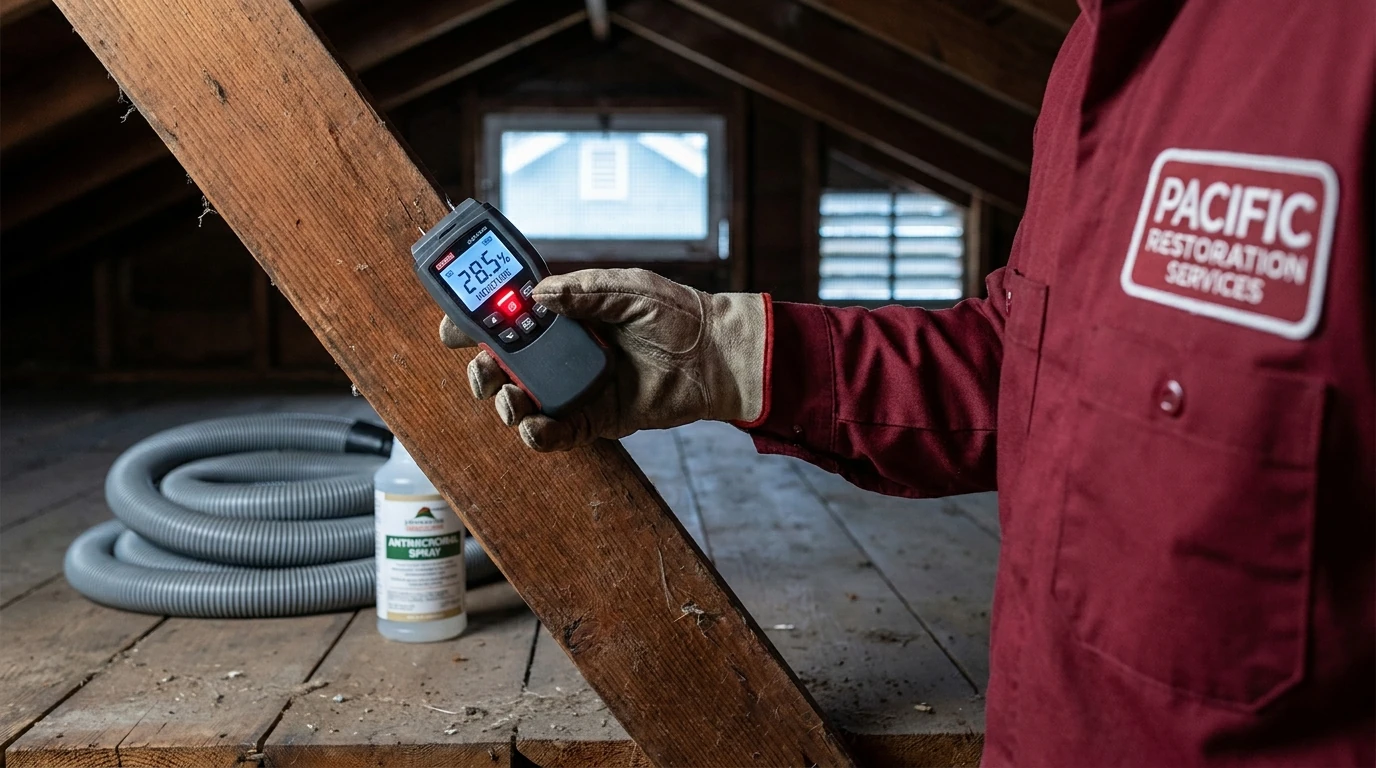
- Inspection and moisture mapping. A technician inspects the attic with a moisture meter and thermal camera to find all wet areas, not just visible mold. This step also identifies the moisture source.
- Containment setup. Poly sheeting seals the attic access point. A negative-air machine with HEPA filtration runs throughout the job, drawing air out through an exterior exhaust rather than into the living space. This is required under both the IICRC S520 standard and Tacoma’s local HEPA ordinance.
- HEPA vacuuming. Loose spores and debris are vacuumed from all affected surfaces before any wet treatment begins. Vacuuming first prevents spores from becoming airborne during scrubbing.
- Antimicrobial treatment. Affected wood is treated with an EPA-registered antimicrobial agent. For surface mold on solid sheathing, this is often sufficient. For deeper penetration, mechanical abrasion (sanding or wire brushing) precedes treatment.
- Sheathing replacement (if needed). Sheathing that has lost structural integrity is removed and replaced. This is a general contracting scope, not just remediation, having a team licensed for both matters here.
- Ventilation correction. Redirecting exhaust fans to exterior terminations, installing soffit baffles, or adding ridge ventilation happens before the attic is closed back up.
- Post-clearance air testing. An independent or in-house air sample confirms spore counts are back to ambient levels. Without this step, you have no documented proof the remediation worked.
For more on what the full mold remediation process involves, see our overview at mold remediation services.
How Do You Prevent Attic Mold from Coming Back?
Attic mold prevention comes down to three things: fix the roof, fix the ventilation, and seal air leaks from below. All three need to happen, addressing only one usually means the mold returns within a year.
Roof maintenance is the most direct lever. Have your roof inspected before fall rains arrive. Tacoma’s wet season runs roughly October through March, and that’s when slow leaks do the most damage. Pay attention to flashing around chimneys, skylights, and any roof penetrations, those are the first places to fail on homes in the Stadium District and Proctor District.
Ventilation balance matters year-round. The standard target is 1 square foot of net free ventilation area per 150 square feet of attic floor space, with intake and exhaust roughly balanced. If your soffit vents are blocked by insulation (check by looking for baffles at the eaves), that’s a straightforward fix.
Exhaust fan routing is the most overlooked issue. Every bathroom and kitchen exhaust fan must terminate at an exterior wall or roof cap, not into the attic. This is a code requirement under the International Residential Code and a very common violation in older Tacoma housing. If you can see a flexible duct just hanging loose in your attic, it’s venting directly into the space.
Air sealing around attic hatches, recessed lights, and plumbing chases reduces the volume of warm moist air entering the attic from below. Even basic weatherstripping on an attic hatch makes a measurable difference.
If you’re in North Tacoma or South Hill and want a professional assessment before next fall’s rain season, National Restoration Construction offers mold inspection and testing as a standalone service, a good starting point if you’re not sure whether you have a problem yet.
About National Restoration Construction
National Restoration Construction is an IICRC-certified, EPA-certified, and Lead-Safe Certified firm serving Tacoma, Federal Way, and the greater Puget Sound region since 2004 (WA contractor license NATIORC792M6). Their crews handle mold remediation, mold inspection and testing, roof leak repair, water damage restoration, fire and smoke damage restoration, and reconstruction across the South Sound. They operate 24/7 and carry full general contractor licensing, which matters on attic jobs that combine remediation with structural sheathing replacement.