
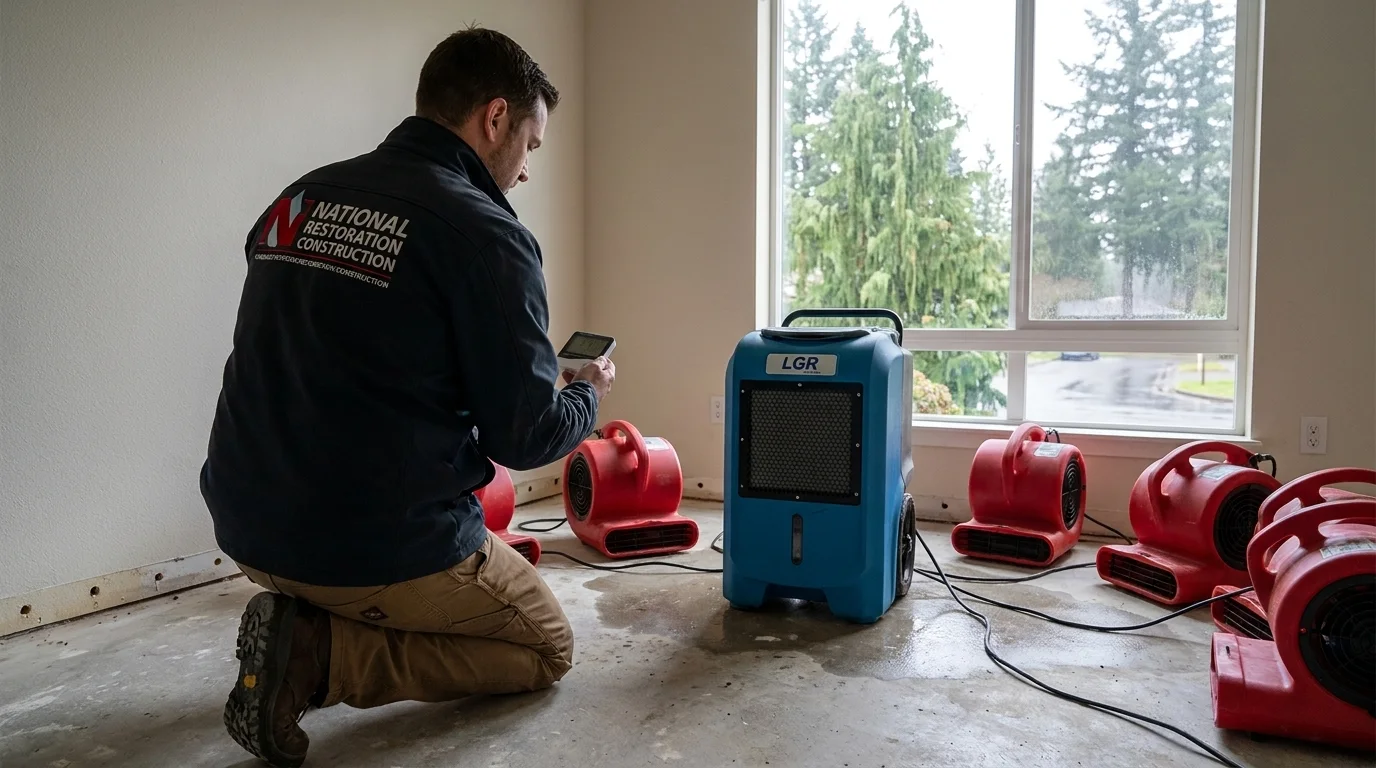
24/7 Emergency Structural Drying and Dehumidification in Federal Way
24/7 emergency structural drying and dehumidification in Federal Way. IICRC-certified, moisture mapping, drying to standard, licensed and insured. Call (206) 883-0333.
We work with all insurance carriers and handle the claim paperwork.
Water damage emergency in Federal Way? We answer 24/7. Call now and our crew heads out to stop the water and start drying your property.
The water is gone, the carpet is out, and the floor looks dry. That is the moment most moisture problems are actually born. Water that has already wicked into subfloor panels, framing, and the bottom few inches of drywall does not leave because the visible water was extracted. It sits inside the structure, feeding mold and warping materials from the inside, until a documented drying process pulls it back out. Structural drying and dehumidification is that process, and in the wet marine climate around Federal Way it is the difference between a repair that holds and one that comes back.
What structural drying and dehumidification actually involves
Structural drying is the engineered phase that begins after extraction and cleanup end. Cleanup removes the water you can see. Drying removes the water you cannot, the moisture bound into the pores of concrete, the water absorbed deep into framing lumber, the saturation hiding behind baseboards and under flooring. Getting it out is a controlled process governed by psychrometrics, the science of how air holds and releases moisture.
The core principle is simple to state and easy to get wrong: wet materials release moisture into the surrounding air only when that air is dry enough to accept it, and dehumidifiers only remove water when air conditions allow it. So the job is a balance of three things working together, air movement across wet surfaces to speed evaporation, dehumidification to pull that evaporated moisture out of the air, and temperature control to keep the whole system in the range where drying actually happens. Point fans at a wet floor without controlling humidity and you have not dried anything; you have moved damp air around and, often, spread it.
That is why equipment selection is not one-size. High-velocity air movers are positioned by a plan calculated from the room’s cubic footage and material types. Low-grain refrigerant (LGR) dehumidifiers handle typical conditions, while desiccant dehumidifiers keep pulling water in the cold, low-humidity conditions of an unheated crawl space or a Puget Sound winter where refrigerant units lose ground. The mix is chosen from the actual psychrometric readings on site.
Our process
-
Moisture mapping and dry standard. We inspect with thermal imaging and calibrated moisture meters to map exactly where water has traveled, not just where it is visible, and we set a dry standard by reading unaffected material of the same type. That reading is the target the wet materials have to reach.
-
Drying plan and equipment placement. Air movers and dehumidifiers are sized and positioned from the room’s cubic footage, material types, and ambient conditions, with LGR or desiccant units chosen to match the psychrometric reality of the job rather than a default.
-
Controlled drying and daily monitoring. The system runs continuously while we take daily psychrometric and moisture readings, adjusting equipment placement as the structure dries so the air stays in the range that actually pulls water out.
-
Removal of what will not dry. Materials that cannot reach standard in place, heavily saturated insulation, certain flooring, compromised drywall, are documented, removed, and disposed of properly rather than sealed up wet.
-
Verification to standard and documentation. Equipment stays until every monitored point meets the IICRC S500 drying goal. We log the readings and photograph the process so there is a record that the structure is dry, not just that it looks dry.
What separates a good drying job from a bad one
The most common failure is pulling equipment too early. A floor that feels dry to the touch can still hold moisture well above the safe standard inside the framing and subfloor. Operators who go by feel, or who rush to get expensive equipment back to the next job, leave that hidden moisture behind, and it resurfaces weeks later as a musty odor, cupped flooring, or visible mold. Documented daily readings that trend down to a set dry standard are the only honest way to call a structure dry.
The second failure is undersizing or mismatching equipment. Consumer-grade dehumidifiers and household fans do not move the volume of air or pull the volume of water a structural dry-out requires, and a refrigerant unit fighting a cold Puget Sound crawl space will stall out where a desiccant unit would keep working. Matching equipment to the psychrometric conditions is not a detail; it is the whole job.
The third is treating drying as separate from the water event that caused it. Category of water, how long materials sat wet, and what the moisture contacted all shape the drying plan. Reading those conditions and building the plan around them is what keeps a contained loss from expanding into a mold remediation project.
What does structural drying and dehumidification cost?
Cost depends on the affected square footage, how many pieces of equipment the space requires, how many days the structure takes to reach standard, and whether saturated materials have to be removed. The figures below are typical market ranges, not National Restoration Construction quotes, and are provided so you can plan.
| Scenario | Typical range |
|---|---|
| Single-room structural dry-out (equipment + monitoring) | $2,000 - $5,000 |
| Multi-room residential drying (several days) | $3,000 - $8,000 |
| Crawl space or below-grade drying (desiccant) | $2,500 - $7,000 |
| Commercial or large-loss dehumidification | $6,000 - $20,000+ |
| Daily equipment and monitoring add-on | $150 - $400 per drying day |
| Moisture mapping and documentation-only assessment | $200 - $600 |
Every structure dries differently, and the number of drying days is the biggest swing factor. National Restoration Construction provides a written scope before work begins, and for a covered loss we can document moisture logs and photos in the format insurance adjusters require.
Seasonal and regional considerations
The Puget Sound marine climate makes structural drying harder here than in drier parts of the country. Federal Way sees persistent rain through the wet season and holds elevated indoor humidity, often in the 60 to 70 percent range, well into spring. High ambient humidity means the air outside the drying zone is already carrying moisture, so dehumidifiers have to work harder and drying often runs longer than national averages suggest.
Crawl spaces and below-grade areas are the regional trouble spots. Cold, unheated, and close to a high water table, they are exactly where refrigerant dehumidifiers lose efficiency and where desiccant units earn their place. Drying a Federal Way crawl space in January is a different job than drying a heated living room in July, and the equipment plan has to reflect that.
Service area
National Restoration Construction provides structural drying and dehumidification in Federal Way and the surrounding South Puget Sound area, including Seattle, Tacoma, Kent, Auburn, Renton, and Bellevue. As a licensed and insured, IICRC Certified firm, we handle drying as a standalone service and as the engineered phase within a larger water or flood restoration project, so the same crew that dries your structure can carry it through to repair.
If you have had a water event and want the structure dried to a documented standard rather than dried by guesswork, the next step is an on-site moisture assessment. Call National Restoration Construction at (206) 883-0333.
Services We Handle
- Wet Carpet Drying
Frequently Asked Questions
How is structural drying different from general water cleanup?
What is psychrometrics and why does it matter for drying?
How do you know when the structure is actually dry?
What is the difference between LGR and desiccant dehumidifiers?
Can you dry the structure without tearing everything out?
Looking for the best structural drying and dehumidification company in Federal Way?
National Restoration Construction provides licensed and insured structural drying and dehumidification in Federal Way, WA and the surrounding area, and has served local property owners since 2004. Customers rate us 5.0 out of 5 stars across 64 Google reviews. We answer calls 24/7 — call (206) 883-0333 for immediate help.
Need Structural Drying and Dehumidification now?
We respond 24/7 across Federal Way and surrounding WA cities.