
Soot Removal in Bremerton
24/7 soot removal in Bremerton, WA. IICRC-certified, insurance billing accepted. Call (206) 883-0333.
We work with all insurance carriers and handle the claim paperwork.
Our IICRC-certified technicians are dispatched from our Federal Way, WA headquarters and are typically on-site in Bremerton within 60 minutes of your call.
Soot from a house fire doesn’t just coat surfaces — it keeps working after the flames are out. In Bremerton’s older housing stock, particularly the wartime-era bungalows and craftsman homes packed into Manette and Charleston, that problem compounds quickly. Those homes were built with porous plaster walls, uninsulated cavities, and wood framing that has spent decades absorbing the damp marine air off the Port Washington Narrows. When soot penetrates those materials, it bonds chemically and drives a persistent, acrid odor that no amount of ventilation alone will clear. Reaching out to (206) 883-0333 sooner rather than later is the single most effective thing you can do to limit permanent damage.
Why Bremerton’s Housing Stock Makes Soot Damage Harder to Reverse
The homes that define Bremerton’s character — the 1930s and 1940s worker cottages built to house shipyard families near the Puget Sound Naval Shipyard — were constructed before modern building science. Plaster-and-lath walls, tongue-and-groove fir flooring, and unconditioned crawl spaces create a network of porous surfaces and hidden voids where soot particles settle and migrate. Unlike drywall, which can sometimes be wiped or replaced panel by panel, original plaster absorbs oily smoke residue into its calcium matrix. Dry-cleaning sponges and HEPA vacuuming address the surface layer, but the subsurface contamination requires chemical sponging with pH-matched cleaning agents and, in severe cases, encapsulation or controlled demolition of affected plaster sections.
Bremerton’s climate adds another layer of difficulty. The city averages roughly 55 inches of rain annually, and interior relative humidity in unheated crawl spaces regularly exceeds 70 percent even in summer. High ambient moisture causes soot particles — which are slightly hygroscopic — to cling more aggressively to wall surfaces and makes odor compounds harder to off-gas through standard ventilation. Thermal fogging or hydroxyl generation is often necessary to reach soot trapped in wall cavities and subflooring.
Our Soot Removal Process in Bremerton
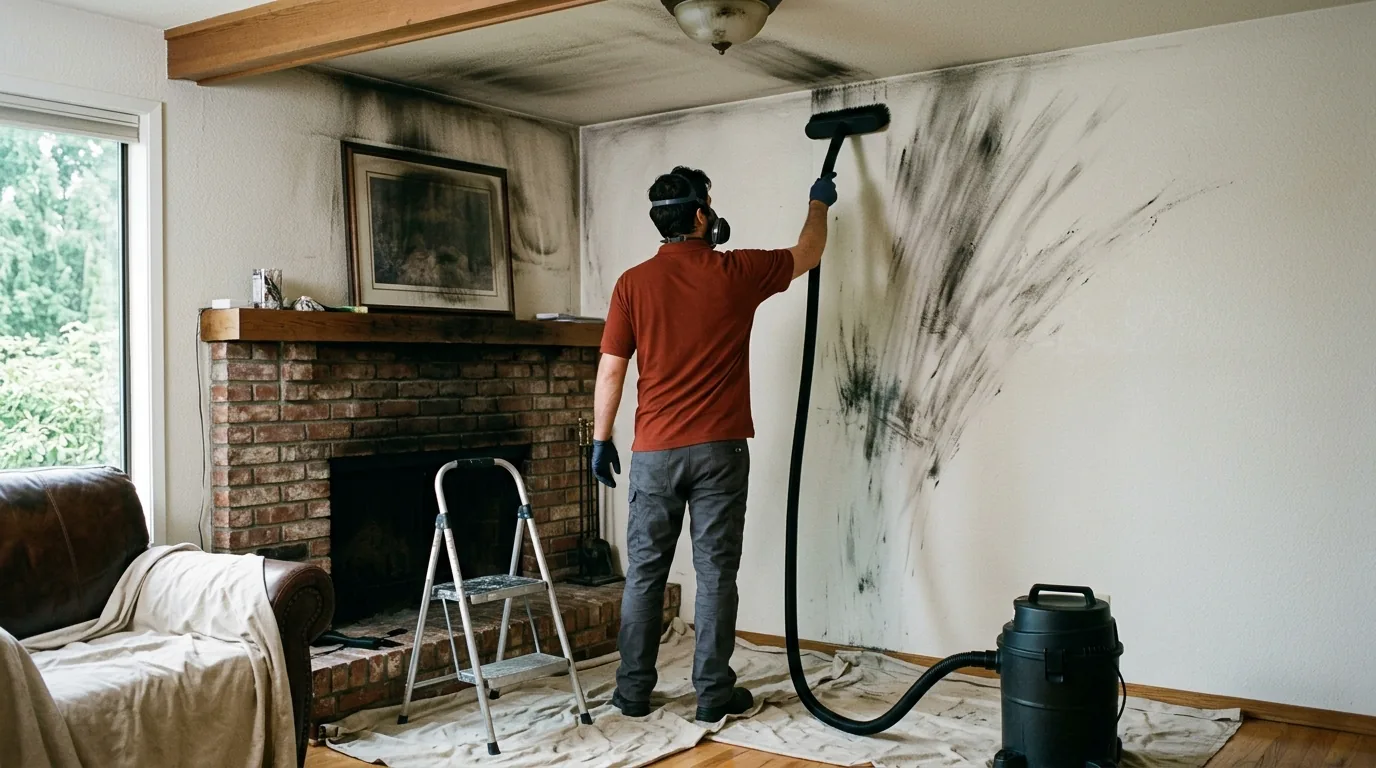
Every soot removal job begins with a structured assessment before a single sponge touches a wall. A technician photographs and documents the full extent of residue — distinguishing between dry smoke (typically from fast-burning wood fires), wet smoke (slow, smoldering fires that produce heavier, stickier soot), and protein residue (common in kitchen fires, nearly invisible but intensely odorous). That distinction drives every cleaning decision that follows.
For Bremerton homes with original plaster walls, the sequence typically runs:
- Containment — sealing HVAC registers, doorways, and crawl access points to prevent cross-contamination to unaffected areas.
- Dry removal — chemical dry sponges and HEPA-filtered vacuums lift loose particulate before any wet cleaning agent is introduced. Introducing moisture too early on plaster can drive soot deeper.
- Chemical cleaning — pH-appropriate cleaning solutions matched to the soot type are applied with controlled pressure, working ceiling to floor.
- Odor neutralization — thermal fogging or hydroxyl treatment penetrates wall cavities, subflooring, and insulation where surface cleaning cannot reach.
- Clearance documentation — written scope and photo documentation suitable for insurance submission.
National Restoration Construction holds IICRC certification and is a Lead-Safe Certified Firm through the EPA — relevant in Bremerton’s pre-1978 housing stock, where disturbing painted surfaces during cleanup requires lead-safe work practices.
Response Time to Bremerton from Federal Way
From our Federal Way headquarters, Bremerton is accessible via WA-16 West across the Tacoma Narrows Bridge — typically 45 to 60 minutes under normal traffic conditions. For properties in East Bremerton or near the 98310 ZIP code, that puts a technician on-site in under an hour on most calls. West Bremerton and the Kitsap Lake area add roughly 10 to 15 minutes depending on the SR-3 interchange. We do not route crews through the Bremerton ferry terminal for emergency calls — the schedule and loading delays make road access more reliable for rapid response.
For Navy families in rental properties near the shipyard, we understand that PCS timelines and lease obligations add urgency to fire damage documentation. We can prioritize written scope reports and photo packages that support both insurance claims and landlord-tenant communications.
Local Note: What Bremerton Contractors Know About Smoke in Crawl Spaces
In Bremerton homes built before 1950 — especially on the hillside streets above Sheridan Park and along the bluff neighborhoods that slope toward the Narrows — crawl spaces are often unvented or minimally vented and sit directly on bare soil. When a fire occurs on the main level, convective airflow pulls smoke downward through floor register gaps and plumbing penetrations into the crawl space, where it deposits on the vapor barrier (if one exists), floor joists, and subfloor sheathing. Homeowners rarely think to check the crawl space after a kitchen or living room fire, but soot odor that “won’t go away” months later is often coming from below the floor, not the walls. Our assessment always includes a crawl space inspection on pre-1960 Bremerton properties.
If you’re dealing with soot residue anywhere in the Bremerton area — whether it’s a kitchen fire in a Manette bungalow or smoke damage from a neighboring unit in a multi-family building near the ferry terminal — call National Restoration Construction at (206) 883-0333. We’ll assess the full scope, document everything your insurer needs, and clear the residue the right way the first time.
Serving Bremerton from our Federal Way headquarters — ★ 4.9 · 57 Google reviews
“Very pleased with the service. They explained each step clearly. They answered any questions we had. They were on time and cleaned up each day any mess they had created working.” — Doneen, July 2026Read our reviews on Google →
Soot Removal in Bremerton: Service Coverage Map
Frequently Asked Questions
How fast can you arrive for soot removal in Bremerton?
How quickly can your crew reach a home in the Manette neighborhood after a fire?
Do Bremerton's older plaster-wall homes require different soot cleaning methods than newer construction?
Is lead paint a concern during soot cleanup in Charleston or East Bremerton homes?
Why does soot odor sometimes persist for months in Bremerton homes even after surface cleaning?
Will my homeowner's insurance cover soot removal for a fire at my property in the 98310 ZIP code?
Soot Removal response in Bremerton
Most Bremerton calls see a technician on-site within 60 minutes from our Federal Way headquarters.