
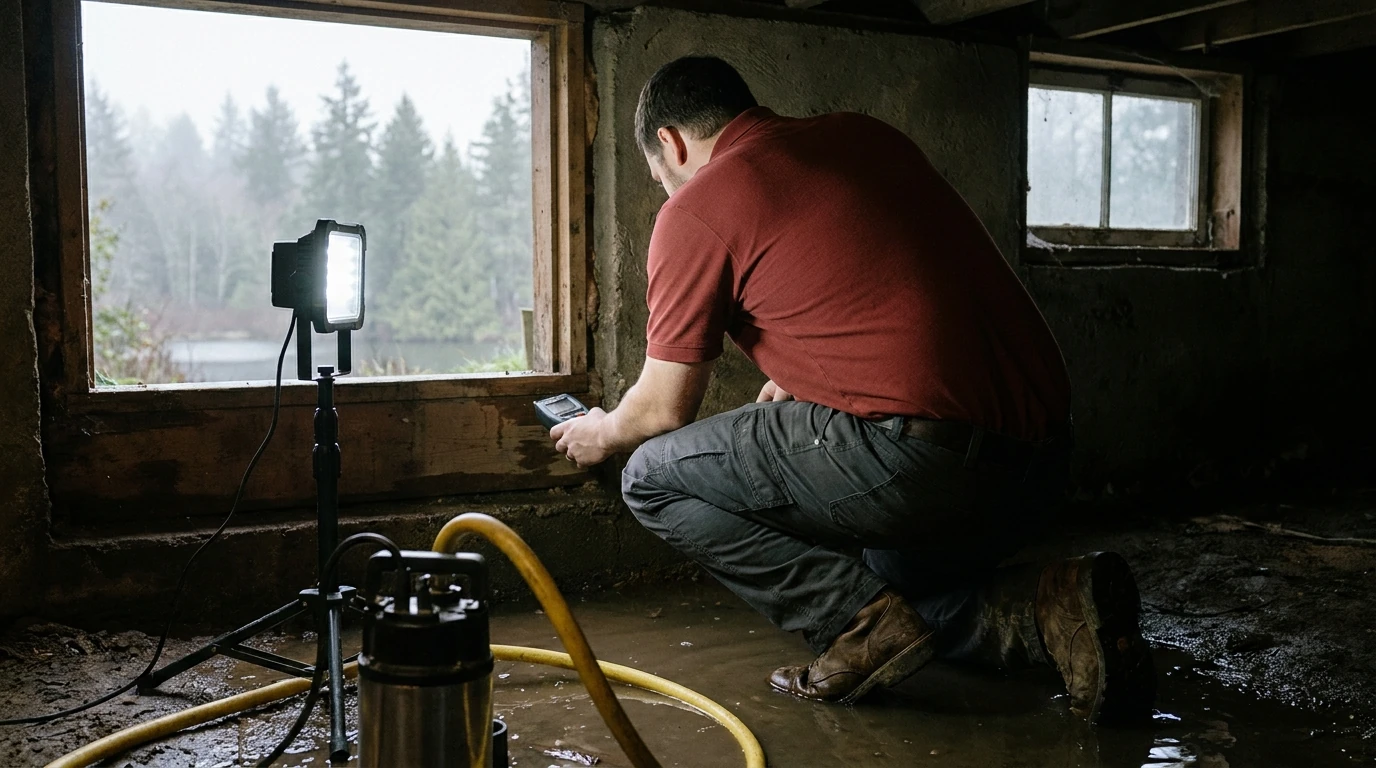
If your house just flooded in Port Orchard, call a licensed water damage restoration contractor before you call your insurance company. Mitigation has to start within hours to limit the damage and keep the claim clean, and a restoration crew documents the loss as they work. National Restoration Construction answers at (206) 883-0333 around the clock and is IICRC certified and licensed with WA L&I (General Contractor Certificate of Registration NATIORC792M6).
That answer changes a little depending on what’s actually flooding. A burst supply line in a McCormick Woods kitchen is a different call than a failed well pump out in rural South Kitsap, or Bay Street taking on water during a king tide. Here’s how to sort it out fast.
Is this a restoration call, a plumber call, or something else?
If water is actively spreading and you can’t stop it yourself, call a restoration contractor first; they can often coordinate the plumber, electrician, or utility on your behalf.
A few quick rules of thumb:
- Water still running from a pipe, supply line, or appliance and you can’t find or reach the shutoff: this is a restoration call. They’ll also know a plumber if the fix needs one.
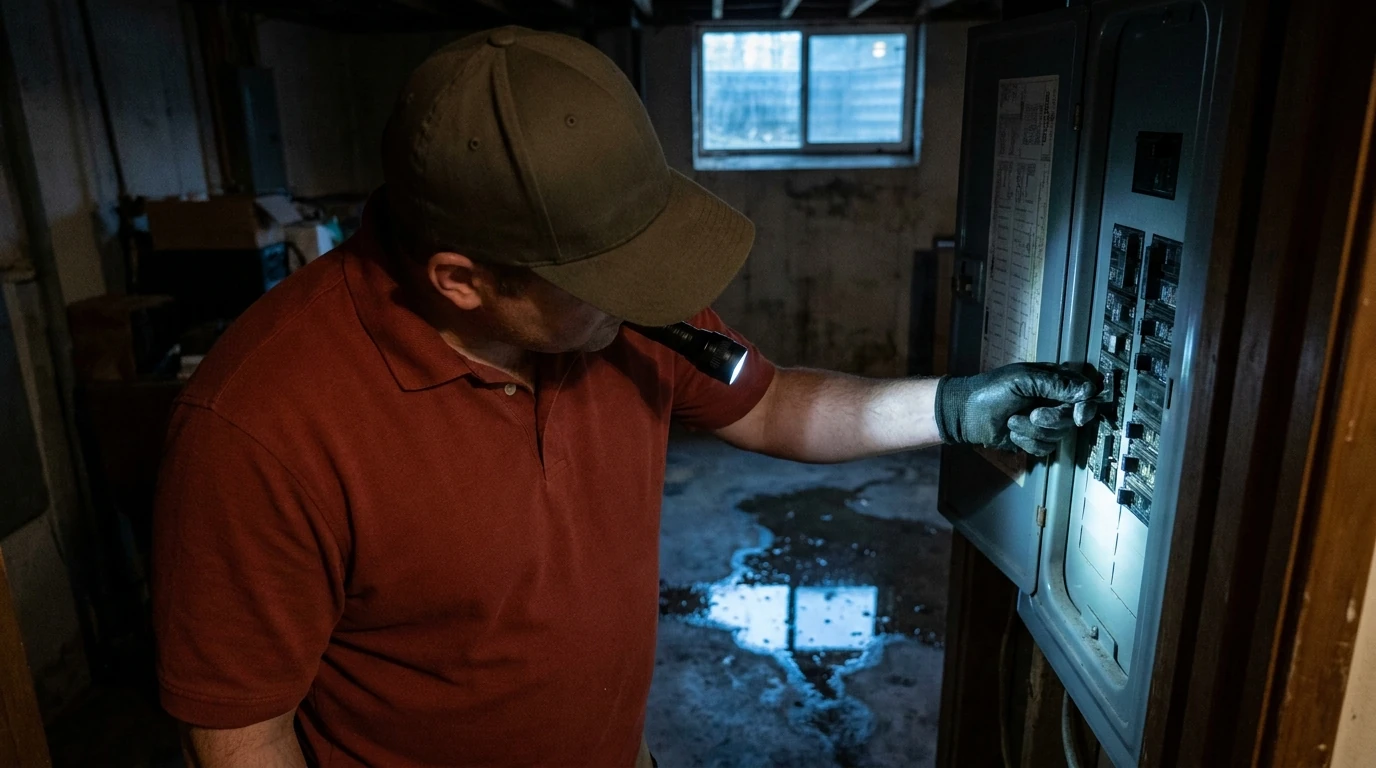
- Standing water near outlets, a panel, or any visible sparking: get out and call 911 or your utility first. Nobody touches standing water near live electrical.
- Sewage or toilet backup, especially common on the septic systems that serve much of rural South Kitsap: this is a biohazard situation, not a mop-and-bucket job. Cat 3 (black water) contains bacteria and should be handled under the IICRC S500 standard, not DIY.
- Tidal or storm flooding along Bay Street or near Sinclair Inlet: this is often a flood insurance question as much as a mitigation one; see the insurance note below.
What should you do in the first 20 minutes?
Shut off the water source if you can reach it safely, then move valuables off the floor and start taking photos before anything is touched.
For a supply line or appliance leak, the shutoff is usually under the sink or behind the washer. For homes on private wells, which is most of South Kitsap outside city limits, there’s no “main shutoff” like a city connection; you’ll need to kill power to the well pump at the breaker instead. If the flooding is from a failed well pump or pressure tank, that’s a job for the pump technician AND the restoration crew. One fixes the source, the other handles the water already in the house.
Don’t run a shop vac on sewage water, and don’t turn on an HVAC system that’s pulled standing water, since that spreads contamination through the ducts. Photograph the water line on the walls, the source if it’s visible, and any damaged belongings before you move anything. FEMA’s National Flood Insurance Program has specific documentation requirements if this turns into a flood claim rather than a standard water damage claim, so more photos now means fewer problems later.
What happens when you call a restoration company?
A real restoration call starts with questions about the water source and category, then a crew dispatched with extraction and drying equipment, not just a quote over the phone.
Expect to be asked: Is the water still flowing? Is it clean (a supply line), gray (a washing machine or dishwasher), or black (sewage or flooding that touched the ground)? That classification under the IICRC S500 standard drives everything that follows, from what PPE the crew wears to whether porous materials like carpet pad and drywall can be dried or need to come out.
On arrival, the crew extracts standing water, sets moisture meters into the walls and subfloor to map how far the water traveled, and places air movers and dehumidifiers to begin structural drying. They’ll also photograph and log the damage, which becomes the documentation your insurance adjuster needs. For homes near Annapolis or the older waterfront stock around Sinclair Inlet, that moisture mapping often matters more than usual; older framing holds water longer than newer construction at McCormick Woods.
Will homeowners insurance pay for this?
Standard homeowners insurance usually covers sudden, accidental water damage like a burst pipe, but it almost never covers flood water that rises from outside the home.
That distinction matters a lot in a place like Port Orchard, where the low-lying Bay Street corridor can take on water during king tides and heavy winter rain. If the water came up from the ground, a storm surge, or Sinclair Inlet itself, that’s a flood claim under a separate NFIP or private flood policy, not your standard homeowners policy. If it came from inside the house, a supply line, a water heater, a washing machine hose, that’s typically a covered peril. A restoration contractor can usually tell you which situation you’re in during the first visit, before you file anything with your carrier. For more on what a standard policy does and doesn’t pay out, see what most homeowners insurance actually covers.
What to do next
If your house is actively flooding right now, stop the source if you safely can, then call for mitigation before you call your insurer. Every hour water sits against drywall, flooring, or framing adds to the eventual repair cost and raises the odds of hidden mold starting within 24 to 48 hours. Call National Restoration Construction at (206) 883-0333 for a same-call water damage assessment, or read what the first 24 hours after water damage should look like if help is still on the way.
About National Restoration Construction
National Restoration Construction is an IICRC-certified, BBB-accredited restoration contractor based in Federal Way, serving South Kitsap and the greater Puget Sound region since 2004. The company is licensed with WA L&I (NATIORC792M6) and holds a 5.0 Google rating across 64 reviews. This article was prepared with the National Restoration Construction team by Jose Osuna.