
TL;DR: Mold removal done correctly follows the IICRC S520 standard: contain the area, establish negative air pressure, physically remove contaminated materials, clean with EPA-registered antimicrobials, and verify clearance with post-remediation air testing. Bleach on the surface does not remove mold, it temporarily bleaches the stain while the colony survives in the substrate. In the Pacific Northwest, where indoor relative humidity regularly exceeds 60%, remediation without fixing the moisture source will fail within weeks.
If you’re looking at visible mold growth in your home right now, the most important thing to understand is that removal and remediation are not the same word. Removal implies wiping something away. Remediation means returning the space to a normal fungal ecology, the same species and spore counts you’d find in an unaffected home. That distinction determines whether your problem comes back in three months or stays gone.
What does mold remediation actually involve?
Professional mold remediation follows a defined sequence: assess the scope, contain the affected area, remove contaminated materials, clean remaining surfaces, dry the space to target humidity, and verify the result with clearance testing. Skipping any step, especially containment or clearance, means the job isn’t finished.
The IICRC S520 Standard for Professional Mold Remediation is the industry benchmark. It defines three contamination conditions (Condition 1 is normal, Condition 2 is settled spores without active growth, Condition 3 is actual colonization) and prescribes different protocols for each. A contractor who doesn’t reference these conditions during scoping is working without a framework.
Here’s what a full Condition 3 remediation looks like in practice:
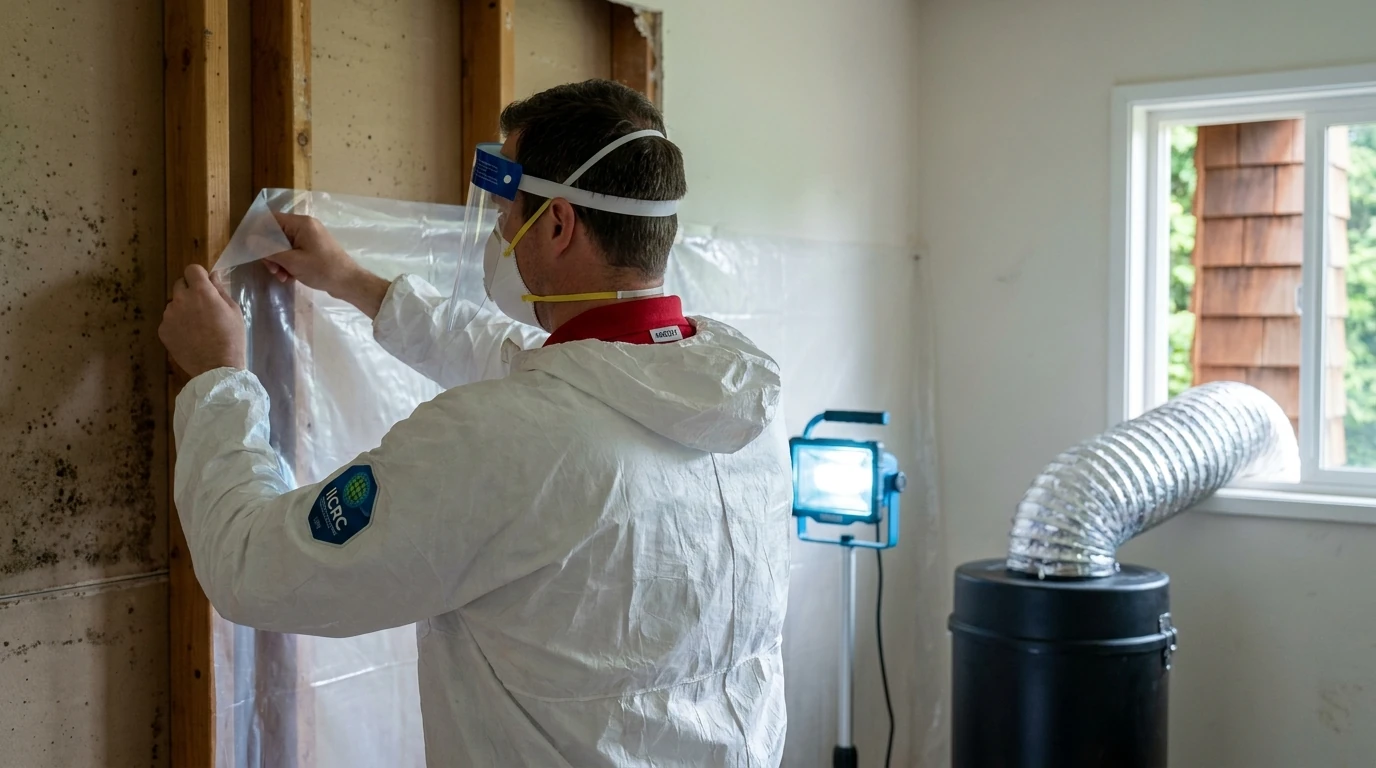
- Containment setup: Poly sheeting sealed with tape isolates the work area. A negative air pressure machine (typically an air scrubber with HEPA filtration) exhausts air outside, so spores don’t migrate to clean rooms during demolition.
- Material removal: Porous materials that are colonized, drywall, insulation, carpet, wood framing in severe cases, are bagged in 6-mil poly and disposed of as regulated waste. You cannot clean mold out of drywall paper; the material has to go.
- Surface cleaning: Remaining structural surfaces are HEPA-vacuumed, then wiped or sprayed with an EPA-registered antimicrobial. Wire-brushing or sanding may be needed on wood framing.
- Drying: The space is dried to below 50% relative humidity before reconstruction begins. Rebuilding over elevated moisture guarantees regrowth.
- Clearance testing: An independent inspector (not the same company that did the remediation) collects air samples and surface swabs. Results are compared against outdoor baseline samples. The job isn’t done until the numbers pass.
Why is mold so common in Western Washington homes?
Western Washington averages 37 to 55 inches of rain per year depending on location, and the marine climate keeps outdoor humidity elevated from October through May. That persistent moisture finds its way into homes through crawl spaces, attic bypasses, bathroom exhaust fans that vent into the attic instead of outside, and supply-line leaks that go undetected behind walls.
Older housing stock makes it worse. Federal Way’s 1970s and 1980s ramblers were built before modern vapor barrier standards. Crawl spaces in Twin Lakes and Dash Point neighborhoods often have inadequate or deteriorated ground covers, and vented crawl spaces in Puget Sound’s climate can actually pull humid outside air in rather than dry things out. Once relative humidity in a crawl space exceeds 70%, wood framing becomes a viable food source for Cladosporium, Penicillium, and Aspergillus species within days.
The EPA’s guide on mold and moisture notes that mold can begin growing on wet materials within 24 to 48 hours. In practice, a slow drip behind a vanity cabinet or a pinhole in a supply line can establish a colony over months before the homeowner notices a smell or sees discoloration. By that point, the affected area is almost always larger than it appears on the surface.
For a deeper look at how quickly mold establishes after a water event, see our post on how quickly mold grows after water damage.
How do you know if a mold contractor is doing the job correctly?
Four things separate a legitimate remediation contractor from someone who will spray bleach and hand you a certificate:
IICRC certification. The technicians performing the work should hold IICRC Applied Microbial Remediation Technician (AMRT) certification, not just the company. Ask to see the individual credentials, not just a logo on a website.
Written scope of work before demolition starts. A legitimate contractor provides a written protocol that identifies the affected materials, the containment strategy, the cleaning agents they’ll use, and the clearance criteria. If you’re handed a verbal estimate and a start date with no written scope, that’s a red flag.
Independent clearance testing. The same company cannot perform the remediation and issue the clearance certificate. That’s a conflict of interest. Clearance testing should be performed by a separate industrial hygienist or environmental testing firm. In Bellevue and Kirkland, HOA rules often mandate independent clearance testing before a unit can be reoccupied, but even where it’s not required, you should insist on it.
Documentation of the moisture source fix. Remediation without addressing the moisture source is temporary. A responsible contractor will not start remediation until the leak, condensation issue, or drainage problem that caused the growth has been identified and corrected, or will explicitly document that moisture correction is the homeowner’s responsibility before work begins.
Our post on how to test for mold in your home walks through the difference between DIY test kits and a professional inspection if you’re still in the assessment phase.
What does mold removal cost in Western Washington?
Mold remediation cost depends on three variables: the size of the affected area, the material types involved (drywall versus wood framing versus concrete), and whether the moisture source requires repair before or during the job.
For a single bathroom with contained drywall mold, expect $500 to $1,500. A crawl space with moderate fungal growth across wood framing typically runs $2,000 to $6,000 depending on square footage and access difficulty. Attic mold remediation, which is common in Pacific Northwest homes where bathroom fans vent improperly, ranges from $1,500 to $5,000 for a standard residential attic. Large-loss scenarios involving multiple rooms or structural framing can exceed $15,000.
Insurance coverage for mold is inconsistent. Most standard homeowners policies cover mold remediation only when the mold resulted from a covered peril, a burst pipe, for example, and only if the claim is filed promptly. Gradual leaks and maintenance-related moisture are typically excluded. See our water damage insurance guide for how adjusters typically treat mold-adjacent claims.
For Seattle-specific pricing context, our mold remediation cost guide for Seattle breaks down costs by room type and scope.
What should you do if you find mold in your home?
Stop the moisture source first. If there’s an active leak, shut it off. If the mold is in a crawl space or attic, don’t disturb it before getting an assessment, disrupting a colony without containment can spread spores throughout the living space.
Don’t paint over it. Don’t spray it with bleach and assume the problem is solved. Bleach is a surface disinfectant; it does not penetrate porous materials, and the EPA explicitly advises against relying on bleach for mold remediation on porous surfaces.
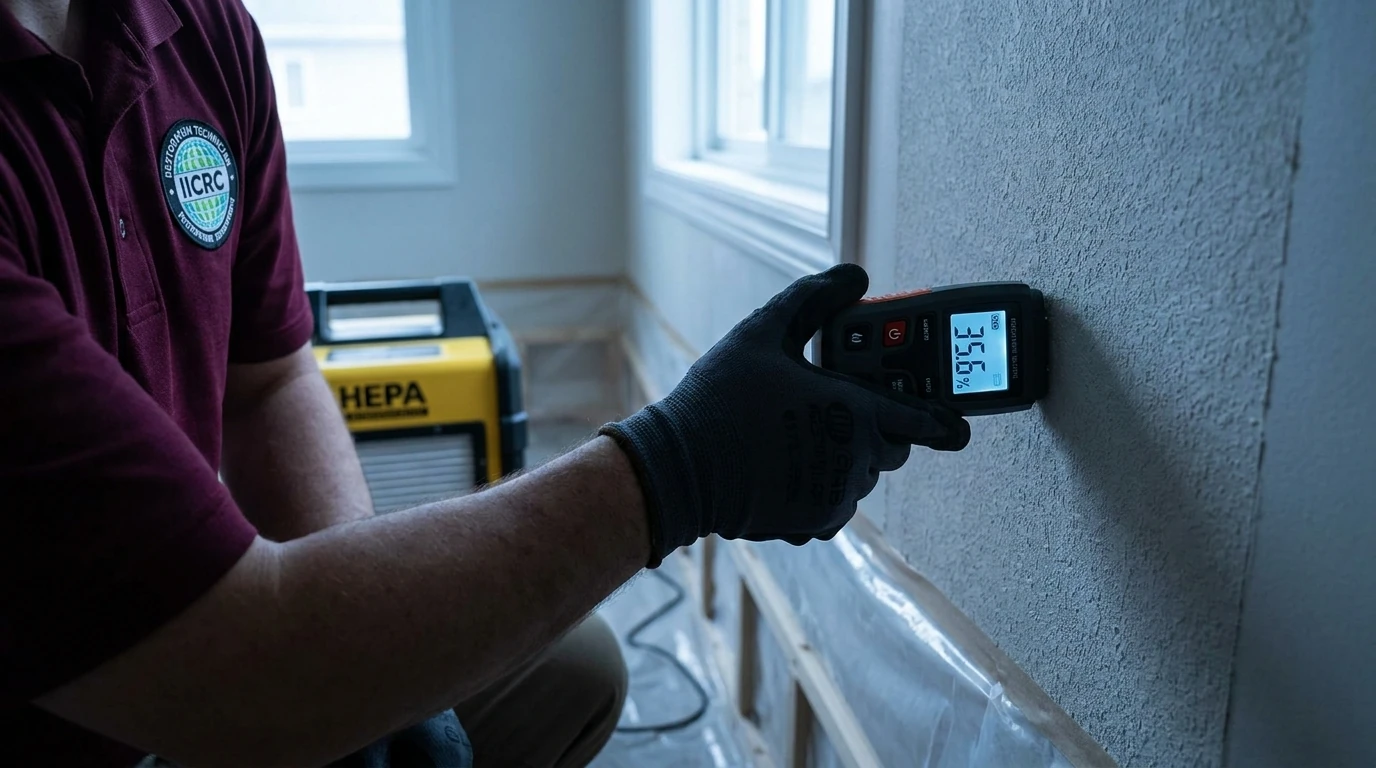
Get a professional assessment that includes moisture mapping, not just a visual inspection. A moisture meter reading of the surrounding materials tells you whether the visible growth is the full extent of the problem or the tip of it. Mold visible on drywall paper often means the cavity behind it has been wet long enough to support growth on the back side of the board and on the framing.
If you’re in Federal Way, Tacoma, Seattle, or anywhere across the South Sound or Eastside, National Restoration Construction’s team is available around the clock. They hold IICRC certification, are EPA certified, and carry Washington State contractor license NATIORC792M6. Request a mold inspection and assessment to get a written scope before any work begins.
About National Restoration Construction
National Restoration Construction is an IICRC-certified, EPA-certified, Lead-Safe Certified restoration firm serving Federal Way, Seattle, Tacoma, Bellevue, and communities across the South Sound and Eastside since 2004. Licensed by the Washington State Department of Labor and Industries (license NATIORC792M6), their crews handle water damage, mold remediation, fire and smoke restoration, and full reconstruction. Available 24/7 at (206) 883-0333.