
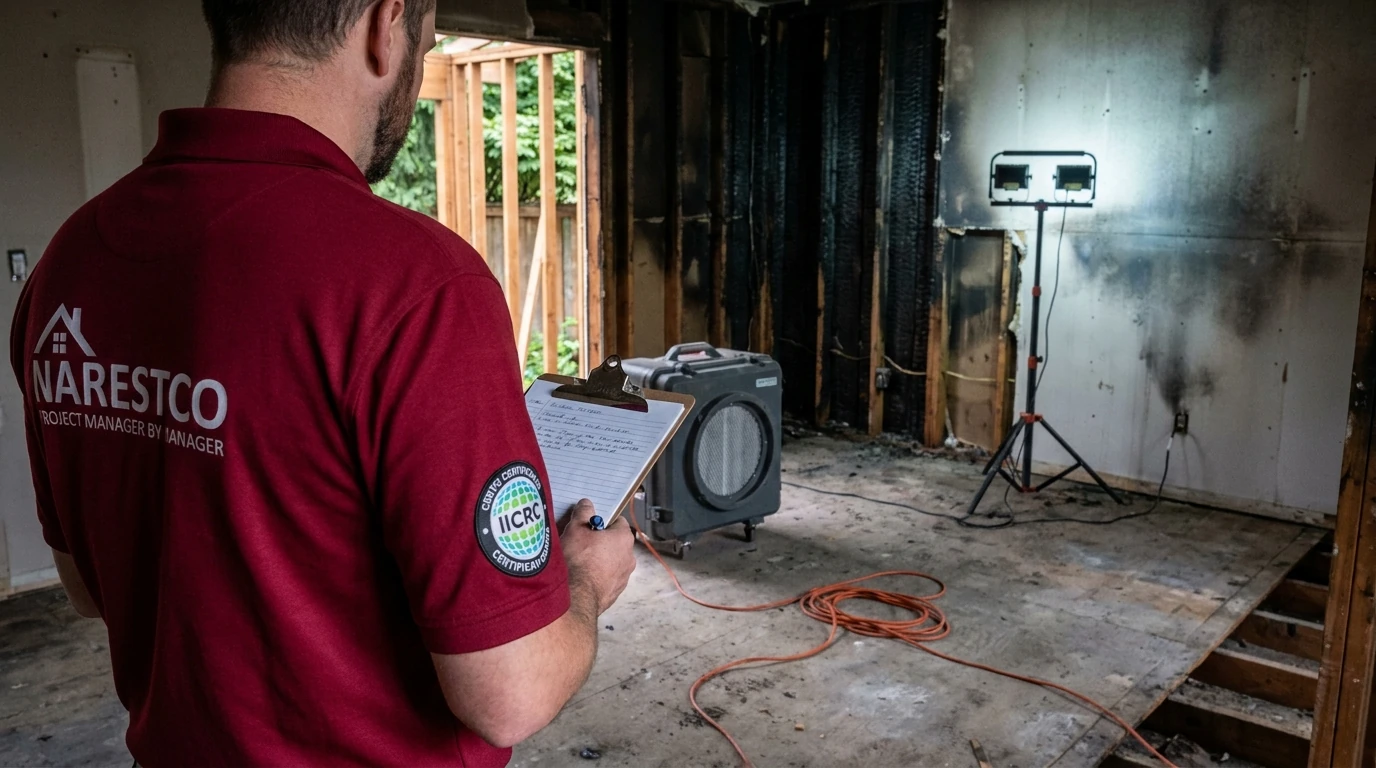
Your house fire is out. The fire marshal has cleared the property. Now you’re standing in the driveway trying to figure out what this is going to cost and whether your insurance will cover it. The honest answer: residential fire damage restoration runs anywhere from $3,000 for a contained kitchen fire with limited smoke spread to $50,000 or more when structural framing, multiple rooms, and full contents are involved. The range is wide because fire damage is rarely just one thing, it’s soot, smoke penetration, water from suppression, structural char, and odor, often all at once.
Here’s how restoration contractors actually price this work, and what you should expect at each severity level.
What Drives the Cost: The Four Damage Categories
Fire damage restoration isn’t priced as a single line item. Contractors working to the IICRC S700 standard (the industry’s fire and smoke restoration guideline) scope the job across four distinct damage types, each with its own labor and material cost.
1. Smoke and soot removal
Soot is acidic and bonds to surfaces within hours of a fire. The longer it sits, the deeper it etches into drywall, wood trim, cabinetry, and HVAC systems. Soot removal typically runs $2 to $6 per square foot depending on surface porosity and soot density. A 1,500 sq ft home with moderate smoke spread might see $3,000 to $9,000 in soot cleaning costs alone, before any structural work begins. Protein-based fires (cooking fires) are the most difficult, the residue is nearly invisible but penetrates deeply and produces a persistent odor that requires chemical counteractants, not just wiping.
2. Structural fire damage repair
Charred framing, burned subfloor, and fire-compromised drywall require removal and replacement. Structural repair costs vary significantly by the extent of burn:
- Contained room fire (one room, limited char): $5,000 to $15,000
- Multi-room or partial second floor involvement: $15,000 to $35,000
- Significant structural involvement (roof, load-bearing walls, multiple floors): $35,000 to $80,000+
These ranges assume a licensed general contractor is doing the rebuild under permit, which is required in Washington State and most jurisdictions for structural work. Cutting corners on the rebuild scope to save money upfront routinely creates code compliance problems at resale.
3. Odor removal and deodorization
Smoke odor isn’t cosmetic. It’s a chemical residue embedded in porous materials: insulation, carpet padding, wall cavities, HVAC ductwork. Effective odor removal uses a combination of thermal fogging, hydroxyl generators, and ozone treatment, not air fresheners. Budget $500 to $2,500 for odor treatment on a contained fire; $2,500 to $6,000 when smoke has spread through HVAC or into wall cavities throughout the home. If HVAC ductwork is contaminated, duct cleaning adds another $300 to $1,000 depending on system size.
4. Water damage from fire suppression
Fire hoses deliver roughly 250 gallons per minute. Even a 10-minute suppression effort leaves significant standing water, and that water wicks into walls, subfloor, and insulation within hours. Suppression water is typically classified as Category 1 (clean water from municipal supply) initially, but it becomes Category 2 or 3 quickly in a fire environment due to soot and debris contamination. Expect water extraction, drying, and documentation to add $1,500 to $8,000 to the total scope, depending on how much water was used and how quickly mitigation starts.
Cost Per Square Foot Benchmarks
For homeowners researching fire damage restoration cost per square foot, here are realistic ranges by damage severity:
| Severity | Description | Cost Per Sq Ft |
|---|---|---|
| Minor | Contained kitchen or small room fire, limited smoke spread | $4 to $12 |
| Moderate | Multiple rooms affected, smoke throughout HVAC, some structural damage | $12 to $30 |
| Severe | Significant structural involvement, full contents loss, roof or wall system damage | $30 to $60+ |
These figures cover mitigation and restoration but not full rebuild of a total loss. A complete rebuild after a total loss is priced as new construction, typically $150 to $250+ per square foot in the Pacific Northwest.
What Insurance Typically Covers (and What It Doesn’t)
Most standard homeowners policies (HO-3 form) cover fire damage under the dwelling coverage (Coverage A) and personal property coverage (Coverage C). The key things to understand:
What’s generally covered: Structural damage from the fire, smoke and soot remediation, water damage from suppression efforts, temporary housing (ALE, Additional Living Expenses) while the home is uninhabitable, and contents replacement up to your policy limits.
What’s commonly disputed or excluded: Damage to detached structures (covered under Coverage B, usually at 10% of dwelling limit), high-value items above scheduled limits (jewelry, art, electronics), and any pre-existing damage the adjuster identifies during inspection.
Actual Cash Value vs. Replacement Cost Value: If your policy pays ACV, the insurer deducts depreciation from your payout. A 15-year-old roof that burned is worth less than a new roof under ACV. RCV policies pay to replace at current cost. Check your declarations page before the adjuster visit.
One practical note: your insurer will likely send their own preferred vendor to scope the loss. You are not required to use that vendor. You have the right to hire an independent restoration contractor and submit their scope to the adjuster. Getting an independent written scope is often the fastest way to identify underpaid line items.
The Timeline: What Happens in What Order
Understanding the sequence helps you evaluate contractor proposals and avoid being upsold on work that happens later.
Days 1 to 3 (Emergency mitigation): Board-up and tarping to secure the structure, initial water extraction from suppression water, placement of air movers and dehumidifiers, HEPA air scrubbers to begin clearing airborne particulate. This phase is time-sensitive, soot etching and secondary water damage worsen with every hour of delay.
Days 3 to 14 (Mitigation and cleaning): Structural drying documentation, soot removal from salvageable surfaces, contents pack-out and inventory for insurance purposes, HVAC cleaning if contaminated, odor treatment.
Weeks 2 to 8+ (Reconstruction): Permitted structural rebuild, drywall, insulation, flooring, cabinetry, painting, fixture reinstallation. Timeline depends heavily on permit turnaround in your jurisdiction and the availability of materials.
The mitigation and reconstruction phases are often handled by the same contractor (which simplifies coordination and insurance documentation) or split between a mitigation firm and a separate general contractor. If they’re split, make sure both scopes are submitted to insurance simultaneously to avoid gaps.
Red Flags When Getting Estimates
A few things to watch for when reviewing proposals:
Vague line items: Legitimate restoration scopes are itemized, square footage of drywall removed, linear feet of framing replaced, hours of HEPA air scrubbing. “Fire cleanup” as a single lump sum is not a scope; it’s a guess.
No mention of IICRC S700: The S700 standard defines how fire and smoke damage is categorized and treated. Contractors who don’t reference it may not be following industry-standard protocols, which can create problems if the insurer disputes the scope later.
Pressure to sign immediately: Legitimate contractors will give you time to review a written scope. Storm chasers and post-disaster solicitors often pressure for same-day signatures on open-ended authorization forms.
No license or certification verification: In Washington State, contractors performing structural restoration work must hold a valid General Contractor Certificate of Registration with the Department of Labor and Industries. Verify the license number before signing anything.
What to Do in the Next 48 Hours
If you’re reading this within two days of a fire, here’s the practical sequence:
- Notify your insurer and get a claim number. Ask specifically whether they require you to use their preferred vendor or whether you can choose your own contractor.
- Document everything before cleanup begins, photograph and video every room, every damaged surface, every piece of damaged contents.
- Get a written scope from an independent contractor before the adjuster’s inspection if possible. An itemized scope gives you a baseline to compare against the adjuster’s estimate.
- Don’t discard any damaged contents until they’ve been inventoried for the claim. Even items that appear unsalvageable need to be documented.
- Ask about temporary housing, your policy’s ALE coverage should cover hotel or rental costs while the home is uninhabitable.
National Restoration Construction handles fire damage restoration and full reconstruction under one roof, which means one scope, one point of contact, and one timeline submitted to your insurer. If you’re in the early stages of a claim and want an independent written scope, request a fire damage assessment through our fire damage restoration service or reach out directly at (206) 883-0333.
For smoke-specific damage, including situations where a neighboring property fire sent smoke through your HVAC, see our smoke damage restoration service. When the scope includes structural rebuild, our reconstruction team handles permitted work from framing through finish.