
If rain water got inside your home and you’re wondering whether your homeowners policy will pay for it, the answer depends on one critical question: how did the water get in. Rain itself isn’t a covered peril under most standard HO-3 policies. What’s covered is the structural damage that let the rain enter, and that distinction determines whether you get a check or a denial.
The Short Answer: It Depends on the Entry Point
Standard homeowners insurance (HO-3 form) covers water damage from rain when rain enters through a sudden, accidental opening caused by a covered peril, a wind-damaged roof, a fallen tree limb that punched through a wall, a hailstorm that broke a skylight. In those cases, both the structural repair and the interior water damage are typically covered under your dwelling coverage (Coverage A).
What it does not cover:
- Surface flooding, rainwater that pools on the ground and enters through doors, windows, or foundation cracks. That requires a separate flood insurance policy, typically through the National Flood Insurance Program (NFIP) or a private flood carrier.
- Gradual leaks, a roof that’s been leaking slowly for two seasons, a window flashing that’s been failing for years. Insurers call this “maintenance neglect” and it’s explicitly excluded in nearly every policy.
- Seepage and groundwater, water that migrates through foundation walls or up through a slab during heavy rain is treated as a flood or seepage event, not a sudden loss.
The dividing line insurers draw is between sudden and accidental damage and gradual deterioration. If you can show the opening in your roof or wall happened during a specific storm event, you’re in covered territory. If the adjuster finds years of water staining and deteriorated flashing, expect a fight.
What a Covered Rain-Water Claim Actually Looks Like
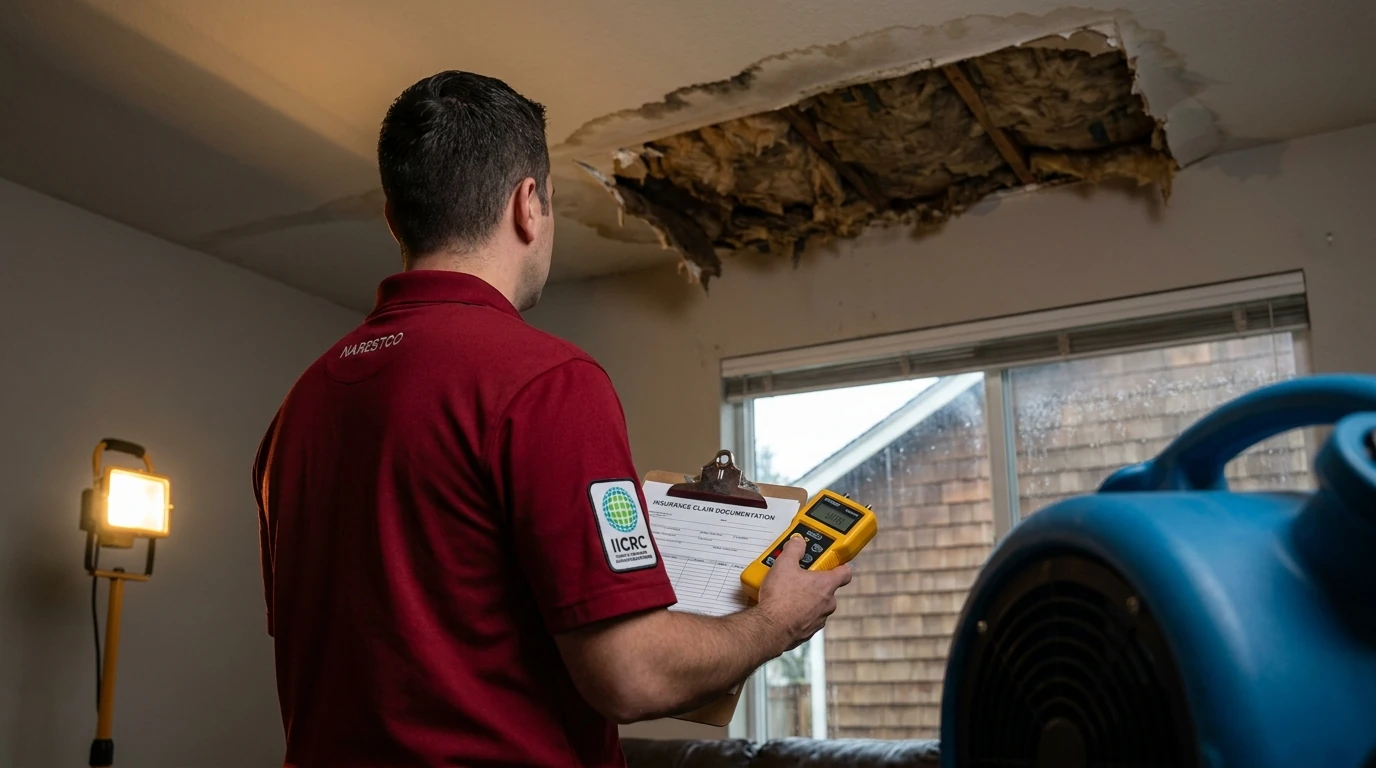
Here’s a scenario that typically gets paid: A windstorm tears off a section of roof sheathing during a storm. Rain enters through the opening over the next 48 hours, soaking attic insulation, ceiling joists, and the drywall below. You call your insurer within a day or two, document the opening, and file a claim. The policy pays to repair the roof and remediate the interior water damage, including drying, demolition of saturated drywall, and reconstruction.
The key elements that make this claimable:
- A specific storm event with a date you can document
- A sudden structural breach, not pre-existing deterioration
- Prompt reporting, most policies require “timely notice” of a loss; waiting weeks can give the insurer grounds to reduce or deny the claim
- Reasonable mitigation steps, you’re contractually obligated to prevent further damage after a loss. Covering the opening with a tarp, extracting standing water, and calling a restoration contractor all demonstrate you acted reasonably.
If you skip mitigation and secondary mold growth develops over the following two weeks, your insurer may cover the initial water damage but deny the mold remediation on the grounds that you failed to mitigate. That’s a painful and avoidable outcome.
What Gets Denied, and Why
The most common rain-related claim denials come down to a few recurring patterns:
Gradual damage findings. Adjusters are trained to look for evidence of pre-existing deterioration, stained roof decking, rusted fasteners, cracked caulk around skylights. If they find it, they’ll classify the loss as maintenance-related and exclude it. The best defense is regular documented maintenance: keep receipts for roof inspections and repairs.
Flood versus wind-driven rain. If your basement took on water during a heavy rain event, the insurer will almost certainly classify it as surface flooding or groundwater intrusion, not covered under a standard HO-3. The fact that it was raining outside doesn’t make it a covered rain event. Flood damage requires flood insurance, full stop.
Delayed reporting. Discovering water damage in your attic three months after a storm and filing a claim then is a difficult position. The insurer can argue the damage worsened due to your failure to discover and report it promptly. Seasonal inspections of your attic and crawlspace after major storm events are worth the time.
Cosmetic exclusions. Some policies include cosmetic damage exclusions for hail or wind, meaning surface-level damage to siding or roofing that doesn’t affect function may be excluded even if it’s storm-caused.
How to Document a Rain-Related Water Damage Claim
Documentation is the difference between a smooth claim and a protracted dispute, and it shapes the final number (see our breakdown of the average insurance payout for water damage). If you’re dealing with rain intrusion right now, here’s the sequence:
- Photograph the breach point before any repairs. Get the exterior opening, the interior water path, and the affected materials. Date-stamped photos from your phone are fine.
- Pull weather data. NOAA’s storm event database and Weather Underground both let you pull historical precipitation and wind-speed records for a specific date and zip code. Print or screenshot the data for your claim file.
- Document the moisture extent. A restoration contractor using a non-invasive moisture meter (Tramex or Delmhorst are common in IICRC-standard assessments) can map the moisture boundary in walls and ceilings. That map becomes part of your claim documentation and defines the scope of work.
- Get a written scope before work starts. A detailed written estimate from a licensed restoration contractor, line items for extraction, drying, demolition, and reconstruction, gives your adjuster a concrete basis for the claim and prevents scope disputes later.
- Mitigate immediately. Tarp the roof opening, extract standing water, deploy air movers and dehumidifiers. Keep all receipts. Emergency mitigation costs are typically reimbursable under your policy’s “reasonable repairs” provision.
Most standard HO-3 policies have a deductible of $1,000 to $2,500 for water claims, though some carriers now apply a separate wind/hail deductible (sometimes a percentage of your Coverage A limit rather than a flat dollar amount). Know your deductible before deciding whether to file, smaller claims close to your deductible threshold may not be worth the potential rate impact at renewal.
Should You File, or Pay Out of Pocket?
This is a judgment call that depends on three numbers: the repair cost estimate, your deductible, and your current claim history. Insurers track claims through the CLUE (Comprehensive Loss Underwriting Exchange) database. Filing a claim, even one that gets paid, can affect your renewal premium or your carrier’s willingness to renew at all, particularly if you’ve filed in the past three to five years.
A rough rule of thumb: if the repair cost is less than twice your deductible, paying out of pocket is often the better long-term financial decision. If the damage is significant, saturated insulation, structural framing, multiple rooms affected, filing is almost always the right call.
If you’re on the fence, a restoration contractor can give you a written estimate before you file. That number lets you make an informed decision without committing to a claim.
What to Do Right Now
If rain water entered your home during a recent storm, the 48-to-72-hour window matters. Wet building materials, drywall, insulation, wood framing, that stay wet beyond 48 to 72 hours are in the window where mold colonization begins under IICRC S500 guidelines. Secondary mold damage that develops because drying was delayed is a coverage gray area at best.
Get the structure dried out first. Then work the claim. Those two things aren’t mutually exclusive, a professional restoration contractor can begin drying while you’re on the phone with your insurer, and the drying documentation they generate (psychrometric logs, moisture readings, equipment placement records) becomes part of your claim file.
National Restoration Construction handles water damage assessment, emergency extraction, structural drying, and the documentation that insurance adjusters need to process claims efficiently. If you’ve had rain intrusion and aren’t sure what you’re dealing with, request a moisture assessment before the drying window closes.