
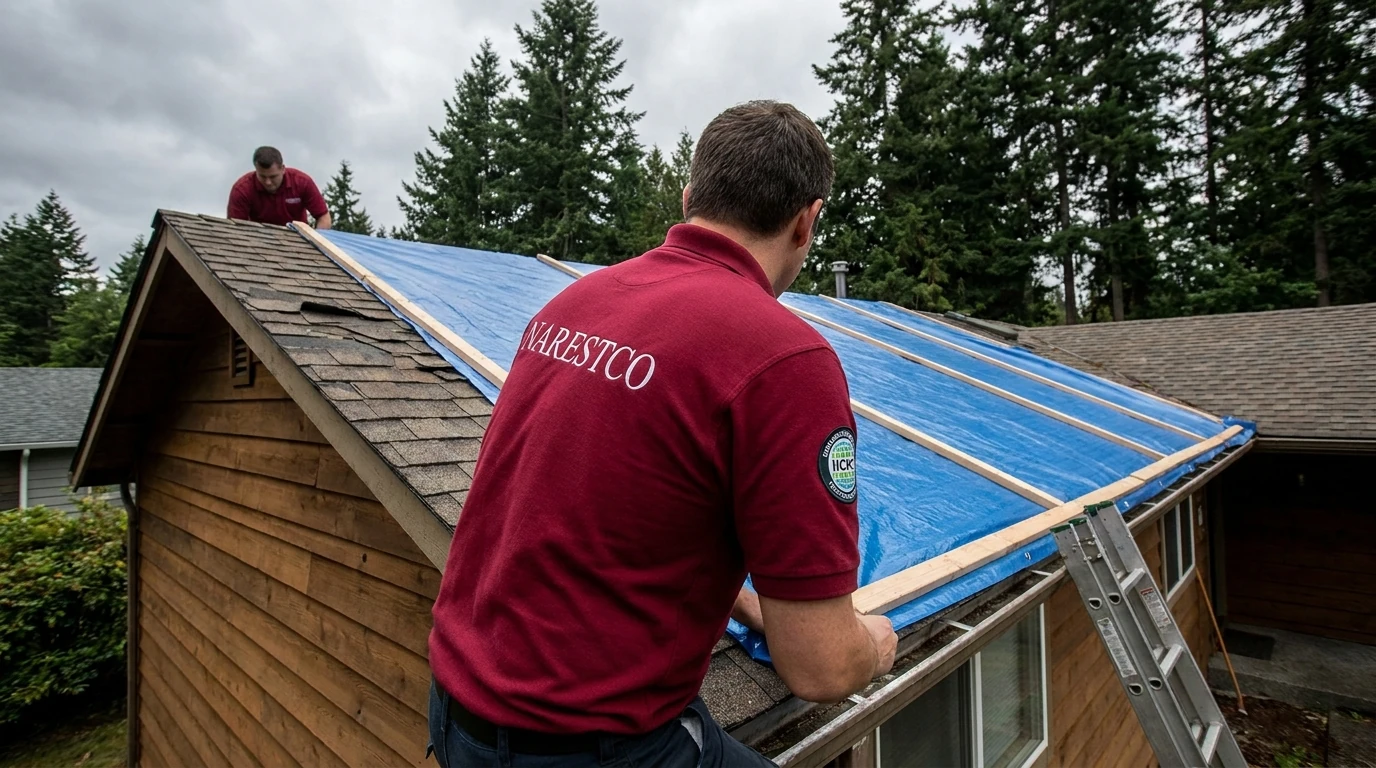
TL;DR: Yes, standard homeowners insurance covers most sudden storm damage: wind, hail, falling trees, and rain that enters through a storm-created opening. What it does NOT cover is flooding from storm surge or rising water (that needs a separate flood policy), damage from gradual leaks, or problems tied to deferred maintenance. In Washington, the distinction between wind-driven rain and ground-level flooding matters a lot, because Pacific Northwest storms deliver both at once.
If a windstorm just tore shingles off your roof, a fir tree came down on your garage, or an atmospheric river drove water through a window frame that blew out, you are probably covered. The question is not usually whether your policy covers storm damage at all. The question is whether the specific damage in front of you fits the sudden-and-accidental standard your insurer will apply. This post walks through what Washington homeowners typically find when they open that policy.
Does homeowners insurance cover wind and hail damage?
Yes. Wind and hail are named perils under virtually every standard homeowners policy (HO-3 form), and they are among the most commonly paid claims in Washington State. If a windstorm lifts shingles, shatters a skylight, or pushes a fence into your siding, that damage is covered under your dwelling coverage (Coverage A) up to your policy limit, minus your deductible.
The Insurance Information Institute notes that wind is one of the top causes of homeowners claims nationally. In the Pacific Northwest, the risk profile skews toward winter windstorms rather than tornadoes or hurricanes. The Puget Sound region regularly sees sustained winds of 40-60 mph during November through February, and gusts from the Cascades can push higher in exposed areas. These events are well within the scope of a standard HO-3 policy.
One thing to watch: some insurers in coastal or high-wind zones add a separate wind or hail deductible, expressed as a percentage of your dwelling coverage rather than a flat dollar amount. A 2% wind deductible on a $600,000 home means $12,000 comes out of your pocket before coverage kicks in. Check your declarations page before you assume your flat deductible applies.
Does insurance cover a tree falling on your house?
Generally yes, if the tree was healthy and the fall was caused by a storm. When a wind event knocks a tree or large branch onto your roof, fence, or detached garage, the resulting structural damage is covered under your dwelling or other-structures coverage. Your policy will also typically pay a limited amount (often $500-$1,000) toward debris removal.
The situation gets more complicated in a few scenarios:
- Your tree falls on your neighbor’s property. Your policy does NOT cover your neighbor’s damage. Their policy covers it, unless you were negligent (e.g., the tree was visibly dead and you ignored written requests to remove it).
- A neighbor’s tree falls on your house. Your policy covers YOUR structural damage. You would pursue your neighbor’s liability coverage only if negligence is provable.
- The tree falls but misses the house. Most policies only pay debris removal when the tree actually damages a covered structure. If it lands in your yard without hitting anything, removal costs are typically on you.
- The tree was already dead or diseased. Insurers may deny or reduce the claim if they can show you knew the tree was hazardous and failed to act. Document tree health proactively, especially large conifers close to structures.
What storm damage is NOT covered by homeowners insurance?
Three categories account for most storm-related claim denials in Washington:
1. Flood damage from storm surge or rising water. This is the most important exclusion to understand. Standard homeowners policies explicitly exclude flooding defined as water that rises from the ground up: overflowing rivers, storm drains backing up into streets, tidal surge, and sheet flow across saturated ground. If an atmospheric river dumps six inches of rain in 24 hours and your basement fills because the ground can’t absorb it, that is a flood loss. You need a separate flood policy through the National Flood Insurance Program (NFIP) or a private flood insurer to cover it.
This distinction is critical in western Washington. A single storm can produce both covered wind damage (shingles off the roof) and excluded flood damage (water in the crawl space from saturated soil) at the same time. Adjusters will separate the two, and you need to document which damage came from which mechanism.
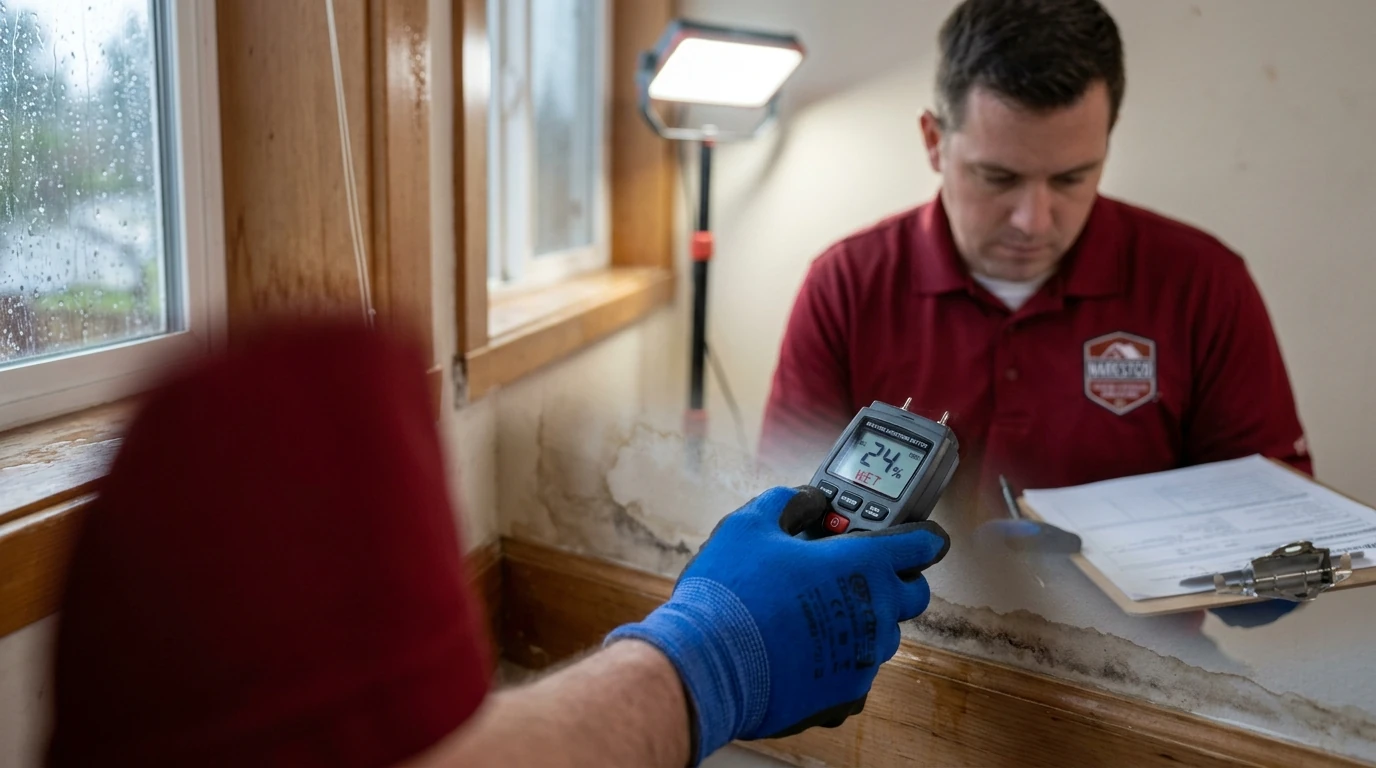
2. Gradual leaks and deferred maintenance. If your roof was already failing before the storm and rain entered through pre-existing gaps, the insurer will argue the damage is from wear and neglect, not the storm event. The policy covers sudden and accidental damage. It does not cover the slow rot that was already happening. This is why pre-storm roof condition matters: a recent inspection report or photos showing a healthy roof before the storm is strong evidence in your favor.
3. Mold resulting from delayed reporting. Washington homeowners sometimes discover storm damage weeks after an event. If mold has already developed in wet framing or insulation by the time you file, the insurer may argue you failed to mitigate promptly. Most policies require you to take reasonable steps to prevent further damage once you discover it. Tarping a damaged roof, covering broken windows, and documenting everything the day you find it protects your claim. See our Storm Damage Insurance Claim Checklist for the step-by-step documentation sequence.
Does homeowners insurance cover roof storm damage specifically?
Yes, but the payout depends on your policy’s loss-settlement method. There are two common approaches:
- Replacement Cost Value (RCV): The insurer pays what it costs to replace the damaged portion of your roof with like materials at today’s prices, minus your deductible. This is the better coverage.
- Actual Cash Value (ACV): The insurer pays replacement cost minus depreciation. A 20-year-old roof on a 25-year shingle may be depreciated to near zero, leaving you with almost nothing after the deductible.
Check your declarations page for which method applies to your roof. Some policies offer RCV on the dwelling but ACV on the roof specifically, especially for older roofs. If your roof is more than 15 years old, this is worth a direct conversation with your agent before the next windstorm season.
For covered roof claims, your insurer will typically pay for emergency tarping, the damaged roofing materials, and related structural repairs. National Restoration Construction handles both the emergency roof leak repair and the full storm damage restoration scope, and can provide the written documentation your adjuster needs to process the claim accurately.
How should you file a storm damage claim in Washington?
File quickly and document everything before any cleanup or repair begins. Here is the sequence that protects most claims:
- Make the property safe first. If there is a structural hazard, gas leak, or electrical risk, address that before anything else. Call 911 if needed.
- Photograph and video the damage before touching it. Walk the entire exterior and interior. Capture date-stamped photos of every damaged surface, from multiple angles.
- Prevent further damage. Tarp the roof, board broken windows, extract standing water. Keep all receipts. Your policy requires mitigation; it also reimburses reasonable mitigation costs.
- Call your insurer to open the claim. Have your policy number, the date of loss, and a brief description of what happened.
- Get a professional damage assessment in writing. An adjuster works for the insurer. An independent restoration contractor’s written scope gives you a second set of eyes on what the repair actually requires.
- Do not sign a direction-to-pay or assignment of benefits without reading it. Some contractors ask homeowners to sign over insurance proceeds before work begins. Understand what you are signing.
For a full documentation checklist, see our Storm Damage Insurance Claim Checklist. For context on how water damage coverage works alongside storm claims, the companion post Does Homeowners Insurance Cover Water Damage? covers the overlap between storm-driven water and plumbing-source water in more detail.
If you are dealing with active storm damage right now, National Restoration Construction is available 24/7 at (206) 883-0333. The crew handles emergency tarping and board-up, water extraction, and the full written documentation your adjuster will need.
About National Restoration Construction
National Restoration Construction is an IICRC-certified, EPA-certified, Lead-Safe-certified firm serving the greater Puget Sound region since 2004 (WA General Contractor License NATIORC792M6). Their crews handle storm damage restoration, roof leak repair, water damage restoration, mold remediation, fire and smoke damage, and reconstruction across Federal Way, Seattle, Tacoma, Bellevue, and surrounding communities. Available 24/7 at (206) 883-0333.