
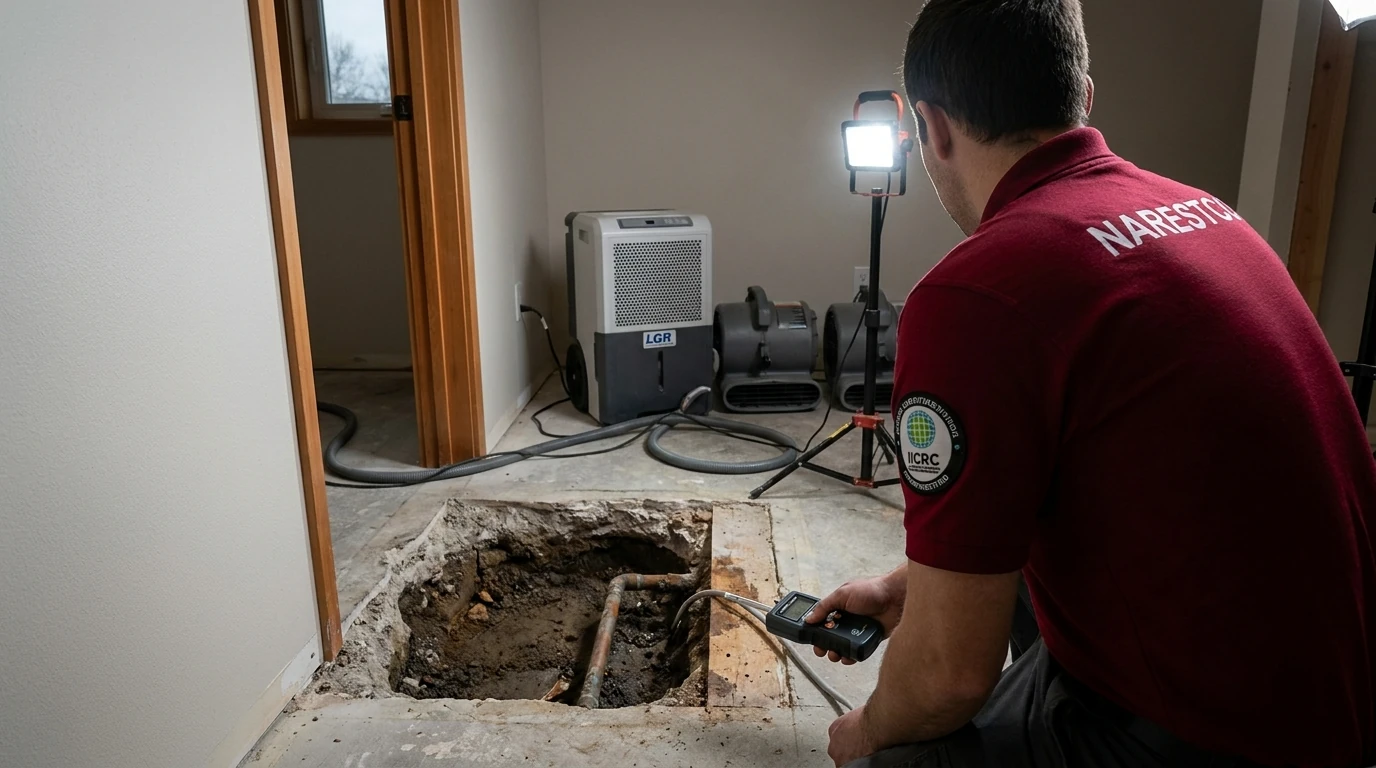
Your plumber just told you the leak isn’t under the sink, it’s under the slab. Now you’re staring at a five-figure repair estimate and wondering whether your homeowners policy will pay for any of it. The short answer: most standard HO-3 policies cover the water damage caused by a sudden, accidental pipe break under the foundation, but they typically exclude the cost of breaking through the slab to reach the pipe and almost always exclude foundation repair itself. What you get covered, and how much, depends heavily on how you document the loss.
What Standard HO-3 Policies Actually Cover
Homeowners insurance is built around the concept of “sudden and accidental” loss. A pipe that ruptures without warning, from a pressure spike, a manufacturing defect, or soil movement that crimps the line, generally qualifies. What that means in practice:
- Resulting water damage to flooring, subfloor, drywall, cabinetry, and personal property is typically covered under your dwelling (Coverage A) and personal property (Coverage C) provisions.
- Tear-out costs, the labor to jackhammer or saw-cut the concrete slab to access the broken pipe, are covered under most policies through what’s called a “tear-out” or “access” endorsement. This is not universal. Check your declarations page specifically for this language. Some policies cap tear-out at $5,000; others cover it at the same limit as the dwelling.
- The pipe repair itself (parts and labor to fix the actual broken section) is almost always excluded. Pipes are considered a maintenance item. The insurer covers the consequences of the failure, not the failure itself.
- Foundation repair is excluded under virtually every standard HO-3 policy. If the pipe break caused the slab to heave, crack, or settle, that structural damage is not covered by your homeowners policy. It may be covered by a separate structural warranty or, in rare cases, a specialty endorsement, but not by the base policy.
The line insurers draw: they pay for what the water damaged, not for the infrastructure that failed.
The Gradual Leak Problem
This is where most denied claims originate. If the pipe under your foundation has been seeping for months, slowly saturating the soil, causing efflorescence on your basement walls, or driving up your water bill, your insurer will likely deny the claim on the basis of “long-term seepage” or “gradual deterioration.”
Insurers look for evidence of pre-existing damage during the claims inspection. A restoration contractor or independent adjuster will note:
- Mineral deposits (efflorescence) on concrete or block walls, which indicate sustained moisture exposure
- Mold or mildew growth that predates the reported loss date
- Rust staining or corrosion patterns inconsistent with a recent event
- Soil saturation patterns suggesting weeks or months of seepage rather than a single event
If the pipe failed gradually, the policy language almost certainly excludes it. The IICRC S500 standard distinguishes between Category 1 (clean water from a supply line break) and Category 3 (grossly contaminated water) losses, but the more relevant distinction for insurance purposes is the timeline: sudden versus gradual.
If you noticed signs of a problem and didn’t act on them, that works against your claim. Document when you first noticed anything unusual and be precise with your adjuster.
What the Claim Process Actually Looks Like
Once you’ve confirmed the break is under the slab, here’s the sequence that protects your claim:
1. Mitigate immediately. Your policy requires you to prevent further damage. Shut off the water supply to the affected line. If standing water is present, extraction needs to start within 24 to 48 hours to prevent secondary mold damage. Mold growth that results from delayed mitigation can be excluded as a separate, preventable loss.
2. Document before anything is touched. Photograph and video the water intrusion, the affected flooring, any visible moisture wicking up walls, and the plumber’s initial assessment. Get the plumber’s written diagnosis specifying that the break was sudden and accidental, that language matters when the adjuster reviews the file.
3. File the claim before authorizing major work. Your insurer has the right to inspect the loss before repairs begin. Jackhammering the slab before the adjuster sees it can complicate your claim. Call your insurer first, get a claim number, and confirm whether they require an adjuster inspection before tear-out begins. Many carriers now allow restoration contractors to begin mitigation (water extraction, drying) before the adjuster arrives, but structural work like slab cutting typically requires prior authorization.
4. Request a written scope from your restoration contractor. A professional scope of work that itemizes extraction, structural drying, affected materials, and moisture readings (in WSMR, wet standard moisture readings) gives the adjuster a defensible basis for the settlement. Verbal estimates don’t hold up in supplement disputes.
5. Understand your deductible and coverage limits. Most HO-3 policies carry a $1,000 to $2,500 deductible. If the total covered loss is $8,000 and your deductible is $2,000, you net $6,000. Filing a claim for a $3,000 loss with a $2,000 deductible often isn’t worth the premium impact, get a restoration estimate before you file.
Common Reasons Claims Get Denied or Underpaid
Beyond the gradual-leak exclusion, watch for these:
Service line exclusion. Some policies exclude pipes that supply water to the home from the municipal main, the “service line” running under the yard and foundation. This is often a separate endorsement you have to add. If your break is on the supply side before it enters the home’s plumbing system, you may be looking at a service line claim rather than a standard dwelling claim.
Mold exclusion. If the pipe break went undetected long enough for mold to establish, some policies exclude mold remediation costs entirely or cap them at $5,000 to $10,000. If mold is present, get a separate mold inspection and testing assessment to document the extent before remediation begins. A professional mold remediation scope submitted with the water damage claim gives the adjuster a complete picture of the loss.
Underdocumented drying. Insurers increasingly require moisture mapping data, daily moisture readings logged by equipment, drying logs from LGR dehumidifiers and air movers, and a final clearance reading, to pay out the full structural drying portion of a claim. A contractor who just drops equipment and doesn’t document the drying process leaves money on the table.
Depreciation disputes. Insurers apply depreciation to flooring, cabinetry, and other materials based on age and condition. If your policy is Actual Cash Value (ACV) rather than Replacement Cost Value (RCV), you’ll receive the depreciated value, not what it costs to replace the materials today. Know which you have before the adjuster visits.
What to Do Right Now
If you’re in the middle of this situation, the two most important calls are to your insurer and to a licensed restoration contractor, in that order, or simultaneously. Get the claim number first so the contractor can reference it in their documentation. A contractor experienced with insurance claims will know how to structure the scope of work to align with your policy’s coverage language, flag the tear-out endorsement question, and provide the moisture data your adjuster needs.
Avoid authorizing slab demolition before the adjuster has confirmed coverage for tear-out. That single step, getting written authorization before the jackhammer runs, prevents the most common dispute in slab-leak claims.
If mold has developed as a result of the leak, that needs to be assessed and scoped separately from the water damage restoration work. Mold remediation under a slab or in a crawlspace has its own documentation requirements and, in some cases, its own coverage sub-limit.
National Restoration Construction handles water damage claims throughout the greater Seattle-Tacoma region, including slab-leak extraction, structural drying, mold assessment, and full reconstruction after slab access. If you need a written scope for your adjuster or want a moisture assessment before you file, request an estimate through our water damage restoration page or contact us directly.