
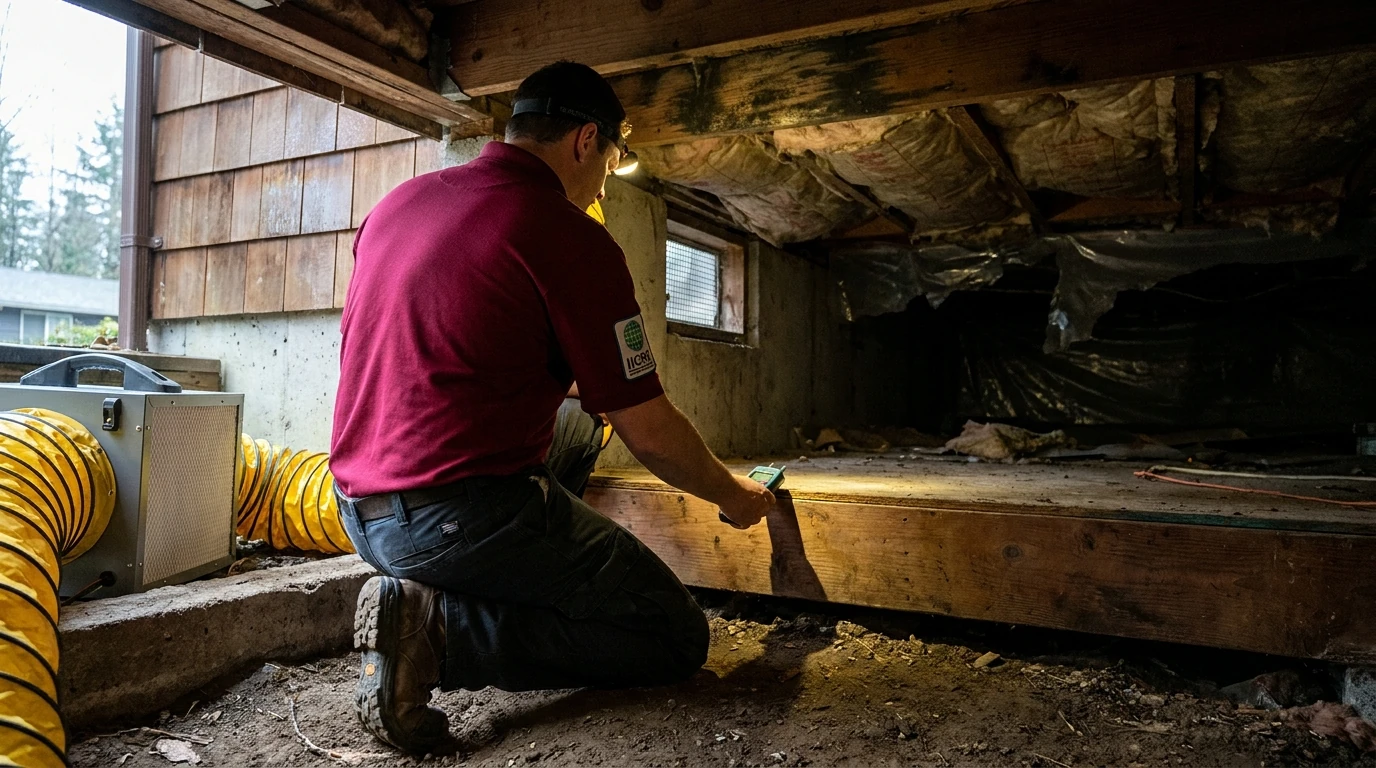
TL;DR: Crawl space mold is extremely common in Federal Way and the broader South King County area because vented crawl spaces pull in humid Puget Sound air year-round. Professional removal involves HEPA vacuuming, antimicrobial treatment, and encapsulation with a reinforced vapor barrier. Costs typically run $1,500 to $6,000 depending on square footage and severity. Left untreated, crawl space mold spreads to floor joists, subfloor, and eventually into living spaces through the stack effect.
You noticed a musty smell when you opened the crawl space hatch, or maybe your home inspector flagged it on a report. Either way, you’re now staring at dark staining on the floor joists and wondering how bad it is and what it costs to fix. In Federal Way, this is one of the most common calls we get, and it’s almost never a surprise. The region gets over 37 inches of rain per year, most of it as low-grade drizzle that keeps ground moisture levels elevated from October through June. Older ramblers in Twin Lakes, Lakeland, and Dash Point were built in the 1970s and 80s with vented crawl spaces that were standard practice at the time. That design made sense in drier climates. In the Puget Sound basin, it’s a mold incubator.
What Are the Signs of Mold in a Crawl Space?
The most reliable signs of crawl space mold are a persistent musty odor inside the home, visible dark staining on wood joists or the underside of the subfloor, and elevated humidity readings (above 60% RH) when you measure inside the crawl space. You may also notice cupping or soft spots in hardwood floors above the crawl space, or worsening allergy symptoms in household members.
Most homeowners never see their crawl space. The mold grows quietly for months or years before it shows up in any obvious way. By the time you smell it inside the house, the colony is usually well established. Here’s what to look for if you do go in:
- White or gray fuzzy growth on joists or the vapor barrier: often early-stage Penicillium or Aspergillus
- Black or dark green staining on wood: can indicate Cladosporium or, in more advanced cases, Stachybotrys (“black mold”)
- Orange or rust-colored staining on concrete stem walls: often combined moisture and biological growth
- Deteriorating insulation: kraft-faced insulation that’s sagging, wet, or discolored is a sign moisture has been present long enough to saturate the batt
If you see any of these, don’t disturb the area. Disturbing mold growth without containment releases spores into the air and can spread contamination to the living space above.
How Does Crawl Space Mold Removal Actually Work?
Professional crawl space mold remediation follows the IICRC S520 Standard for Professional Mold Remediation. The process starts with containment and ends with clearance testing to confirm the work is complete.
Here’s the sequence a qualified remediation crew uses:
-
Inspection and moisture mapping. A technician enters the crawl space with a pin-type moisture meter and a thermo-hygrometer to document moisture content in the wood (target: below 19% MC) and ambient relative humidity. This establishes the scope of work and identifies the moisture source.
-
Containment setup. Poly sheeting is used to isolate the crawl space from the living area above. HEPA-filtered negative air machines create negative pressure so disturbed spores exhaust outside rather than migrate into the home.
-
Removal of contaminated materials. Saturated insulation, damaged vapor barrier, and any wood that’s structurally compromised gets bagged and removed. HEPA vacuuming removes surface spore load from joists and subfloor.
-
Antimicrobial treatment. EPA-registered antimicrobial solution is applied to all affected wood surfaces. This kills active mold and inhibits regrowth. Some crews apply a borate-based wood preservative as a secondary treatment, which is particularly effective on the Douglas fir framing common in Pacific Northwest housing.
-
Drying. Commercial LGR (low-grain refrigerant) dehumidifiers run in the crawl space until wood moisture content drops below 19% MC. In a Federal Way crawl space in winter, this can take 3 to 5 days.
-
Encapsulation. A reinforced vapor barrier (typically 12 to 20 mil polyethylene or reinforced laminate) is installed across the entire crawl space floor and up the stem walls, sealed at seams and penetrations. This is the step that prevents recurrence.
-
Post-remediation verification (PRV). Air sampling or surface swabs are collected by a third-party industrial hygienist. The clearance standard under IICRC S520 is that spore counts inside the crawl space should not significantly exceed outdoor background levels for the same species.
How Much Does Crawl Space Mold Removal Cost in Federal Way?
Crawl space mold removal in Federal Way typically costs between $1,500 and $6,000 for a standard single-family home, with most jobs landing in the $2,500 to $4,500 range. Encapsulation adds $3,000 to $8,000 depending on square footage, and is almost always recommended as part of the same project.
Here’s how the cost breaks down:
| Scope | Typical Range |
|---|---|
| Mold removal only (small area, <200 sq ft affected) | $1,500 to $2,500 |
| Mold removal, moderate (200-500 sq ft affected) | $2,500 to $4,500 |
| Full remediation + encapsulation (1,000-1,500 sq ft crawl space) | $5,500 to $10,000 |
| Structural wood replacement (sistering damaged joists) | $500 to $3,000 additional |
Insurance coverage for crawl space mold is inconsistent. Most standard homeowners policies exclude mold unless it resulted directly from a covered peril (like a burst pipe). If the mold grew from long-term ground moisture, which is the case for most Federal Way crawl spaces, it’s typically not covered. That said, if a plumbing leak or roof leak contributed to the moisture problem, document that carefully, it may open a coverage path. Request a written scope of work from the remediation company before filing any claim.
Why Are Federal Way Crawl Spaces Especially Vulnerable?
Federal Way crawl spaces develop mold faster than most because of the combination of a wet climate, older vented crawl space design, and cold ground temperatures that cause condensation on wood surfaces.
The physics are straightforward. Warm, humid air from outside enters through crawl space vents. When it contacts the cooler wood framing and concrete stem walls (which stay near ground temperature, around 50-55°F year-round in South King County), moisture condenses directly onto those surfaces. Wood above 19% moisture content supports mold growth. In a vented crawl space in Federal Way, wood moisture content can hit 25 to 30% during wet months without any plumbing leak involved.
The 1970s and 80s ramblers common in Dash Point and Mirror Lake neighborhoods were built to building codes that required vented crawl spaces. Those codes assumed a drier climate. Modern building science recognizes that in climates with more than about 20 inches of annual rainfall, a sealed, conditioned crawl space dramatically outperforms a vented one. Washington State’s current energy code (WAC 51-11C) allows sealed crawl spaces with interior insulation, and many remediation projects in Federal Way end with the vents sealed as part of the encapsulation scope.
What Happens If You Ignore Crawl Space Mold?
Ignoring crawl space mold leads to structural wood decay, worsening indoor air quality, and significantly higher remediation costs the longer you wait.
Mold doesn’t stay in the crawl space. The stack effect, the natural upward movement of air through a home, pulls crawl space air into living areas through gaps in the subfloor, around plumbing penetrations, and through floor registers. Studies by the EPA and the Building Science Corporation have found that as much as 40 to 50% of the air in a home’s first floor originates from the crawl space. That means mold spores, mycotoxins, and elevated humidity are continuously entering your living space.
On the structural side: Cladosporium and other common crawl space molds are primarily cosmetic. But if moisture persists, wood-rot fungi (not technically mold, but often co-occurring) will begin breaking down the cellulose in your floor joists. By the time you see soft spots in your floor, the joist may have lost 20 to 30% of its structural capacity. Sistering new lumber alongside damaged joists adds cost and complexity to what started as a straightforward mold job.
Schedule a crawl space moisture assessment before the problem reaches that stage. Early-stage mold on sound wood is a one-to-two day remediation job. Structural wood replacement is a multi-week reconstruction project.
National Restoration Construction handles both the remediation and the reconstruction if joists are involved, so you’re not coordinating between two separate contractors. If you’re in Federal Way or anywhere in South King County, request a crawl space mold assessment through our mold remediation service or visit our Federal Way service area page for local contact information.
About National Restoration Construction
National Restoration Construction is an IICRC-certified, EPA-certified, and Lead-Safe Certified restoration company serving Federal Way, WA and the greater South King County region since 2004 (WA License NATIORC792M6, issued by the WA State Department of Labor & Industries). Their crews handle mold remediation, water damage, fire damage, and full reconstruction across the Puget Sound area. BBB Accredited. Available 24/7 at (206) 883-0333.