
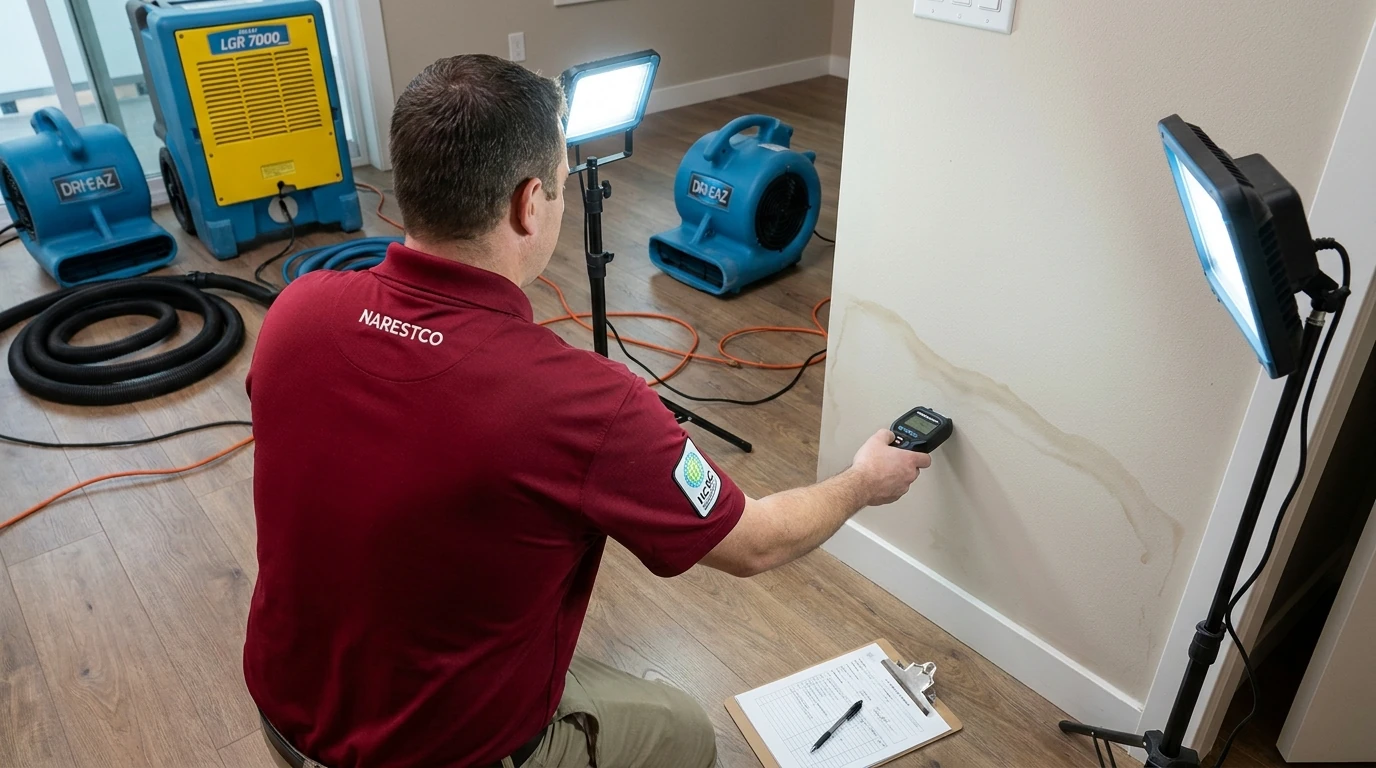
TL;DR: The best water damage restoration company in Bellevue, WA is one that holds a current IICRC certification, carries a valid Washington State contractor’s license, responds around the clock, and has documented experience with Eastside housing, including the HOA-mandated air clearance testing common in Bellevue’s condo and townhome developments. This guide explains what those credentials mean in practice, what questions to ask, and what the restoration process looks like for a Bellevue home.
If you just discovered water damage in your Bellevue home, a burst supply line in a Somerset townhome, a roof leak over a Crossroads condo, a sump failure in a Lake Hills basement, you’re probably searching for someone trustworthy right now. This guide won’t rank companies. It will tell you exactly what separates a qualified restoration contractor from one that will cost you more in the long run.
What credentials should a water damage company in Bellevue actually have?
A qualified water damage restoration company in Bellevue should hold IICRC certification, a current Washington State General Contractor’s license, and, for older properties, Lead-Safe Firm certification from the EPA. These aren’t marketing badges; they’re the baseline for safe, insurable work.
Here’s what each one means:
IICRC Certification, The Institute of Inspection, Cleaning and Restoration Certification sets the industry standard for water damage drying through its S500 Standard. An IICRC-certified firm’s technicians are trained to classify water damage by category (Category 1 is clean water from a supply line; Category 2 is gray water from a dishwasher or washing machine; Category 3, also called black water, includes sewage and floodwater) and by class of absorption. That classification determines the drying protocol, the equipment used, the target moisture content, and the documentation required for your insurance claim.
Washington State Contractor’s License, Restoration work that involves structural drying, demolition, or reconstruction requires a General Contractor Certificate of Registration from the WA State Department of Labor & Industries. Ask for the license number and verify it at L&I’s online lookup before signing anything.
Lead-Safe Certified Firm (EPA), Bellevue has a mix of housing ages. Older West Bellevue and Newport Shores homes built before 1978 may contain lead paint. Any renovation or demolition work on those properties requires an EPA Lead-Safe Certified Firm. If a company skips this and disturbs lead paint during water damage demo, you have a liability problem.
National Restoration Construction (license NATIORC792M6) holds IICRC certification, Lead-Safe Certified Firm status, EPA certification, and BBB Accreditation, and has served the Eastside since 2004.
What does the water damage restoration process look like in a Bellevue home?
A proper water damage restoration follows four phases: emergency response and water extraction, structural drying, post-drying assessment, and reconstruction. For most Bellevue residential losses, the full process takes 5 to 10 days, depending on the water category and how much material absorbed moisture.
Phase 1, Emergency response and extraction (Day 1) The crew arrives, stops the water source if it’s still active, and extracts standing water using truck-mounted or portable extraction units. In a finished basement in Lake Hills, that might mean pulling up carpet and pad, extracting from the subfloor, and beginning to remove saturated drywall below the waterline. Speed matters here: mold can begin colonizing wet organic material in as little as 24 to 48 hours under the right temperature and humidity conditions, per EPA guidance on mold and moisture.
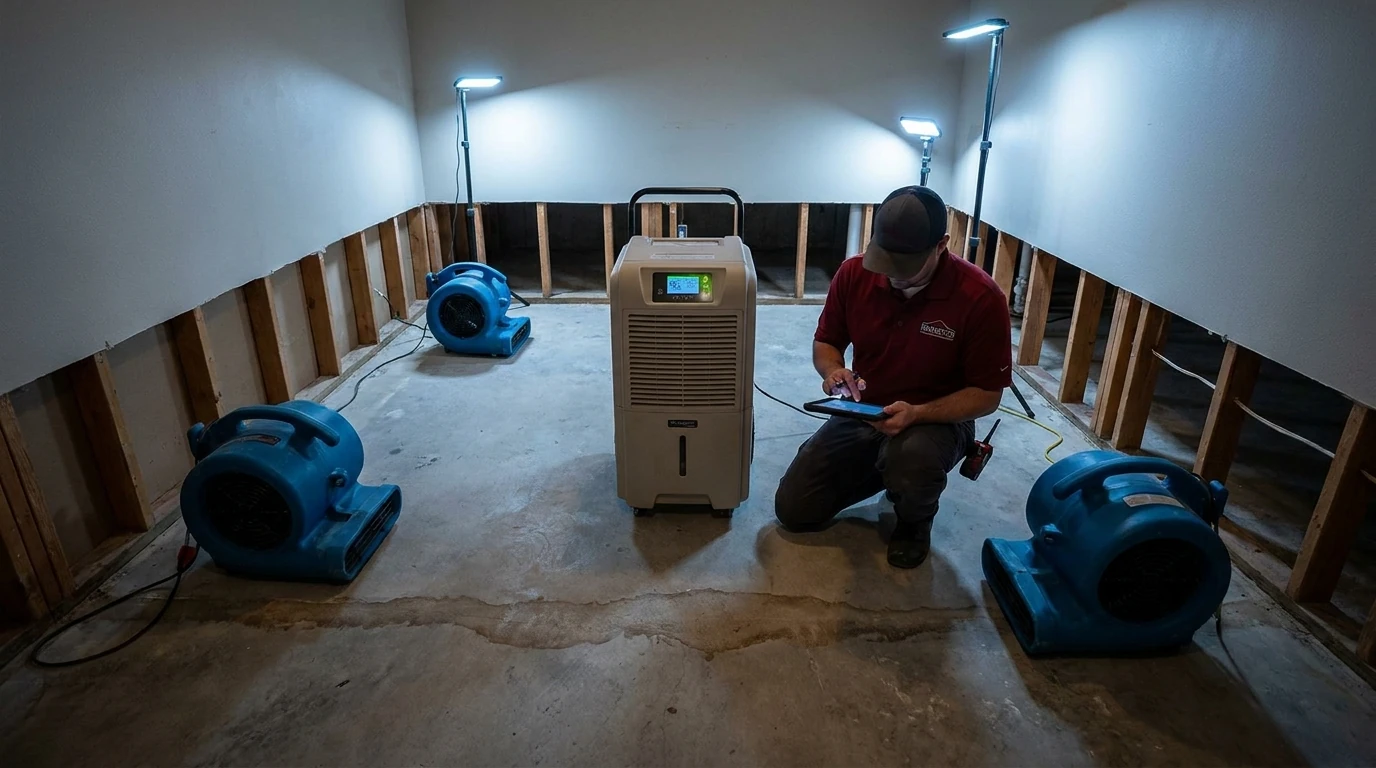
Phase 2, Structural drying (Days 2 through 5, typically) Low-grain refrigerant (LGR) dehumidifiers and high-velocity air movers run continuously. A properly sized drying system for a 400-square-foot affected area might include 4 to 6 air movers and one or two commercial LGR dehumidifiers pulling 100+ pints per day. Technicians take daily moisture readings with a calibrated pin or pinless moisture meter and log them, that documentation goes to your insurance adjuster as proof the drying was performed to the IICRC S500 standard.
In Bellevue’s condo and townhome developments, where HOA management often requires post-remediation air clearance testing before walls are closed, that daily log is also what the HOA’s third-party industrial hygienist will review. Don’t hire a company that doesn’t document moisture readings.
Phase 3, Assessment and clearance (Day 5 to 7) Once materials reach target moisture content (typically below 16% for wood framing, below 1% for concrete), a final inspection confirms drying is complete. If mold was present or suspected, air sampling may be required before reconstruction begins. See our post on how quickly mold grows after water damage for context on why this step matters.
Phase 4, Reconstruction Replacing drywall, insulation, flooring, and trim is part of a full-service restoration. A company that handles both the mitigation and the rebuild means one point of contact for your insurance claim and no gap between the remediation crew leaving and the reconstruction crew arriving.
What questions should you ask before hiring a Bellevue restoration company?
Before you sign an authorization form, ask these five questions. A qualified company answers all of them without hesitation.
- Are you IICRC certified? Ask for the firm’s certification number, not just a verbal yes. You can verify at iicrc.org.
- What is your Washington State contractor’s license number? Verify it at the L&I lookup. An unlicensed contractor performing structural work creates insurance and liability complications.
- Do you document daily moisture readings? If the answer is vague, the documentation won’t hold up with your adjuster.
- Can you handle the full scope, mitigation and reconstruction? If they hand off to a separate GC, ask who coordinates the insurance scope of work.
- Are you available 24/7? Water damage that sits overnight compounds. A company that only takes calls during business hours is not equipped for emergency response.
For more on evaluating restoration contractors, see our guide on how to choose a restoration company.
How does Bellevue’s housing stock affect water damage risk?
Bellevue’s neighborhoods present different water damage scenarios depending on where you live, and a locally experienced crew recognizes them on arrival.
In Somerset and higher-elevation neighborhoods, ice dams are the primary winter roof risk. When heat escapes through the roof deck and melts snow, the melt refreezes at the cold eave, and when it backs up under shingles, water enters the attic and ceiling. By July, those losses have been repaired, but if you’re seeing staining now, it may be a slow leak that was never fully dried. Our roof leak repair service covers both the source and the resulting interior damage.
In Crossroads and Factoria condo developments, plumbing stack failures and appliance line failures are common. A refrigerator supply line that fails on the third floor affects two units below it. HOA bylaws in many of these buildings require the restoring contractor to provide post-remediation air clearance documentation before drywall is reinstalled, make sure your contractor knows this before they start.
In Newport Shores and West Bellevue, older homes near Lake Sammamish State Park and Mercer Slough have crawl spaces and basements that accumulate ground moisture during Puget Sound’s wet season. A basement flooding cleanup call in one of these homes often reveals a secondary mold issue that developed slowly over one or two wet seasons before the homeowner noticed.
For any of these scenarios, the restoration process is the same, but the crew that’s worked Bellevue properties knows what to look for before they open a wall.
What should you do right now if you have active water damage?
Stop the water source first if you can safely do so, shut off the supply valve under the fixture or the main shutoff. Then call a restoration company that answers 24/7. Do not wait until morning.
While you wait for the crew:
- Move electronics and valuables off wet floors
- Do not use a household vacuum on standing water, it’s not designed for it and creates an electrocution risk
- Take photos and short video of all visible damage before anything is moved or dried, your insurance adjuster will need this
- If the water source is a sewage backup or involves toilet overflow, stay out of the affected area; Category 3 water carries pathogens
For a full first-response checklist, see what to do in the first 24 hours after water damage.
National Restoration Construction responds 24/7 across Bellevue and the Eastside. Call (206) 883-0333 to reach a live technician, or request a water damage assessment online.
About National Restoration Construction
National Restoration Construction is an IICRC-certified, EPA-certified, Lead-Safe Certified restoration firm serving Bellevue, Federal Way, Seattle, and the greater Puget Sound region since 2004 (WA license NATIORC792M6). Their crews handle water damage, mold remediation, fire and smoke damage, sewage cleanup, and full reconstruction, from initial extraction through finished rebuild. BBB Accredited. Available 24/7.